
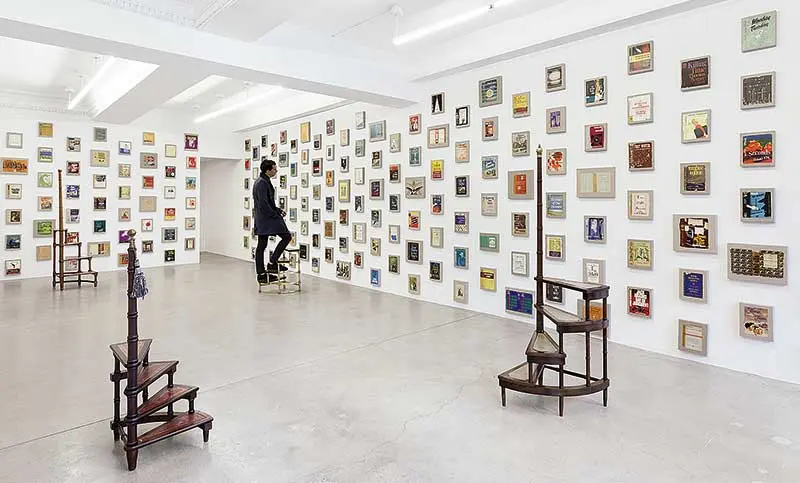
Brazilian artist Valeska Soares (Belo Horizonte, 1957) refuses to give her works fixed meaning and instead favors continuously shifting narratives. Each of her exhibitions represents a highly crafted experience on par with the motivation they require from the public to exist. Whether it is in installations that rely on perfume, lights, books, library chairs-steps, or watches, everything is in suspension as a tacit state that refers to life but also escapes it. Any Moment Now… is an installation that consists of a montage of 365 framed book jackets whose titles make references to time. They belong to literature books from all periods and genres and are arranged according to the four seasons of the year to create a metatextual situation about time. Soares encourages dual, contradictory, actions where viewers must choose, for instance, whether to read everything on these covers or to ignore the text and concentrate on the images and the typographic value. Move the body width of the walls and discover the material which in turn has dematerialized and is no longer literature, only the covers. Likewise, viewers are in a library that is not a library but a narrative equivalent to the calendar: a book cover for each day of the year. Each jacket that references the weather is a book that refuses to be read. A cover that flashes the issue intermittently while also declining to reveal the book’s content. What notions of time are addressed in the book that belongs to the first cover in the first vertical row? What hides behind the cover that is right in front of the viewer wondering about this?
Valeska Soares was born in Belo Horizonte, in the intense state of Minas Gerais. Although she has lived and worked in Brooklyn, New York for over two decades now—since 1992—she nonetheless continues to incorporate in her work all the vibrations that she brought with her from her hometown. Soares studied architecture and her work approaches language from a conceptual and minimalist perspective. She inhabits both artistic approaches without being held hostage to them, without dogmatism, as they are subjected to the fictional narratives that they serve and not the other way around. Her exhibitions are always subjective creations (as art must always be). With Valeska Soares, artistic creation reaches a level of abstraction and subjectivity that, through the use of a variety of real materials, confronts viewers with feelings of frustration, seduction, and rejection. In this exhibition, more than exhibiting, Soares modifies the space and the manner in which viewers are confronted with the works—as her installations are sensitive confrontations.
This gallery has two addresses. In the one located at 195 Chrystie Street, the dust jackets are mounted on linen and hung salon-style covering the walls of the entire gallery. The other venue at 11 Rivington Street—which gives the gallery its name—presents the work titled Ouroboros. It consists of a pocket watch suspended from the ceiling and connected to a mechanism that makes it rotate. The watch has the minutes and seconds hands but is missing the hour's hand. Ouroboros is a Greek term that means “a dragon or serpent that eats its own tail.” Here it refers to the shape of the ring around the watch but it also has other meanings, including self-reflection. Both the beast that devours its own boundaries and self-reflection address the subject of time pursuing itself and the manner in which a person faces his/her time-bound decisions or awareness. The timepiece in question is one of those pocket watches for men that have a chain. By being suspended from the ceiling in the middle of the gallery, its usual location has been altered. Its movement—powered by the mechanism, air currents, or through the contact of visitors—has more than one rhythm and, thus, its interaction with time and space. An opposite approach to the time-space relationship is present in the dust jackets. In all of their unmovable rigidity, they nevertheless also point to a hypothetical time required to read them or even the content that they protect. Soares infers that the pocket watch—a symbol for measuring the time—places viewers back in the context of the theme addressed in the “paintings” displayed in Chrystie Street. By combining the two exhibition experiences, Valeska Soares consolidates a theme that is as slippery as it is distressing, as physical as it is intangible: time.
The artist works in a studio but also integrates space and time in her inquiries. She travels in search of the neuralgic points of each project and uses found materials or even designs her own objects, which she commissions others to produce. Valeska Soares is not interested in constructing representations of fixed and ideal models—like, for instance, a garden and a library. She occasionally inverts relationships, having even created copies of pots and destroyed the originals. As a creator, she is driven by an urge to design spaces that infringe upon customary representations through innovative proposals—with all the risks that such an approach may entail.
GRACIELA KARTOFEL