
Alberto Cavalieri (Caracas, 1969) is today one of the most prolific and renowned sculptors in the Venezuelan art scene. His work is highly characteristic, marked as it is by the establishment of a visual and tactile play between the materials employed in the execution of the works, and the plastic possibilities it affords as a three-dimensional form subjected to an aesthetic design. In this way, Cavalieri’s sculptures sustain a dynamic and sensorial relationship with the space around them, the space that penetrates them: they are lines-volumes that form curves, knots, spirals, sinuous segments, in a state of levity that contradicts the concreteness, the weight, and the hardness of the material in which the works are made, almost always solid iron and, more recently, stainless steel.
Cavalieri’s education as an industrial designer and his studies in mechanical engineering has supported most of his artistic proposal, which, because of the implications already mentioned, have made increased use of technological tools in their design and execution.
The exhibition Inoxidables involved a turn and a risk for Cavalieri. The artist sees this exhibition as a synthesis of his 20-year career, and for this reason, he included works that point toward the past, the present, and the future possibilities of his art. The show included a large-format polyptych, eight sculptures, four wall works in stainless steel, and two installations in metal and carob-tree wood.
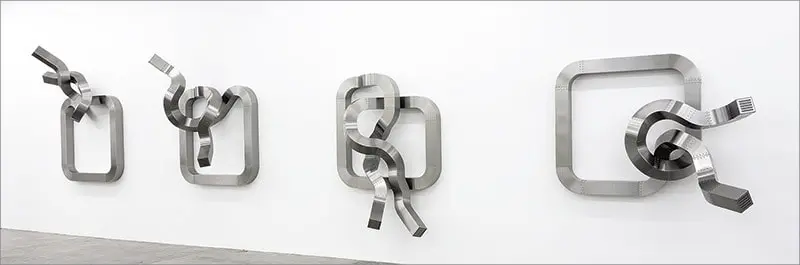
The works in the series Pipelines closely follow Cavalieri’s work with sculptures of sinuous lines and knots, made in iron, where, with a great mastery of the technique, he is able to trick the eye and represent malleable shapes and unexpected points of balance. But in the Pipelines Cavalieri introduces innovations that account for a playful aspect of the proposal. First, he abandons solid iron and works with stainless steel in hollow, tube-like segments. As critic Costanza de Rogatis notes in the text presenting the exhibition, Cavalieri “posits, on the one hand, a geometricized synthesis harking back to piping systems in order to play with the possibilities of shapes that seem to drip down the walls, curving themselves in an apparently precarious, yet in reality very calculated equilibrium.” Cavalieri himself has emphasized that the introduction of a certain irreverent tone, related to some discourses in contemporary art, is present in this series of works.
Technology, as we have mentioned, plays a dominant role in the achievement of these works and the attainment of their calculated equilibrium. For that, the artist uses a software program to design 50 parts, which he coded to build his own game of shapes that he could, thanks to the program, assemble and visualize in all their aspects.
But the manual element of Cavalieri’s works is also important and is found in the impeccable make of his sculptures, assembled by the artist himself. In the case of the Pipelines, the lines of rivets bordering the ducts emphasize this aspect.
The exhibition also included an ultraviolet digital print on a polyester and PVC grid, created on the basis of the image generated by a software program titled Wireless Structure, which Cavalieri used to model his works, and which displays the skeleton of the structures created by the artist in an draftsmanship-like approach to digital design.
The third section of works is the series Stocks, which features Cavalieri’s most recent productions. In this series, the artist sets entirely aside from his previous discourse, although retaining his interest in the material as a three-dimensional expressive element in itself. The artist creates volumes in the shape of ingots and piles them up to form a column. Duralumin and carob-tree wood are the materials chosen on this occasion, after an in-depth process of research on the matter that becomes a work of art.
The investigation underlining Stocks is no longer related to the perception of the physical properties of matter, but to their transformation into primary volumes for their warehousing and commercialization. In that sense, Cavalieri has noted that these works are related, on the one hand, to the global issue of the economy, and on the other to the scarcity of materials that is projected for the future.
With Stocks, Cavalieri’s work takes a step in the direction of a more conceptual approach to sculpture. By referring us to a minimal and, in a way, a neutral unit of matter, the artist seeks to focus on that which more concretely gives shape to his work. However, the reference to the ingot as a measure for the warehousing of wealth opens up a broad pathway for the future development of his art, in agreement with the critical narratives of the contemporary era.
KATHERINE CHACÓN