
Entering the exhibition spaces of Colección Mercantil, where Alfred Wenemoser—an emblematic figure in Venezuelan contemporary art—presents his most recent works, can clearly amaze and bewilder the unsuspecting viewer confronted with the encounter of a strange realm that is reinvented and transmuted by Wenemoser in the exhibition titled Retro-transformation and Other Methods of Perception (November 2014-February 2015).
This remarkable private collection, focused on Venezuelan art from all periods, is usually divided into several recurring exhibitions—as a result of its extensive nature—organized according to thematic, pathological, or monographic frameworks that offer revealing clues to the research. The current exhibition represents the second occasion in which this cultural space offers this scope of innovative museum practices by inviting a contemporary artist to establish a dialog between his own artistic practice and the revisited reading of the collection’s wide-ranging repertoire of works. This exploration of art produced in Venezuela aims to construct a critical memory that visualizes these new experiences and accredits or denies the dogmatic postulates of historiography that are continuously being revised.
Austrian artist Alfred Wenemoser (Graz, 1957), who resides in Venezuela since 1980—when he immediately associated with members from the conceptual art scene—approaches the proposed challenge with an installation based on selection, transformation, and accumulation of works from the Colección Mercantil. Through renovated strategies, Wenemoser revisits the expanded notion of the perception of the artwork, idea, or theme that he has been developing throughout his long career, and in which he has invariably suggested a binary system of relationships between the artist, the work, and the viewer, based on dense proposals—formalized according to the established requirements—in installations, actions or interventions, both in the museum space and urban context.
Retro-transformation and Other Methods of Perception essentially consist of the ability to transmute, translate, and innovate the univocal perception of the work of art. To do this, Wenemoser chose three specific works by Venezuelan artists—who, like him, were not born in Venezuela and who he greatly admires for their reflections and the projection and influence of their artistic practices—to outline the narrative of the exhibition: the traveling artist of Russian origin, Nicolás Ferdinandov; the famous graphic designer and painter of Lithuanian origin, Gerd Leufert; and contemporary artist and personal friend, Roberto Obregón.
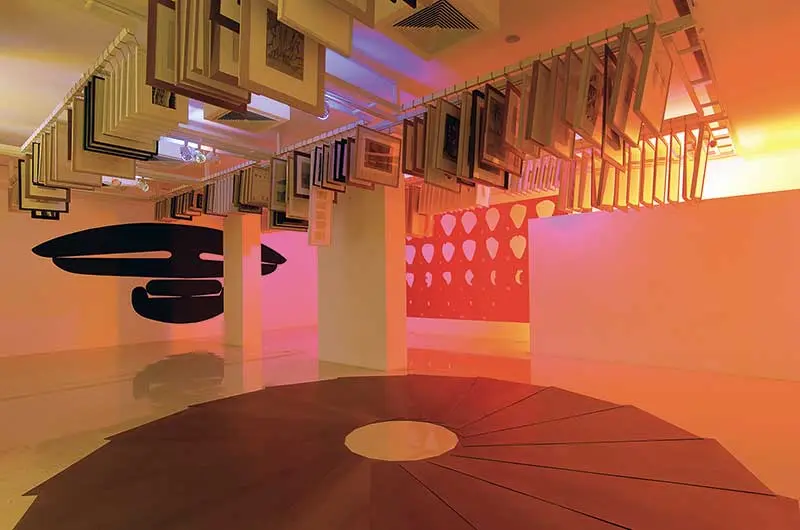
Despite suggesting emancipated readings, the installation maintains a direction that establishes a possible route through several seasons or moments. Visitors enter through a rectangular tunnel that sets the preamble for the exhibition. It is a metaphorical construction that, like in earlier proposals, implies a sense of transition, a rite of passage that prepares viewers to access an itinerary of virtual thresholds. Thereafter, the re-transformed versions of the selected works will be revealed, but always in interaction with the originals—which are strategically placed in the space. Thus, Crisantemos (Chrysanthemums), the delicate piece by Ferdinandov, is kept inside a panel that viewers access through a hatch. The piece metamorphoses into an immense blue fan outlined on an adjacent wall. Part of a series of compelling graphic explorations—that essentially refer to the funerary—the imposing presence of the work Nenia, created by Leufert, can be observed in the background. And lastly, there is the painting LDR by Obregón expanded across a stunning stretch of rose petals numbered and distributed over a saturated red background. The fourth piece titled Diafragma (Diaphragm) is a work by Wenemoser laid out on the floor, perhaps to symbolize the organizing and modifying mechanism of perception to which the artist induces us. Finally, a group of over one hundred framed works taken from the vaults of the collection has been rearranged and reinserted by being suspended from the structural frame of the roof. Without an established chronological order, the conglomerate of drawings, prints, and photographs tell a displaced and random story that basically covers works by the painters-travelers from the nineteenth century, the landscape school, and prominent contemporary artists.
Since his initial proposals, Wenemoser has relied on the selection of symbolic objects that contain strong cultural baggage to allow viewers into the artwork. This results in extremely complex works with minimal structures that support intricate philosophical ideas. To the concrete-soaked structures and creases of textiles found in earlier works, Wenemoser now incorporates accumulations of objects of art. And while that atmosphere of seclusion is maintained—favored by the darkness in those austere, monochromatic and difficult to interpret installations from the 1980s and 1990s—that feeling is reformulated in this recent proposal because the light sources and room reflectors are covered with yellow, red and blue filters that render a warm and expressive environment—like that of a cloister designed for the emotional and sensory perception that collects fragments scattered across the architectural space. As an epilogue—and only directed to a few spectators—Wenemoser includes one last station in the Colección Mercantil with a selection of ceramic pieces and a video where art critics Francisco D’Antonio and Armando Reverón evoke the likely conversations between Nicholas Ferdinandov and Armando Reverón, two characters who envisioned, each in their own way, awareness and perception of the underground, one from the watery depths and the other from the incandescent light.
Beyond the recycling and appropriation of images as a practice, the exhibition by Alfred Wenemoser, the protagonist of an existential, reflective, and stimulating event that stimulates, even from the provocation of one representation to another, renewed “methods of perception” and ultimately a celebratory ritual.
RUTH AUERBACH