

The show Circa MMXI is a comprehensive view of decades of creation by the Brazilian artist. It offered the public a reencounter with visual poetry that established unique itineraries through personal convictions as she affirmed her presence in the national and international scene.
Among the works displayed in Centro Cultural Correios, dozens of works offered a panoramic view of an artistic production interested in various expressive mediums, such as engraving, painting, photography, and video. The engraving that marked the beginning of Geiger’s artistic trajectory already offered signs of an experimental vocation framed by a project of consolidation of abstract art.
One aspect has to be mentioned especially in the context of the show: self-curatorship. Geiger took on the curatorship of the exhibition and embraced the challenge of confronting her own image in the mirror, thus assuming the exercise of a dual role of negotiation that any contemporary art curatorship must accept as a goal.
By redefining a certain curatorial approach in the first person, the artist recalled her own strategies of action while tackling the contemporary art problems that she has had to face during the different periods of her intense artistic practice.
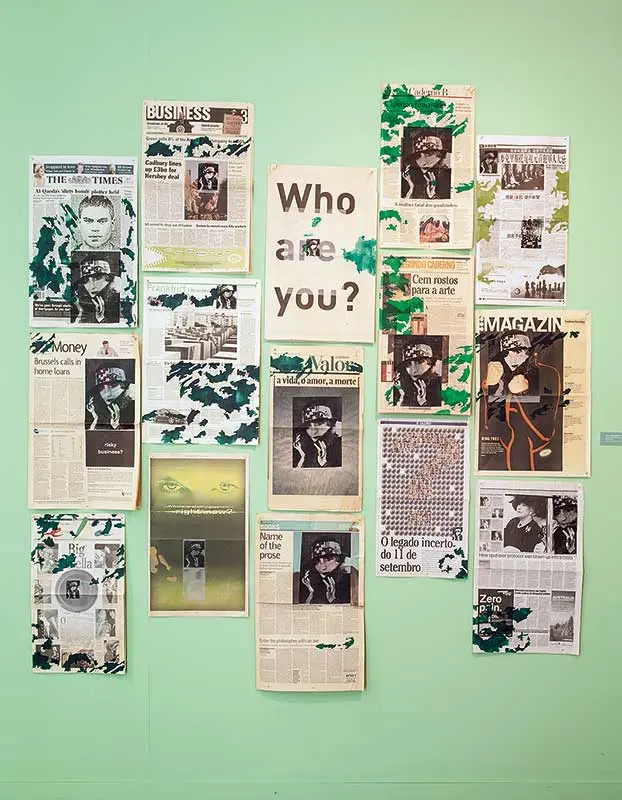
Zona Portuária (Port Zone), displayed in exhibition room one, presented a group of works created in photogravure, charcoal, acrylics, and photo-serigraphy, among other media that contextualized Geiger’s concerns with the evolution of abstraction, placed at the center of a wide-ranging visual debate and inserted in a landscape of great interest in experimentation. Exhibition room two contained América Latina Brasil (Latin America Brazil), which proposed a look into the openly critical nature of Geiger’s poetic.
The titles of the works are indicators of the direction of this production, starting with the series of montages Native Brazil, Alien Brazil (1976/77), continuing with the photogravure in metal Burocracia (Bureaucracy, 1975) and Diario de una Artista Brasilera (Diary of a Brazilian Artist, 1976), in which the image of a smiling young Anna Bella Geiger emerged alongside a picture of artist Marcel Duchamp, in an intimate and intriguing scene built as a conscious affirmation exercise of her own condition as a Latin American woman artist. In fact, during the 1970s, Geiger began to immerse herself in the construction of a critical approach to the complex sociopolitical environment in the Brazil of that period. At the time, her strategy for confronting the stereotype-based cultural representations of all things Brazilian was to rely on parody and the reversed representation of the power structures, both in society and in the art scene.
In the series Native Brazil, Alien Brazil series, Geiger expressed her convictions by problematizing photographs of assimilated indigenous people from Brazil, who back then were idealized in postcards—produced by the Bloch publishing company—that were available nationwide. Confronting the dominant trend of the themes associated with Brazilian identity and affirming her place and condition as a woman artist, Geiger reinforced the critical reading of a disagreement with her own history, her people, and with the Brazil of that time. Geiger’s confrontation strategies in the series included two postcard-size images displayed side by side: on the left, an indigenous person in a routine situation amid the collective environment that is possibly his own village; and on the other, the image of a white woman—who always happens to be Geiger—reproducing the exact position of the indigenous person in the other scene. The photographic enlargement of two postcards from Native Brazil, Alien Brazil series extended the discussion through the use of self-portraiture as the voice of denunciation.
In Fronteiriços (Borderlines), in room 3, the artist once again revealed the experimental nature of her production, both in the exploration of different materials such as lead, velvet, file drawers, springs, sheets, and copper wires and parchment paper, as well as in the structuring of a field of research pertaining to the nature of objects. In the series displayed in exhibition room 4, Geiger adopted the term “visceral”—an appropriation of the reading by art critic Mario Pedrosa of her prints from 1966-1969—to group undefinable manifestations of her poetic, that shared the depiction of entrails, of the internal processes of the human body, displayed in works like Corazón y Otras Cosas (Heart and Others Things, 1966) and Hígados Conversando (Livers Conversing, 1968).
The leading role of photography in cartographic associations was evident in the exhibition room that presented the series Polarities, through photoengraving and photo-serigraphy explorations created in a period of three decades.
The associations established through maps and other graphic representations used as recurrent elements in Geiger’s artistic practices, allowed her to put into action—by acting as a cartographer of territories that she herself reinvented—conceptual maneuverings that produced, analyzed, and interpreted several cultural constructions.
Just as the cartographies by Deleuze and Guattari enable the development of analyses that emerge from the micropolitical status of the social sphere, the creations of artist-cartographer Geiger elucidate dissonant relationships and postures. The videos created by Geiger—a central contribution to the history of video art in Brazil—were important elements in the exhibition. Presented in a projection room, the selection of works offered records of Geiger’s creative process, performance actions, as well as a conversation with Joseph Beuys. The Video Circa contained the video-installation Circa V, 2010 in a sound and image inciting montage and images designed by the artist as a sound-visual alert.
And lastly, as a strategy to contain and connect all the elements of the exhibition project, the artist-curator proposed as an introduction to the exhibition the Limit-Situations photographic series from 1975, presented in the work Pasajes (Passages), with black and white images of the artist inert, like an apparition, in a train car.
Synthesis of one of the most emblematic artistic productions in Brazil, the exhibition Circa MMXI clearly conveys the vast visual thinking of a woman artist whose work has evolved through the years, leaving us her inescapable and powerful creative signature.
CLAUDIA FAZZOLARI