
Architecture has always been at the center of Carlos Garaicoa’s concerns and interests. Starting with his early works of the 1990s, when he used photography to interrogate it and the lines—traced or threaded—to decipher its lines of force, to this day, when Garaicoa returns to architecture in order to showcase new questions about the current state of society (and even art). The exhibition Orden inconcluso (open at Centro de Arte 2 de Mayo in Móstoles, in Madrid) focused on works from the latest period in the development of this notable Cuban artist. The course began with the forceful Cerámicas porno-indignadas, which attests to another turn of the screw in Garaicoa’s interest in architecture as ruin or vestige. The work is comprised of pieces of walls taken down from an old building in the Lavapiés neighborhood of Madrid, showing advertising bills from the early Twentieth Century printed on colored tiles with a drawing style and a composition that today we see as naïf.
These posters ornamented the façade of an old pharmacy, each illustrating the beneficial effects of their advertised medicines on those afflicted by the flu, diarrhea, menstrual cramps, fatigue, migraine, etc. The work does not lack in interest from the standpoint of urban archeology, nor in visual impact in an exhibition gallery, yet Garaicoa has made these possibilities subordinate to his desire to highlight, through such unusual artwork, a series of slogans that the current wave of indignation against politicians and bankers has made newly valid in Spain. The legendary medicines advertised by Garaicoa’s naïf posters are useful to expel from our bodies no longer viruses or parasites, but those whom popular disgruntlement identifies as the cause of the dramatically hard times the country finds itself in. Garaicoa has printed the slogans in lines of tiles added to those of the original composition, to the point that they can be confused with them.
To me, Garaicoa’s intervention is not entirely convincing, although it must be said that it implies a kind of response to the title of another work featured in the exhibition: ¿Es el cuerpo humano igual al cuerpo social? (Is the human body the same as the social body?). This is an architectural model of a modern urban sector—it could be today’s Havana—whose Cartesian, rationalistic volumes and profiles are interrupted by a biomorphic shape evoking a human intestine. It proposes as elemental a contrast between geometry and biology as the identification of the flu or diarrhea with politicians and bankers; fortunately, a more elaborate proposal comes to replace it in another work on exhibit, Edificio público como ágora griega.
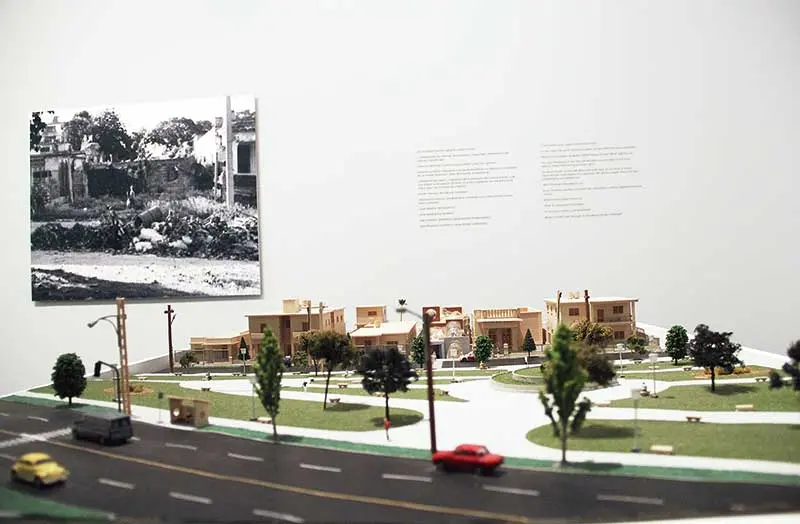
This work consisted of a series of large-format black and white photographs hanging from the walls, in front of an architectural model. The photographs showed the remains of a structure of concrete beams and columns, abandoned in a city lot and covered by exuberant tropical vegetation. Here Garaicoa is revisiting an old topic: modern ruins, the remains of ambitious city projects that were left definitively unfinished. Just like the modern project has been, according to philosopher Jurgen Habermas. An idea with special meaning in Havana, Garaicoa’s home town and a city with the appearance of an assemblage of decayed urban projects: colonial, republican, deco, modern… The model accompanying the photographs depicted a modern construction designed by Garaicoa, with a ramp winding around the building that allows people to walk up from the ground to the roof. Along the way, climbers are given a full view inside the apartments, since the walls are all glass.
The Glass House, the fully transparent house, was a radical project of the German architectural avant-garde in the 1920s and 1930s, and it implied the materialization of extreme ethics, celebrated for instance by Walter Benjamin. Garaicoa uses it to ask whether, despite the proclaimed transparency of our world, are we really ready to see and be seen. Or is it rather that the panopticon is the kingdom of blindness?
In Campus o la Babel del conocimiento, an impressive model for a utopian urban group closer in spirit to Étienne-Louis Boullée’s Cénotaphe à Newton than to Bodys Isek Kingelez’s fantastic cities. With it, Garaicoa radicalizes into parody the contemporary pretension of solitary self-shaping, with no other human contact than that provided by the Internet.
Closing the exhibition was a large-format installation that prefigured the Cuban artist’s intended intervention in Móstoles’ sewage system, and an even more imposing installation focused on two open safes inside which we could see gold replicas, in scale, of the headquarters of the Bundesbank and the Bank of Spain. Gold, the devil’s excrement, as an old medieval saying had it.
CARLOS JIMÉNEZ