
Mexican photographer Carmen Mariscal (1968), who has been living in Paris for several years now, has always nurtured her art, in whichever form she chooses to express it, as a poetic and metaphorical take on the human body. And it is her own body—a symbol of a vast universe that is both intimate and cultural—the pretext for revealing a sort of “diary” of images with which to associate personal and familiar objects. The close relationship that Carmen Mariscal has established between her body and art goes back further in time, to her own pictorial history (body painting or paintings of fruits cut in half, which she associates with “organs”), as well as to her hospital work in Mexico with bulimic or anorexic youth. This is her way of questioning, stigmatizing, or exorcising with infinite subtlety time and time again the complexity of her multiple influences and origins.
This important exhibition devoted to Carmen Mariscal at the Scène Nationale in the city of Le Creusot includes works—thirty-nine photographs, videos, and installations—that were created in a period that spanned from 1997 to 2015. The conceptual axis chosen by the artist and the curator pertains to an inquiry into memory and the artist’s own remembrances associated with her family (of Catalan origin) and with those people that have become part of her life through her marriage, to further expand the persistence of the questions that feed her doubts and confirm her certainties. Therefore, it is her own life that has exclusive paternity/maternity of her work and what absorbs her but also allows her to detach in order to achieve the indispensable perspective that she needs. In this memory exercise that can be a way to exorcise the past, Carmen Mariscal builds bridges between things, events, and people, develops existential hypotheses, and endeavors to unravel secrets; all-the-while analyzing the real and the unknown, deciphering, transcending, and poetizing affections; building universes that are familiar and mysterious at the same time. Each of her creations is an existential drama and the group of works shown in this exhibition clearly weaves the visual, intellectual, and sensitive discourse offered to visitors.
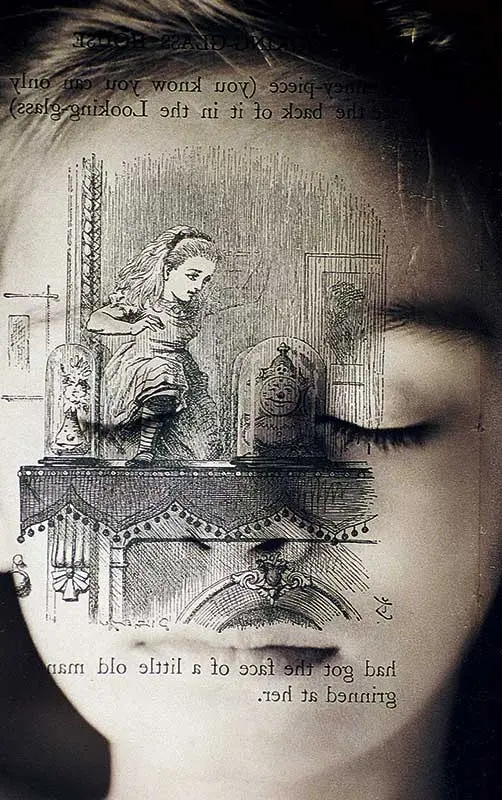
Two large exhibition rooms contain photographs and installations grouped in several series from different periods like the installation La Novia en Efecto de Espejos (The Bride Mise en Abîme, 1997-2014), Recuerdos (Memories, 2007-2013), Alicia a Través del Espejo (Alice Through the Looking Glass, 2010), or the photographic series Jalousie Filigrane (2011). Another smaller and darker exhibition room, whose walls and floor are painted black, contained several objects that give meaning to a group called Beautiful Place (2015). Whether it is Ella y Nosotros (She and We, 2010), an installation consisting of 5 replicas of the artist’s head created with resin and connected by a blond braid; Umbilicus 1/1 (2003-2004), a photograph of the artist who appears covering her eyes with her hands while several wires sprout from her navel and extend toward several babies—made with illuminated resin—placed on the floor; or El Amor en Vértigo (Love in Vertigo, 1997-2014), consisting of a mirror, the wedding dress of Mariscal’s great-grandmother and five photographs of the artist wearing this dress, Mariscal’s universe evokes a world of confinement and deprivation of liberty, alienation, pain ... associated with her(?) condition as a woman and mother. But it is violence enveloped in sweetness; it is more melancholy than bitterness and dream and a nightmare at the same time. Covered face, hands tied or hidden, ropes, or braided hair that connects and imprisons the bodies ... Her image is blurred, lost to then find itself again in an even better state. Recuerdos (2007, 60 x 40cm) shows Mariscal covering her face with her hands in two photographs that show the—skin-deep—damaged texture of an old wall. In Yo, Ella, Nosotras (I, She, We), two photographs from 2006 that measure 55 x 40 cm each, artificial hair braids connect the two faces of the artist shown with her eyes looking down or closed. The mise en abîme effect in her portraits (self-portraits), the implicitness of their criterion in detriment of an excessive reality supports that dissociation of body and spirit that is, in a sense, the essence of her creative explorations. The diptych A Través del Espejo (2010), consisting of two color photographs that measure 30 x 40 cm, shows the face of Mariscal’s daughter with superimposed images of text fragments and engravings from an edition of Alice in Wonderland. This work offers a more tranquil dimension that is another aspect always present in her work: the dimension of love. It is also visible in the 2010 series Roma, a piece that measures 50 x 60 cm, in which the hand of the girl delicately covers her pubis.
The installation titled The Beautiful Place represents the reinterpretation of a past that is not Mariscal’s. To appropriate it, she reconstructs time with objects linked to the history of the family home, a structure formed by two towers, one of which was destroyed by a fire. In the center of the installation, a “tower”— measuring 1.8 meters high by 60 cm in diameter—made with old sheets and illuminated from within, is occupied by suspended small red resin sculptures inspired by the caps of glass jars; in one corner, a bed of barbed wire; on the wall, six serigraphies on steel representing the absent tower and on which the following words can be read: “fear,” “elegance”, “restlessness” ... and on a wall bracket, a small replica of the tower in steel. In three-color videos titled Espejo (Mirror, 3’19, 2006), A Través del Espejo (Through the Looking Glass, 3’40, 2010), and Umbilicus Rêve (Umbilicus Dream, 2’, 2005), Mariscal also addresses the issues of repetition, the nostalgia of childhood and the fear of emptiness and the unknown.
Through works of a very diverse nature, the consistency demonstrated in this exhibition confirms that Carmen Mariscal is an actress and a complete artist. Indeed, by placing herself at the heart of this passionate mise en scène, she stages, again and again, the infinite unfolding of her image as she follows the steps and the trail of her memory.
CHRISTINE FRÉROT