
Fragments of a Revolution is a stunning series of photographs taken by Nicaraguan artist Claudia Gordillo during the 1980s when she worked as a free-lance photographer as well as a reporter for Barricada, the official newspaper of the Sandinista Front for National Liberation. Gordillo documented the Nicaraguan war and its “crucial influence on people’s everyday lives,” as well as the effect of that struggle on the spirit of her countrymen through photographic work in Managua and other more remote parts of Nicaragua. Her job as a correspondent even took her into battle areas, where the encounters between Sandinistas and the Contras were taking place and she had to be armed in case of an attack.
Claudia Gordillo was born in Managua in 1954 and began her studies in Sociology at the Universidad Centroamericana. However, she interrupted that career to move to Italy where she studied Photography at the Istituto Europeo de Design in Rome during the 1970s, returning to Nicaragua in late 1979, shortly after the triumph of the revolution. Her first photo essay focused on the ruins of the Managua Cathedral, a historic neoclassical building that had been destroyed by the 1972 earthquake. The series provided the material for her first solo exhibition held in 1982 at the Asociación Sandinista de Trabajadores de la Cultura (Sandinista Association of Cultural Workers), for which the poet Carlos Martínez Rivas wrote the introduction. To him, those images Gordillo had rescued for the Nicaraguan people made up an album of what he described as “photography of every day,” photos of “the unknown which is also intimate to us,” phrases which, strangely, could also refer to her later photos of the revolution.
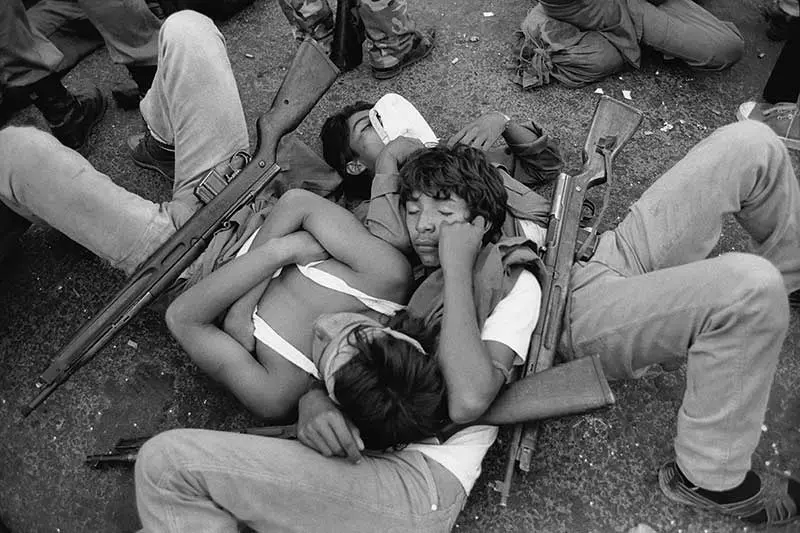
The Museo de Arte Contemporáneo in Panama presented a selection of forty photographs in black and white from Claudia Gordillo’s extensive collection of Fragments of a Revolution negative. The exhibition, with photos that were shot between 1980 and 1989, covered a range of themes, from religious processions to marching Sandinista battalions, and from innocent children to lonely old men. It also included her photographs of celebrity visits to Nicaragua during that period by figures such as Pope John Paul II, Henry Kissinger, Graham Greene, and the Panamanian intellectual Chuchú Martínez. In addition to bringing attention to the work of Gordillo, an artist relatively unknown to the Panamanian audience, the exhibition offered a live history lesson about a period and a popular movement that was important not only for Nicaragua, but for the whole Central American region.
In spite of its documentary nature, Fragments of a Revolution includes images that are open to interpretation, particularly when considered with historic hindsight. Upon observing Gordillo’s photos of the Sandinista Revolution, one cannot help but feel what the great Nicaraguan writer Sergio Ramírez describes as “the nostalgia for what might have been, but didn’t happen.” Gordillo documented that watershed period from a human perspective and, although the technical quality and compositional value of her photographs are impressive, what remains with you after seeing them is the remembrance of those human beings. One perceives pride and optimism in the women’s battalions, the men with their weapons held high, or the peasants receiving deeds to their lands, but also grief and dismay at the sight of children bearing arms, the permanently disabled young men, or mothers with souvenirs of their sons lost in battle.
This photo essay reflects the hard work—for example, in the harvesting of rice, coffee, and tobacco—the project for a new nation required, but also some of the armed conflict’s painful consequences, such as the forced displacement of whole villages away from the battle zones. However, in addition to the work and the struggle, Gordillo’s photographs offer proof of how the Nicaraguan people’s religious fervor was not diminished during those years, a reflection of the fact that Sandinismo was one of the few leftist movements in the 20th century which did not reject or ban religious practices.
In some cases, Gordillo explores human circumstances through photographs that include no people at all. One particularly poignant image shows a humble living room decorated with balloons and toilet paper, with an untouched birthday cake on a table, as if ready for a party that was never held. Another bleak photograph records a view of the former site of Managua’s historic district, now an empty plain, where a humble shack in the foreground emphasizes the sense of desolation. This kind of barrenness contrasts with other photographs full of brave young people, images that feature the excitement and promise of a new Nicaragua that drove the Sandinista Revolution. There is no single history, no absolute truth, not even in the photographic documentation of real situations. In fact, Claudia Gordillo’s photographs can be considered neither demagogic nor strictly objective, because although she captured images of historic, political and cultural worth, she did so from a point of view that was both aesthetic and personally sensitive to the situation of Nicaragua people.
MÓNICA KUPFER