
Cristina Kahlo’s work ranges from contemporary creations of an anthropological order to the interaction of authored scenes achieved with light and the camera’s shutter, occasionally painted over with watercolors.
The type of photography confined to a limited scope is often referred to as document and documentary photography. Some paintings also fall within that category but their appreciation/status as works of art prevents us from approaching or reflecting on them from that perspective. No matter which media, the documental element is an underlying characteristic in both photography and painting. Notwithstanding the great importance of the documentary element in the history of mankind, it is up to each author to stay within its confines or to go beyond it. In both disciplines, the scope can vary in range and intensity. It is not a matter of technique or whether a work is rendered more manually or mechanically that makes a work of art.
Another way to approach Cristina Kahlo’s work is by remembering the 2013 exhibition titled Coexistences. Gazes on San Carlos. Both “coexistences” and “gazes” are terms that aptly describe the aesthetic philosophy of this artist. Kahlo has had to coexist with her family name and has done so with humility and without abuse, displaying a strong work ethic—since her days working as a gallery assistant, and now as a photographer, artist, and gallery owner—that has earned her a place in the very rich and substantial territory of Mexican women photographers. There, for over a decade she has consolidated with professional seriousness her artistic career. In two of her recent exhibitions, Marco Polo is a Metaphor at the Galería Patricia Conde and 80 Years Palacio de Bellas Artes at the Galería del Aeropuerto Internacional in Mexico City. The former consists of twenty works including palladium/platinum prints, polaroids, inkjet prints, and two objects. Upon entering the exhibition one could perceive an ethereal and wholesome atmosphere in which everything flowed except for the contrasting static feel of four portraits: Constelación Según Pitágoras (Constellation According to Pythagoras), La Vírgen (The Virgin), La Hiedra (The Hydra), and El León (The Lion) are essays on landscape painting throughout history. All of them except Constelación Según Pitágoras were intervened with pins. The artist accompanied Marco Polo’s journey across oceans and deserts, through geographies and in the study of the stars, extended horizons, and understated archaeologies. Confirming her assessment of the time-space relationship of that past that survives from the 13th and 14th centuries, Cristina Kahlo created this narrative with contemporary means: inkjet print on cotton paper (to achieve a longer-lasting photograph) and used pins—industrial objects that symbolize the strategic study and markings on the maps by those three brothers, or is Marco Polo the sole master of those adventures or fantasies...?—to mark the Italian explorer’s route.
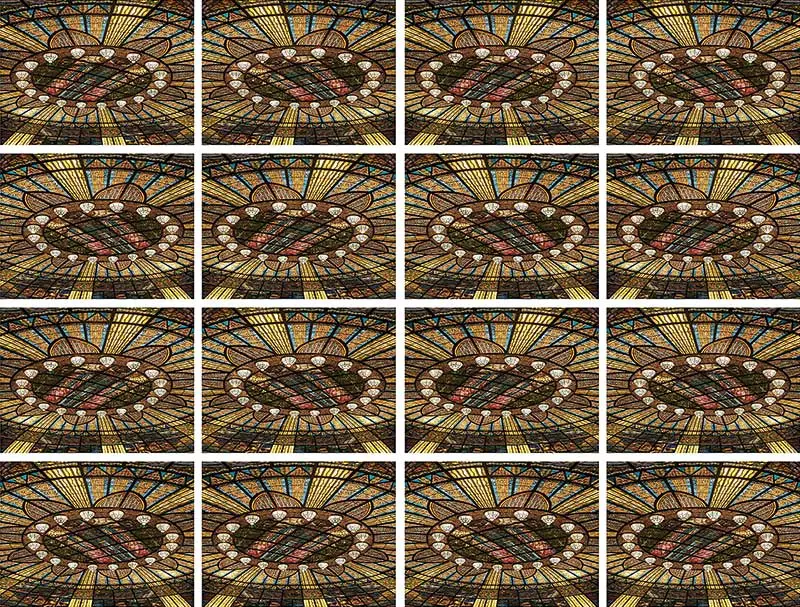
80 Años Palacio de Bellas Artes at the Galería del Aeropuerto Internacional in Mexico City transported viewers into the dressing rooms of that emblematic cultural institution, evoking certain operas whose costumes came to life in pictures. Cristina Kahlo pursued a difficult production in several ways. She had to decide whether to photograph the famous architectural, sculptural, or pictorial elements that, because of their familiarity, were more prompt to yield emotional results than original ones, or to look for unvisited places, bring life into them, and underscore the various activities offered in that cultural institution—exhibitions, book presentations, and awards, concerts, opera, and ballet, in addition to being home of famous murals. Cristina Kahlo chose both options and presented them in various dimensions and on different supports that offered viewers original journeys—from canvas prints measuring 250 x 400 cm to photographic paper prints mounted on 40 x 60 and 60 x 80 cm stretchers. In this large portfolio documentary, photography became imbued with emotion. The architectural images helped the public gain access to previously inaccessible places and offered them the added suspense of being incognito in the bathrooms or dressing rooms of the place, where at any moment a soprano could try one of those garments in the silent hallway of vacant gowns waiting for someone to wear them once again. Yes, Marco Polo is a metaphor and 80 Años Palacio de Bellas Artes is a series of gazes into something stable that documents an endless number of coexistences. Among Cristina Kahlo’s body of work, there are pieces that specifically speak of photo-painting or painting-photo, in those instances when the images are painted over with watercolor, when they are polaroids or inkjet prints, or when they are objects and interventions. The environment in both exhibitions reaffirms the idea that it is a mistake to speak of the visual arts and photography as two separate entities.
GRACIELA KARTOFEL