
The Exhibition titled Organized Saltwater by Colombian artist Delcy Morelos (Tierralta, Córdoba, 1967) is an invitation to reflect on the metaphorical relationship between the essence of the pictorial occurrence and the human body as a group of tissues and fluids that give us form. In this manner, Morelos connects the viscera of both entities—pictorial and human—to finally talk about a possible origin for violence. The curatorship at the Galería Alonso Garcés has focused on underscoring the metaphorical use of materials and their relationship with the body and the landscape.
With works created between 2007 and 2014, Organized Saltwater is divided into two exhibition areas; the main exhibition hall of the gallery, dedicated to monumental works; and a smaller exhibition room with works of smaller dimensions but equally incisive. The large hall contains, on the one hand, natural fiber strips—cotton and jute—that, like trimmed canvases or parts of a body, hang from iron structures that protrude from the wall. The fibers have been coated with very watery acrylic washes of white, red, and earth colors, which have been applied to cover every part of the surface through a slow and painstaking process. Resting against two cubes, two large and thick canvases in the center of the room have been soaked in layers of paint and brought to life by the brilliance of their surfaces—which allude to the density and viscosity of bodily fluids. The pieces on the wall function as pictorial sculptures while those on the floor become sculptural objects fashioned with canvas and paint. This nonexistent boundary between one format and the other permits our full attention on the materials—that, offered in their purest form, candidly speak to us—and on the matter of the human body oozing from every fiber of the exhibition. The painting becomes blood and body fluids, and the canvas turns into cartilage and muscle. The superhuman scale of these pieces constitutes an omnipresent body that is penetrated by our own bodies; it creates a macroscopic opening into the pictorial interweaves, a contemporary landscape which we are committed to wandering through.
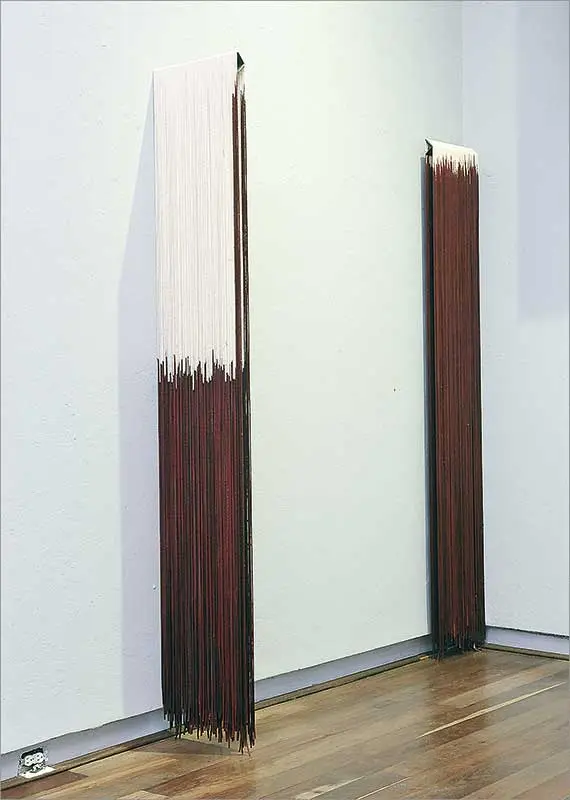
Through this play with materials and meanings, Morelos exposes two sources. The first is painting in its purest form—the paint-covered natural fibers—without figures or composition. The exhibition as a whole features works aligned with the minimalist tradition but that, because of their rawness and exposed technique, can also be associated with the school of matiérisme or matter painting. Morelos’s iconoclastic work favors metaphorical allusions over sensationalism so viewers can meditate and experience the work without being guided by either current. What we see is what we get, even as we know that the artist wants us to look beyond the materials and structures. The work by Morelos also addresses the origin of violence. This recurrent theme has been approached in her work from perspectives that range from the violence caused by racial intolerance to domestic abuse as the source of all violence. By relying on the painting medium to place us face to face with the mechanisms of the body, Morelos puts us in touch with our own body. It is precisely this lack of contact and our ignorance about its innermost aspects that generate violence that begins with ourselves and then spreads to others to become a public issue. According to Morelos, the pieces in the exhibition show us the human body “as an internal nudity that connects us to the most primitive aspects of the earth that we are made of.”1 Earth as it pertains to the predominant colors that symbolize the fertile soil—referenced by the artist in other works—which she has often used as material to create her pieces. She presents the earth color as that hue which the urban and the supposed civilized order try to conceal—for fear that it may be confused with poverty—and connects it to the color of blood through iron, a metal that makes the existence of both materials possible.
The other exhibition room contains paintings that hang like pieces of skin directly “glued” to the wall and that sometimes overlap each other, frameless and without any other device that separates them from the surface. Just as the cubes in the other exhibition room, these paintings represent the human while showcasing painting as a metaphor of the body. Organized Saltwater offers a poetic look into the origin of creation and life. Before forms appear, there is matter containing the potential of that which is in the making. Delcy Morelos brings us back to this original and intrauterine point perhaps with the hope that we take a good look deep inside before taking part in the violence that surrounds us.
NOTE
1. Interview for Arcadia magazine, http://www.revistaarcadia.com/arte/articulo/agua-salada-organiza-delcy-morelos/40150
CARIDAD BOTELLA