
It has been ten years since Eduardo Ponjuán’s first solo exhibition at the Museo Nacional de Bellas Artes. A decade when his system of ideas reached a unique profile, as it moved through a series of existential problems in the country and amplified with its constructions the symbolic meaning of everyday materials.1 Seen now in perspective, some of his exhibitions— Limbo, Koan (2003), Lo tengo en la punta de la lengua (in the museum, 2004), Opera Rex (2006), Salitre, Sur (2007) and Make a wish (2009)—come across as specific monuments in a trajectory that has given contemporary Cuban art a set of emblematic works alongside with the weight of its teaching.
Bésame mucho2 is the title of the recent solo outing with which Ponjuán returned to the institution’s galleries, now as the recipient of the National Fine Arts Award, given him in 2013 in recognition for his lifetime achievements. Unlike that universe of objects filled with lyricism and expressive materiality, the space of philosophical discernment Ponjuán conceived for this occasion was characterized by asceticism and sparseness. The introspective atmosphere that dominated it brought forth the artist’s interest in presenting ever more condensed judgments and avoiding representation; a declaration of intent already noticeable in the show El ladrón de los guantes de seda (2013) and confirmed here, and also extensive to his intervention for the 6th Contemporary Cuban Art Salon with Prólogo para una Historia del Arte Cubano (Volumen II) (2014).
The installation Unmonumental (2013) greeted visitors. Comprised of two modular structures, it featured some 10 niches which—suspended in time—held in their interior small objects connected to the artist’s personal history. It was an invitation to withdraw, invoking that kind of spiritual seclusion in which we start to evaluate the details that define what is truly transcendent: a nest, drawings of varied nature, the foundation base of a Loló Soldevilla sculpture, a small photograph of the artist’s grandmother placed on top of the cover of the book Unmonumental. The Object of the 21st Century, a scene with tiny figures of Mickey and Minnie Mouse next to Wifredo Lam, an admission ticket to the Guggenheim Museum. Each one of these elements established a zone of intimacy and meaning on the basis of the fragments of an evoked memory. This cryptic section, built on the basis of individual references and markings, was the first gesture is a reflection on impermanence as the conceptual support that opened with the exhibition.
The discourse in this interior space, however, wasn’t limited to the fleetingness of existence. Preconceived ideas about things were also confronted. The artist’s meditations, his plays, and contrasts reviewed the meaning of that which we find monumental and that which is not, from the standpoint of a value system that subverted the common ideas about that and other pairs of opposites: interior/exterior; full/empty; memory/oblivion; defining them as subjective, spiritual notions. Integrated into this strategy are nine large-format canvases where, with a hyper-realist intention, Ponjuán reproduced various supports: lined pages ripped from notebooks (Hoja de papel rasgado and Hoja de papel arrancado); Polaroid negatives marked with the stain left by a cup of coffee (Polaroid I and II); a white post-it (Sticky notes); a blank postcard from a trip (Postal); a 45-rpm record (45RPM). Resources all of them capable of containing everyday annotations, narratives, stories; life writings found uninhabited here, filled with absence, ready for the register but still soulless.
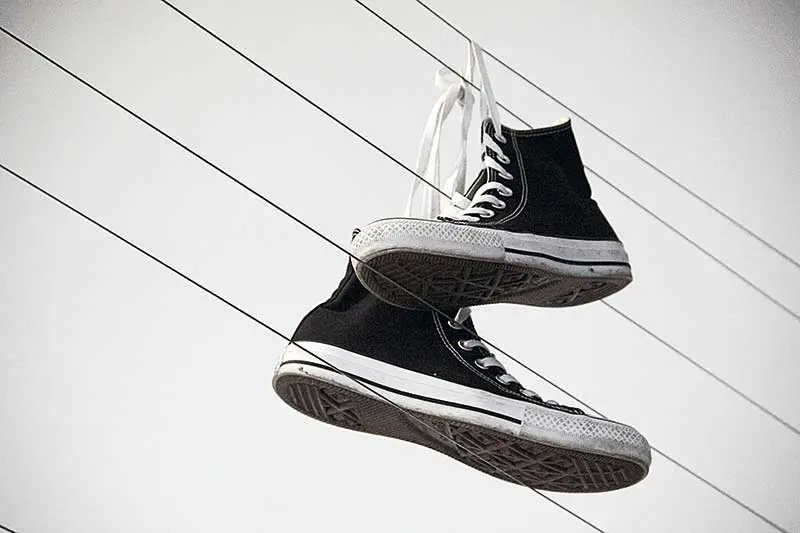
That poetic trance coming after abstraction and philosophical discernment make it possible to imagine a kiss (an emotional expression with sexual, erotic, affective implications) as the pillar and sole support against the oscillations of the world. Perhaps because of that, Bésame mucho was—with its steel lines—an extremely succinct translation of Consuelo Velázquez’s bolero of the same title. In a large music sheet at the back of the room, Eduardo Ponjuán established a connection with the past (with his mother, with his childhood) by revisiting a collective gesture that transforms power-grid lines into a landscape. Tying together a pair of old shoes and throwing them against the cables is a rebellious, anonymous gesture that brings the lines dangerously close to one another, places tension on what hangs and is left to the vagaries of the wind, and at the same time multiplies the contact of such a singular pair. That touch awakened a spiritual note, providing such emptiness with a soul.
NOTES
1. Roofing paper, asphalt, daisies, grout, tanks, canvas, and coins, among others.
2. As in Consuelo Velázquez’s bolero, an expression of an entire era and one of the Twentieth Century’s most popular songs.
CARIDAD BLANCO DE LA CRUZ