
The exhibition by Ernesto Neto titled The Protest and the Serpent formulates sharp social criticism framed by a personal aesthetic universe. It is an inquiry into the dialectic between nature, social protest, and institutional repression. And there was no better context for such inquiry than the social unrest in Brazil, which gained international visibility during, and as a result of, the 2014 Soccer World Cup. Amid the rampant interests of macroeconomics and global politics, the local appearance of social demands and ecological vindications were not absent from the Brazilian scene, and the reaction of the art world did not take long to ensue.
Ernesto Neto’s art is not high-colored: it acquires and strengthens its political dimension through its poetic powers. The exhibition operates like a representational subversion in which a pair of Cristian icons—the cross and the serpent—is problematized and reinterpreted as current symbols through installations, engravings, and sculptures. However, the scope of the symbolic in itself is overpowered in the exhibition by its metaphysical restlessness and the underlying political agenda. The operation unfolds in two stages: On the one hand, the desecration of the cross and its resemantization as an instrument of power and torture and, on the other, the vindication of the serpent and its moral connotations in Christian cosmogony.
The piece Lápida da Tortura, Democracia Contemporanea (Torture Tombstone, Contemporary Democracy, 2013-14) consists of a white marble plaque in which a cross and a police baton have been cut in negative. Thus a parallel is established between two separate objects and their repressive functions. This idea is perhaps more explicit in the work Sangue, Ouro, Cruz a Porra (Blood, Gold, Cross, Baton, 2014), where both objects made of wood are connected by a thread. Beyond the fact—in itself surprising—of the religious significance given by Christianity to an instrument of Immolation that has become the ultimate icon of that faith, the paradox that denounces the first piece is also achieved by virtue of the material used, which has been recurrent in the representation of Christian imagery in art history.
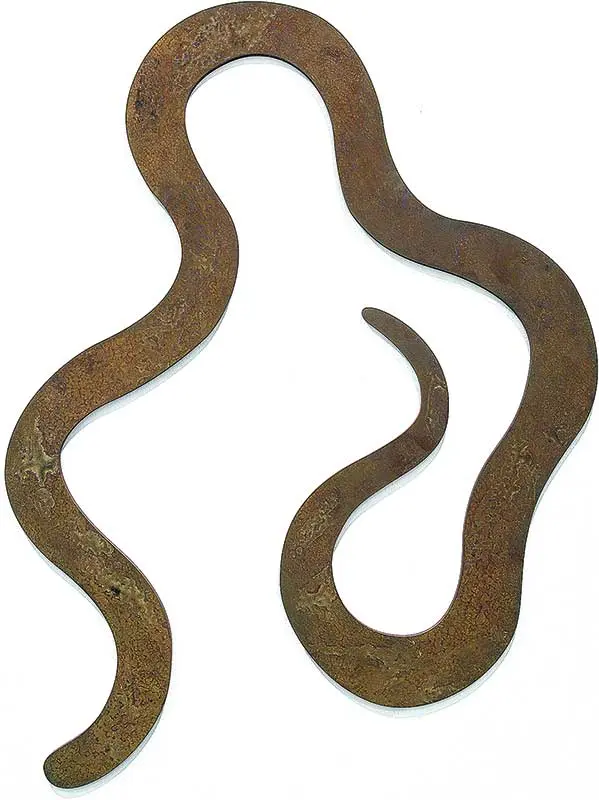
The serpent stops being part of the Judeo-Christian conception of evil to appear as a sacred being and giver of life: “without the power of the illuminated serpent seducing Adam and Eve they would continue to be in paradise and we would not exist.” In the engraving Para Eva, e la Serpente deu a Luz (2013-14) Neto’s serpent is an abstract, organic, and sensual stroke in motion. While in the discourse of the exhibition the snake is presented as a metaphor for the power of nature, it is also used to generate a tension of opposites when associated with the cross: the serpent as the natural drive of the body towards sensuality and reproduction, versus the cross as the artifice of imposition, punishment, and death.
Far from the drive towards modern progress and its contempt for nature, Neto proposes accepting nature instead of denying it, controlling it, or dominating it. The sacred and mystical role of the natural world in his work is evidenced by the use of organic materials like tree leaves, healing stones, wood, and seeds. Besides serving as symbolic elements and vehicles for sensorial immersion in the installations, the materials also function as ritualistic elements for exercising a spirituality that is associated with the presets of the Amazonian Huni Kuin, indigenous people of Brazil and Peru, who have recently become the subject of the artist’s interest.
If the force of nature prevails and the serpent entices Eve to commit the sexual act, then protesting could take the place of the serpent and drive the social body toward the liberation of an imposed paradise or toward the search for new paradises. However, this process is not free from violence and the practices of power, and the formal proposal in this exhibition does not evade them either, as it is not limited to organic and natural elements. The installation titled O Desconhecido nos Espera de Braços Abertos (The Stranger Awaits Us with Open Arms, 2013) incorporates galvanized iron magnets, neon, and a gas mask, and Quem Matou Jesus (Who Killed Jesus, 2014) combines wood with building stone, terry cloth, and a bullet—a clear allusion to tourist development in Rio de Janeiro and its social implications. The piece speaks to the current Brazil while it dialogs with tradition; it alludes to “Quem Matou Herzog” (Who Killed Herzog), the famous phrase in the Insertions project by Cildo Meireles.
From the series, Heroes are on the Street, the stencil To Hélio. Seja Vândalo, Seja Heroi (To Hélio. Be an Outlaw, Be a Hero, 2014) also appropriates and reinterprets Hélio Oiticica’s slogan in and from its overwhelming contemporaneity. Just as in the work by Oiticica, the slogan in Neto’s case should not be interpreted as a defense of vandalism, but rather as the exaltation of a vital stance in the face of adversity. The marginal condition to which he appealed, deeply linked to the vitalist gesture of immediacy, made a clear mark in Neto’s aspiration that all crosses be eliminated from churches and that, instead, they be replaced by the representation of a singing and dancing Jesus, as well as his recognition of urban life that does not lose connection with nature. Old but timeless utopias from Río de Janeiro.
DIANA CUÉLLAR LEDEZMA