
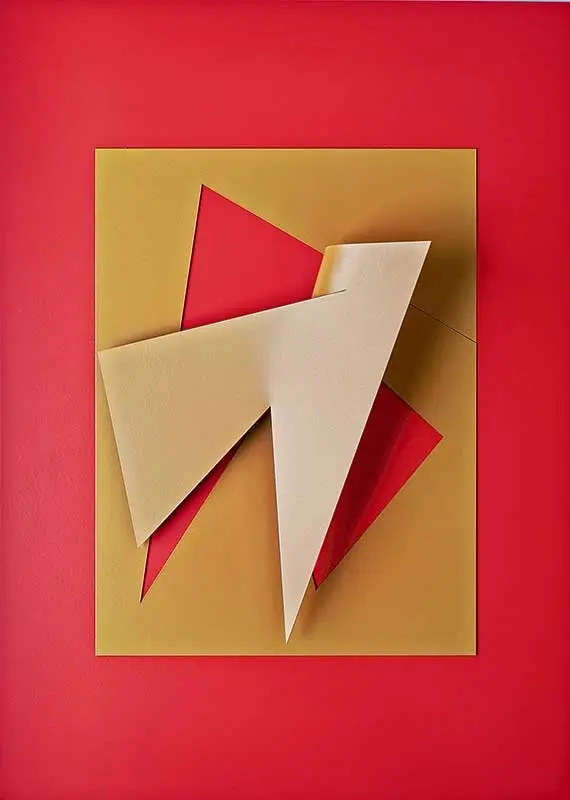
A little-known fact about poet and art critic Ferreira Gullar was recently revealed in São Paulo: his endeavor as a visual artist. The result of his aesthetic inquiries can be seen in the exhibition titled Revealing the Reverse: Collage Reliefs by Ferreira Gullar at the Dan Galería in São Paulo, Brazil. The exhibition consisted of thirty three-dimensional steelworks (in editions of three each), accompanied by a refined craft book with photographs by Nana Moraes and poems by the author himself. Each book sold for R$ 12,000 (US$ 4,200) and contains one work.
Gullar’s three-dimensional works are unfolded versions of his collages on paper, a pastime that the poet has pursued for nearly 20 years and that has already led to two children’s books: Zoología BIzarra (Bizarre Zoology) and Bichos de la Basura (Garbage Bugs). The work—whose paper strips jumped from the two-dimensional plane, twisting and showing their underside—eventually evolved into three-dimensional pieces on metal.
Newly elected member of the Brazilian Academy of Letters (ABL) and one of the authors of the Neo-Concrete Manifesto, Gullar affirms in the introduction of his book: “The relief collages shown here for the first time were the product of chance. In truth, I have been doing collages for a long time. Initially, I would draw bottles, teapots, and cups and then create colored paper cutouts to glue on top of them. But on one occasion, as I was about to glue the clippings on a drawing, my cat hit the piece of paper and disarranged the cutouts. I decided to glue them just as they were. This resulted in the drawing becoming the ordered element and the cutouts the disordered one.”
In press interviews and articles, Gullar has said to have taken a break from poetry for lacking “fear”, a reference to a literary passage of his in which he states that “poetry is born out of fear.” Thus his transition to visual production. His disenchantment refers to, among other issues, the meaninglessness that exists in the contemporary art world and to what many authors regard as an “anything goes” attitude in the art system. Philosopher Jean Galard, for example, wrote that the art world has become a scene in search of singularities, where each artist tries to do what has not yet been done, rather than what is meaningful. In this sense, galleries and museums have become a showroom of novelties. Gullar himself points to the urgent need to establish new approaches to counteract this pluralism, citing that during the 1960s Herbert Marcuse was already condemning pluralism as a new type of totalitarianism.
To Gullar, the contemporary art scene is dominated by a certain vulgarity. He said in a recent interview that “Art should bring joy to people not torture them. Even when something dramatic is created, it should express and overcome the drama experienced and not solely torment viewers. Art is the overcoming of suffering, of banality. An individual endeavoring in the creation of art that is purely banal is someone producing anti-art.”
Gullar was a central figure of one of the most important movements in the Brazilian art of the last century, Neo-Concretism, whose manifesto he wrote and was a signer of. Rebelling against the geometric radicalism of the Concrete artists from São Paulo, Neo-Concretism advocated freedom, experimentation, a return to subjectivity, the recovery of the creative possibilities of artists, and the effective incorporation of the observer as a participant in the work. The proposal would eliminate the technical-scientific nature of Concretism. The Cocoons and Counter-Reliefs by Lygia Clark (1920-1988) from the late 1950s emerged as a good embodiment of Neo-Concretism ideals in that they were three-dimensional unfolding of drawings from her earlier Modular Surfaces series. Her Bichos or Creatures, which Clark began to create in 1960, sought the effective participation of the public, thus revealing a new chapter in the history of art that reaffirmed a political dimension by the collective body, as well as a phenomenological dimension that favored the experience of the individual and spatial senses.
The poet was also a central figure during the unrest caused by the resurgence of censorship by the military dictatorship in the late 1960s. While Gláuber Rocha’s Cinema Novo emerged onto the Brazilian art scene along with the socially conscious and experimental theater by Augusto Boal, Ferreira Gullar buried a poem in the sand as a radical gesture.
Gullar makes no claims to being a visual artist and this exhibition only responds to the encouragement of his friends. Nonetheless, the work presented in this show turned out to be pretty consistent, revealing the art critic and former poet’s refined gaze. At eight-four, Gullar has dedicated most of his life to art and everything seems to indicate that he will follow other art critics who at the end of their career—like Brazilian Mário Pedrosa and Clement Greenberg from the US—became disenchanted with their time. However, with his personal poetic revolution that transformed letter and image, Gullar surprises us with a new and major aesthetic legacy: believing in the creative power of life.
ALESSANDRA SIMÕES