
Viewers who encounter the work of Eduardo Scaglia (Lima, 1981) immediately perceive its technical mastery. But the intention does not stop there. The Peruvian artist synthesizes a process from mid-2011 through 2014, after several journeys to the island of El Frontón, located in the Pacific Ocean, across the bay of Lima.
After several exploratory visits, Scaglia decided to initiate a spatial-temporal appropriation and installs his ‘atelier’ on the island. An island that is filled with history: from the commercialization of guano to the remains of prison (it was also known as Devil’s Island). To develop his work, Scaglia works, obtains, and transfers elements from the same location in which they are composed.
Scaglia’s works are the product of on-site reflection and correspond to the historical and social situation of this small island, as well as its landscape. Through the large exterior display window, intrigued visitors can contemplate the composition. The arrangement of various objects and rocks on the ground is not only unusual. Scaglia took what was in the location where he worked, broke it apart, and reconstruct it just as it was in Paris. The Mesa de trabajo-mapa, 2014, comprising the top part of the support for the cement and tile surface that served as his desk, along with other found remains vestiges, and blocks that the artist recovered in El Frontón.
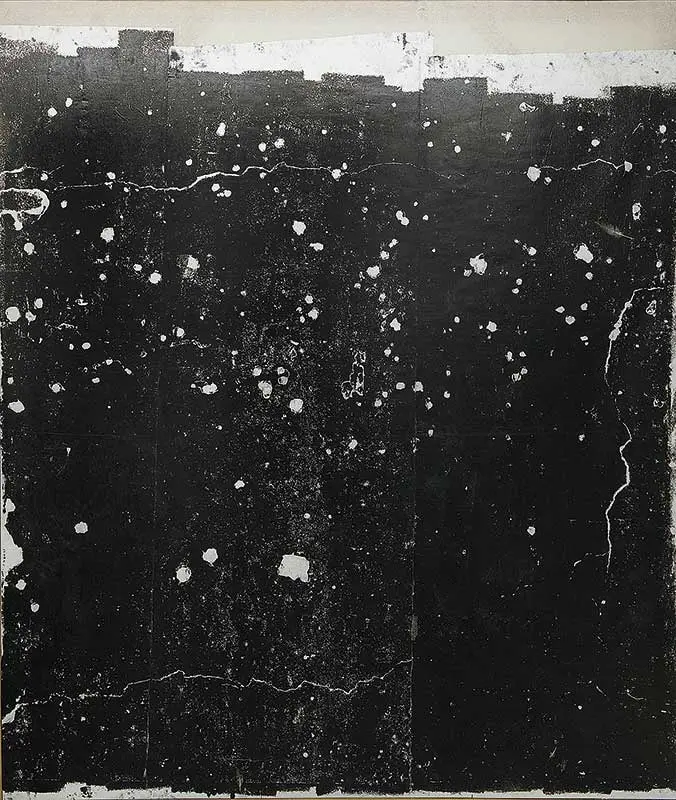
The works covering the left-side wall in their entirety are called drawings. There is a black background, obtained from using a roller with oil paint on Japanese cherry wood paper; some circles and scratches or graphics preserve and let us see the white surface. These are traces of writing, messages of human presence, bullet holes that attest to summary executions, and a historic bombardment of the island, since the rocks on the gallery floor refer us, metaphorically, to the location of stars in the sky. This is how Scaglia synthesizes a work of art that translates the violence from which it originated.
As if by mimicry, traces of shootings are contained in the outsize paintings on the wall, which against a black background resemble, paradoxically, stars in a constellation.
The recurrent antinomy of devastation and construction, the product of human actions, is an intense message Scaglia was able to articulate using a variety of techniques and materials. These paintings are the shifting record of the island’s landscape and its appearance at various times of the day. Scaglia’s execution is clean and neat.
The installation is a mysterious encounter of paintings, elaborate cultural elements, and others in their natural state. And a ‘metaphysical’ or higher stratum also refers to the presence of pre-Hispanic worlds. The subterranean realm, with its well-known Hell; the human realm; the upper world. What allows the dose of eclecticism with which Scaglia overcomes mere appearance is the articulation of these three worlds.
The theme of constellations was also a landmark in Modernist Latin American poetry and in contemporary art. But Scaglia seeks to disassemble all hierarchies of representation. He draws the constellation on the place that is, topically, opposite the sky: the ground. He measures objects in relation to a paradoxical situation with regard to astronomy. And, finally, representations of seascapes, with symbols of metal elements used in pre-Columbian rituals. The sea opens the way for the coastal desert that dominates the scene nearby.
This dynamic between identity and negation appears as another element driving the deeper meaning of this construction.
Scaglia doesn’t exhaust here the system of production thus created. All of this is also an active part of the proscription: from the office to the marginal, from the metropolis to the abandoned periphery, from the dark to the luminous, the hidden and the diaphanous, the poverty and the riches of history.
SUSANA SULIC