
Abstract art, as we conventionally understand it in the Modern Western sense, has been around for a century. If we factor in older traditions such as Early Medieval, Islamic or African art, then it dates back even further. Yet there still exists an ongoing debate as to how to look at, or more trendily, “read” abstract works, what kind of meaning we may ascribe to them, indeed whether or not any meaning at all can or should be ascribed. For much of the Modern period, abstract art has been confined to being addressed in purely formalist terms; the prevailing idea has been that there is nothing to interpret or know; anything to be derived from these works remains on strictly visual terms. Despite these formalist stalwarts, a great deal of time and effort has been expended in an attempt to explain that much abstract art, in all its myriad forms and cultural contexts, can actually be informed by and convey significant content and most contemporary abstractionists continue to work within this sensibility.
It is therefore all the more intriguing when an artist, such as Jesus Matheus has recently done, chooses a project that insists upon a formalist approach as well as other, extra-formal considerations. Matheus, who was born in Caracas, Venezuela and has also lived and studied in Brazil, has over the course of his artistic career pursued both figurative and abstract idioms of art in a variety of media, often exploring the nature of form and signs, citing inspiration from artists such as Joaquin Torres-Garcia and his investigations of geometric forms and glyphic figures. Another artist that comes to mind, perhaps not surprisingly given Matheus’ time in Brazil, is Lygia Clark, especially when Matheus’ work turns to geometric abstraction and engages the idea of abstract geometry as an actualization of space and place, concrete or otherwise.
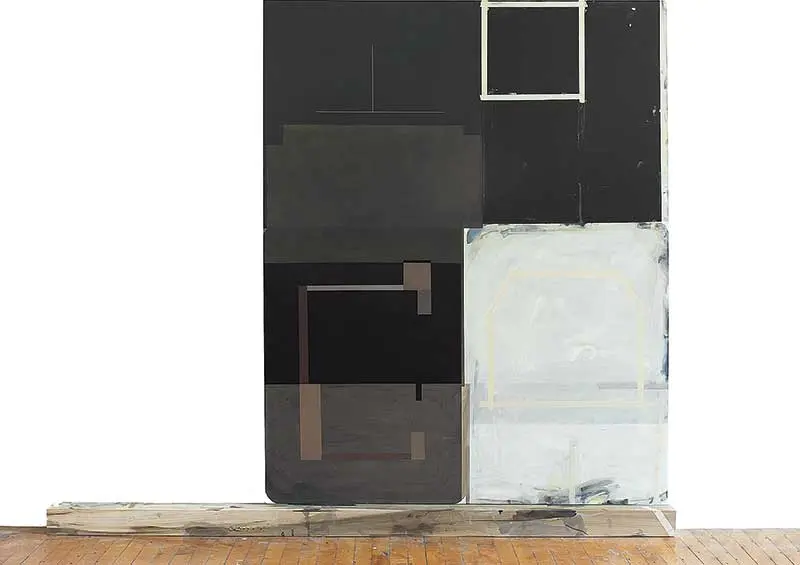
Matheus’ current New York exhibition, at Cecilia de Torres Gallery, explores these esoteric geometries. The collection Form. Sign. Place. is the result of a collaboration between the artist, the gallery, and the curator Juan Ledezma who was approached by the gallery to guide this project. The exhibition consists of a group of works in various media and dimensions, ranging from smaller works on paper to large wood-and-canvas painting constructions. The works themselves tend to focus on the square or rectangle, although often the pure severity of the geometry is softened by gestural strokes that can sometimes leave one field to “violate” another or with his mixed-paper assemblages that lack sharply defined edges. There is the sense of ethereal or otherwise non-specific space in these works, much as one senses in the best of Suprematist artists like Kasimir Malevich; indeed a recurring title for many of them is Ideogram. These works also engage the idea of pure geometry as sacred in form, which connects back to Incan masonry and is iterated more firmly with the totemic or fetish-like quality of the wooden beam structures that also populate the exhibition, and once again one finds titles such as Altar and Altar T to reinforce such thinking.
Nevertheless this exhibition, for all of its engagement with esoteric notions of ideas as space and spiritual geometry, also insists on being regarded in the concrete here and now, in very formal terms. Although comprised of individual works of art, the exhibition was conceived to be experienced as a single entity, a site-specific installation created for the Cecilia de Torres Gallery. Each work, powerful on its own terms, is meant to be seen as part of the larger whole and was made with a specific arrangement and location in mind. One can see this particularly with a work such as Pizarras, a triptych (again a very conventionally spiritual form of art) that fits perfectly within a framed engaged archway, or in the way the wooden extensions of many of the paintings created a resonance with the exposed wood beams of the gallery, or even in the generally more muted palette that the artist has adopted which works atmospherically within the whites and earth tones of the gallery space.
With Form. Sign. Place. Matheus and Ledezma have presented many strong and evocative pieces whose parts then join to form a whole that, while not necessarily greater, adds an entirely new dimension to how one engages these works. For a brief time the all-too-frequent polarities between formalist and esoteric abstraction, individual and installation art, even the artist and the curator, have been resolved, and to great effect.
JOHN ANGELINE