
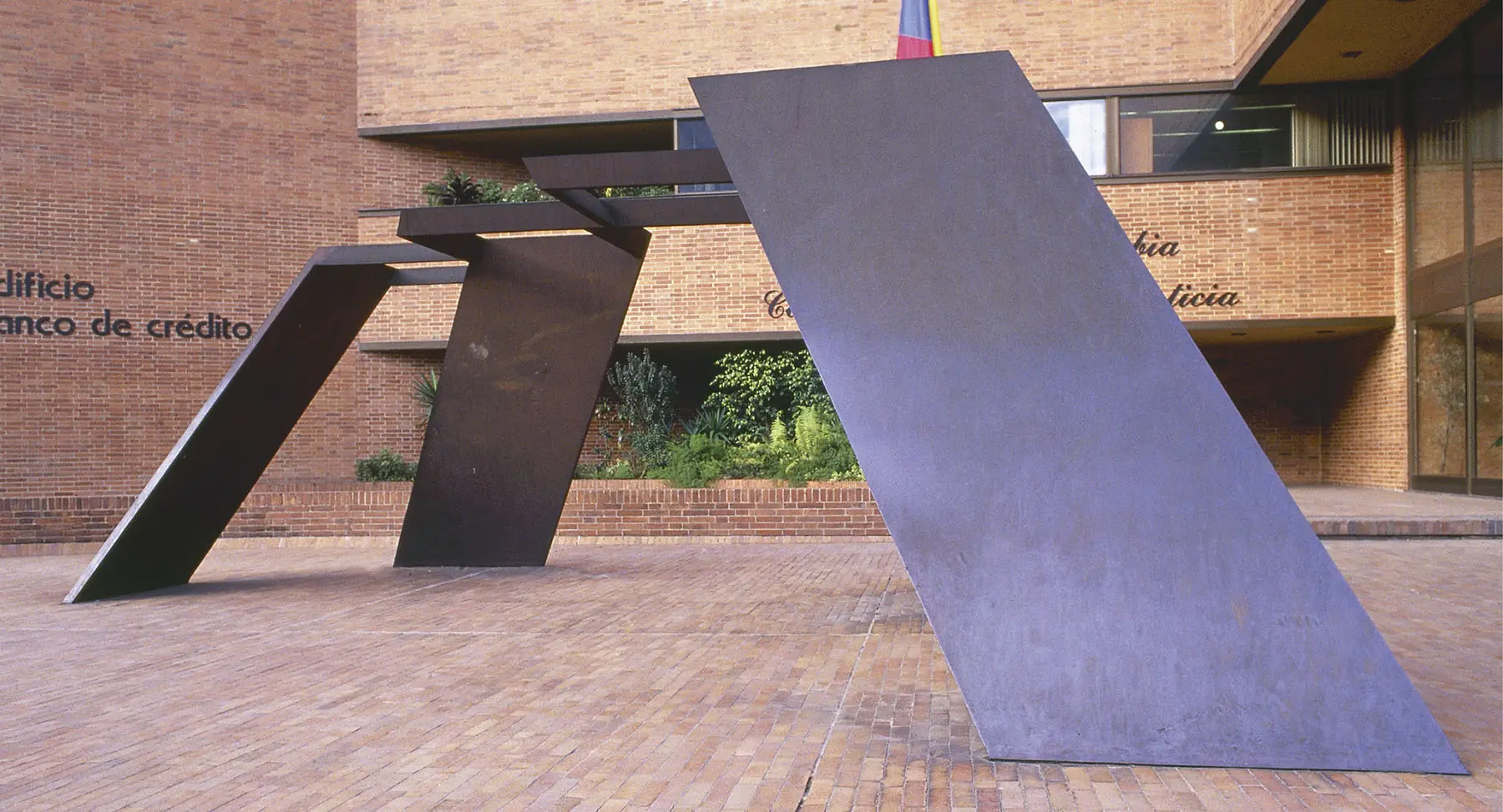
The sculptor John Castles, born in Barranquilla in 1946, has devoted the last 45 years to the creation of three-dimensional works of art that always seek a rotundity of form and leave metal in view as an expressive and persuasive element. His earliest structures were made in wood and date from 1970. They were exhibited in Castles’ first solo show at Galería El Parque, in Medellin. The artist had traveled to the latter city to finish his architecture studies at Universidad Nacional after having begun them at Universidad Javeriana in Bogotá, where, still a student, he took part in the university’s 4th Painting Salon, as well as in Universidad de Los Andes and the National Library, all in 1968.
But it is in 1972 that Castles opts for painted aluminum as the preferred material for his sculpture. Of course, the use of this metal in the form of nuts and bolts, as well as the flat colors chosen for the surfaces, have a precedent in the work of Edgar Negret, whose language had at the time reached full maturity. Castles admired Negret but also wanted to differentiate himself. His shapes pointed towards physical and structural concerns and thus moved away from his predecessor’s engineering and humanistic evocations. Castles’ sculptures were structured on the basis of straight planes and allowed us to observe their spatial solutions by the presence of empty spaces and by marking filled space with painted aluminum surfaces outlined by screws. The titles of his works between 1972 and 1974 were Articulación, Progresión Laminar, Progresión Simétrica, and Modulación Vertical.
Castles had already participated in important group exhibitions since 1972, the year he was included in the 1st young Artists Salon organized by the La Tertulia Modern Art Museum in Cali, and also in the 3rd Coltejer Art Biennial in Medellin. Thus began an intense, uninterrupted career that continues to grow stronger to this day.
Throughout his development as a professional artist, Castles has always attracted the attention of critics ready to disentangle a variety of meanings from his austere forms. Of his first solo show, Luis Fernando Valencia said that “the classic tone of John Castles’ sculptures comes from an intense need for order, which produces a predominance of relatively simple shapes, and his reiterated module contributes to emphasize this phenomenon. In that sense, it contrasts with romantic forms, based rather on the variety and complexity of nature.” Castles remained particularly active in the 1970s. He participated in the 24th and 25th National Visual Arts Salons, where he received a prize in 1974. He was also present in the 2nd Atenas Salon at the Museo de Arte Moderno in Bogotá, and was included in the Novísimos colombianos show that Marta Traba organized for the Museo de Art Contemporáneo in Caracas. Castles’ work was also featured in two thematic group shows: 8 Esculturas Colombianas at La Tertulia in Cali, and La Nueva Escultura Colombiana at Universidad de Antioquia. In 1979, Castles also participated in the 1st Buenos Aires Printmaking Biennial. Cuban art critic Galaor Carbonell wrote in 1975: “Based on the image of crystal, Castles produces highly disciplined sculptures, formulated by edges that form volumes with bases always framing the rectangle. And that sculptural crystal, subdivided in modules, is, in turn, the module that Castles programs, so that, starting with it, we contemplate the possibility of elaborating a universe where structure reigns.”
In 1975, Medellin’s Galería de la Oficina presented the exhibition La Generación Urbana, which started a path towards Once Artistas Antioqueños at the Museo de Arte Moderno in Bogotá, at the Centro de Arte Actual in Pereira, and at the Banco de la República, back in Medellin. Among the participants were Juan Camilo Uribe, Javier Restrepo, Saturnino Ramírez, Óscar Jaramillo, Félix Ángel, Dora Ramírez, Hugo Zapata, Humberto Pérez, Ethel Gilmour, Marta Elena Vélez, and John Castles. The Medellin Group, as they were also known, belonged to different generations and practiced different aesthetics, but they shared an avid libertarian intention and were stimulated and excited by the Coltejer biennials, which shifted the direction of the arts not only in the capital of Antioquia but in the country’s principal cities as well. These artists had the support of Alberto Sierra, director of Galería de la Oficina in Medellin, and Eduardo Serrano, curator at the Museo de Arte Moderno in Bogotá. Sierra wrote about Castles around that time: “His structures don’t appear as objects; rather, his delicately positioned planes force us to consider three specific points: first, the elements that comprise it—large planes in rusted iron, set in opposition and in unstable positions, maintaining for whoever details them the spatial sensation of an elemental, heavy architecture; second, the linear elements that usually give structure to the iron sheets at the upper levels provide fragility, and clarify the work of gravity-based sculpture; third, the spatial reading absorbs our attention for the extreme care taken by the sculptor in the initial creative steps. It all forces us into a trajectory where we understand the logical projections generated by the lines and planes. There are, then, no gratuitous spaces, but the strict control that the sculptor exerts in the creation of his vacuums, gaining more and more terrain outside the same shapes, a recourse never before used in our sculpture.”
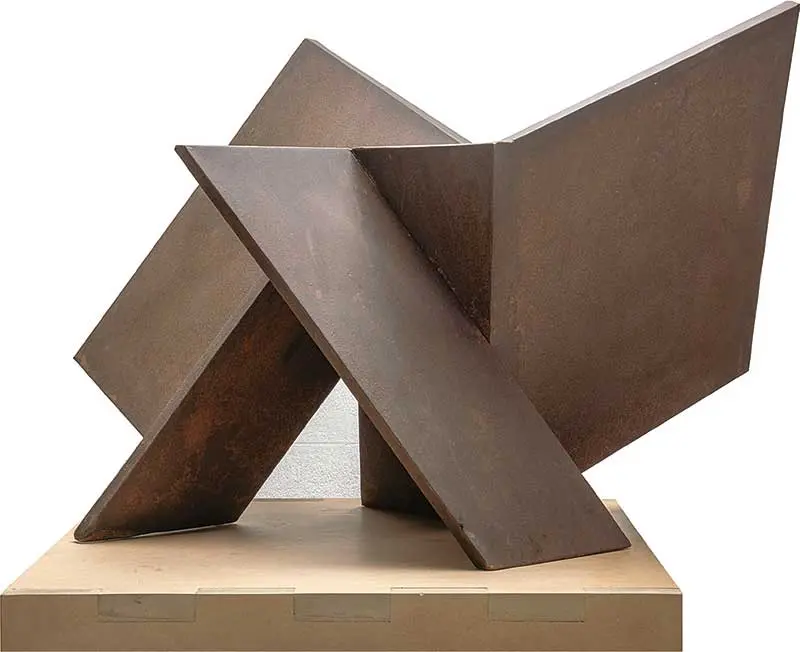
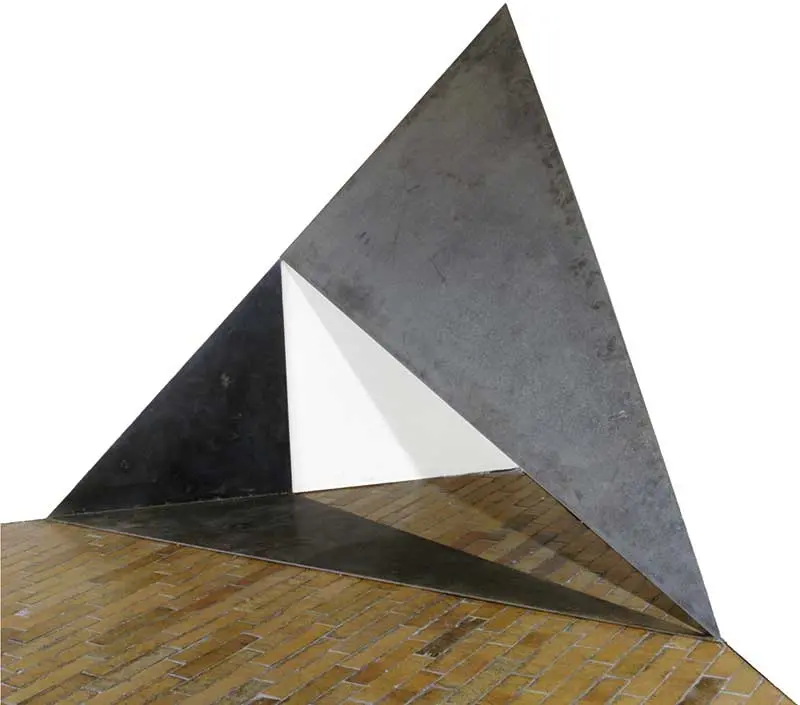
In the 1980s, Castles began to see his work exhibited in the international arena. In 1981 he participated both in the 16th São Paulo Biennial and in the 5th Printmaking Biennial in San Juan, Puerto Rico. In 1983 his sculptures were on display at the Center for Inter-American Relations in New York City. John Stringer, the Center’s visual arts director, wrote: “The work of John Castles is founded on the logic of construction. His sculptures play, challengingly, with the physical properties of balance and equilibrium, and they possess progressive relationships not only between artworks but also between their component elements. Restricting his formal vocabulary to diagonal metal sheets (with the occasional use of rods), Castles has achieved a forceful homogeneity in his sculptures and has maintained a high level of execution.” During the eighth decade of the Twentieth Century, Castles continued with the exploration of metals and their physical properties. He used melted iron in compact, modular works. Also nickel and melted aluminum. He used steel, glass, and soldering. He proposed works on paper with graphic-like rust imprints. Asterisco, Triángulo, and Pliegue de India are a few of his titles. In 1986, Sala Mendoza in Caracas presented a selection of 26 works, dating from 1982 to 1986. The Venezuelan critic Axel Stein, then director of Sala Mendoza, wrote: “There will come a time, and several works in this exhibition demonstrate it, when each element in a sculpture will seek more than a complementary relationship to reconstruct the unit, a point of maximum balance and tension, material or visual, with respect to all others. The sculptor almost loses his dominion over matter and limits himself to reorganizing it according to the most elemental of physical laws. The fracture is definitive. Then, a critical moment appears in his oeuvre. A breakpoint. This happens when logic is momentarily interrupted; in that interval, a motion emerges that alters the system, producing a slight sensation of insecurity when confronted with a purely geometric structure.” In 1986 Castles was also present at the 2nd Havana Biennial, and two years later he was at the First Bogotá Art Biennial in the Museo de Arte Moderno.
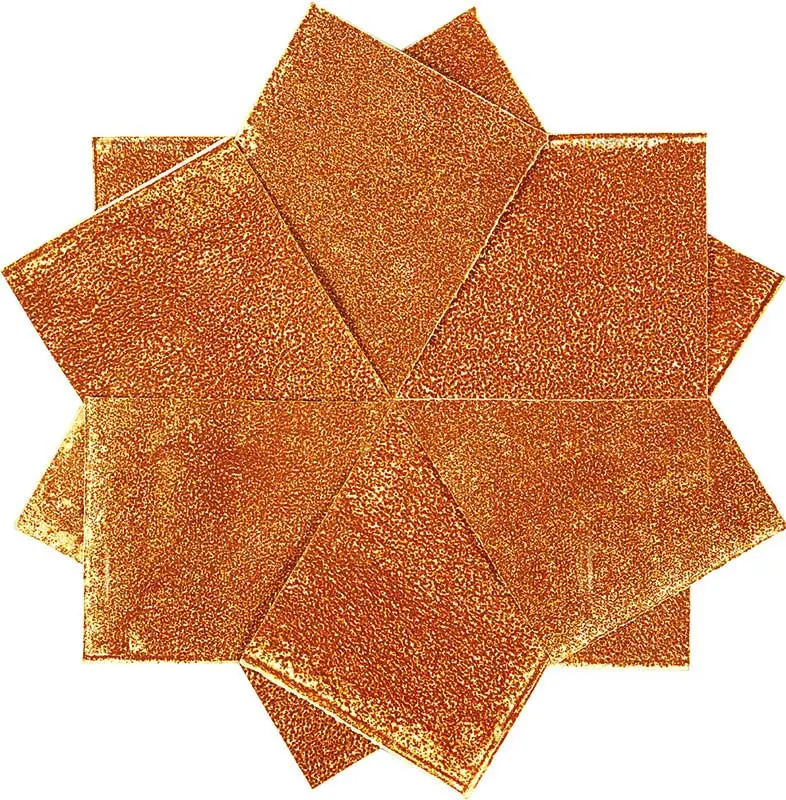
In 1991, the Museo de Arte Moderno in Bogotá presented 23 of Castles’ works dated between 1989 and 1991. The exhibition was, according to museum director Gloria Zea, “a great career-making solo show, bringing to the public a consolidated body of work in a mature and personal language, and with achievements well established in the recent history of Colombian art.” On that occasion, Carmen María Jaramillo said that “despite the fact that his works today tend towards verticality, Castles has begun to lose interest in bases, in anchoring his works. He supports his sculptures at the edge of the metal sheet, and in this way, they integrate naturally into the ground. When he works in arches and doorways, Castles situates those edges at a 90-degree position, creating the illusion of an enigmatic perspective where the dimension of depth seems like a long stretch that comes to a close. Also, the motion of the sheet and the semi-frontal view afforded by its right-angle positioning make the work imposing and forceful.”
But Castles’ production has not been limited to interior sculptures exhibited in museums and galleries; he has also a significant body of public artwork, with proposals dating back to 1975 when his Pectoral was installed in an open space. In “Una escultura difícil de percibir,” an article in Medellin’s El Colombiano newspaper, Leonel Estrada interestingly writes that “If we imagine Castles’ sculptures at a larger scale in the middle of nature, they become monumental, and they should be considered architects now projecting and building works in spaces with large green areas. Medellin would gain in beauty and become more of a focal center for culture and the arts.” Much of these wishes have become true, and Castles has been one of the protagonists not only in Antioquia’s capital but also in Bogotá, and in exterior projects like Simposio Iberoamericano de Escultura in Santo Domingo in 1985, the Certamen Iberoamericano de Escultura in San Juan, in 1985 and 1991, and the University of Connecticut's event in 2000. In 2007, the Gilberto Alzate Avendaño Foundation organized the exhibition Urbana (proyectos urbanos) to highlight this aspect in Castles’ production. It brought forth early works from the 1970s such as Pectoral, already mentioned, and Vanos, from 1976. Also, Castles’ later participation in events like the First International Symposium, mount Nutibara sculpture park in 1983, the Sculpture contest for the Rionegro Airport in 1984, the project for Banco de Crédito, the Rio grande 2 National Art Contest in 1989. In 1991, the Trisesquicentenario de Bogotá contest and four years later the Concurso de Arte para Bogotá. In 2006, the Parks-Library contest for the Municipality of Medellin. The show’s curators, Jorge Jaramillo and Guillermo Vanegas said that “John Castles’ Urbana exhibition presents us with the development of the artist’s work and the different solutions he has found for his incursion in public spaces. The meaning of Castles’ oeuvre must be found in the perceptual experience it proposes in a cultural landscape that tends to institutionalize this kind of sculpture. His work points to the need to understand the close relationship between the work of art and the space where it is to be located, to establish a dialog between the project and the expectations of the sponsoring institution. Nevertheless, and although his activity as an open-space sculpture involves his skills as an architect, it must be said that on some occasions these works do not achieve the expected impact, especially because circumstances such as urban expansion and changes to the original conditions of the location do not follow the project’s prescriptions.”
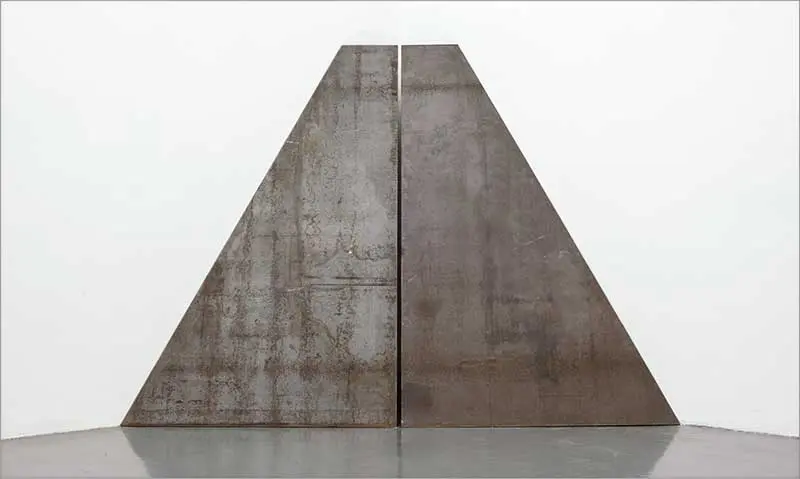
In 1997, on the occasion of his participation in the Luis Caballero Prize, Castles presented his exhibition Intersecciones, a notable display of works that take into account the location and shape of the gallery. The sculptures used the wall for anchoring and emphasized in that way the idea of involving it not only as a support but as the illusion that something extended beyond. Other works used the floor as their anchoring point. In both solutions, the shape of the gallery was taken into account and made evident both in private and public spaces; the intention of Castles’ sculpture considers them and they become indispensable.
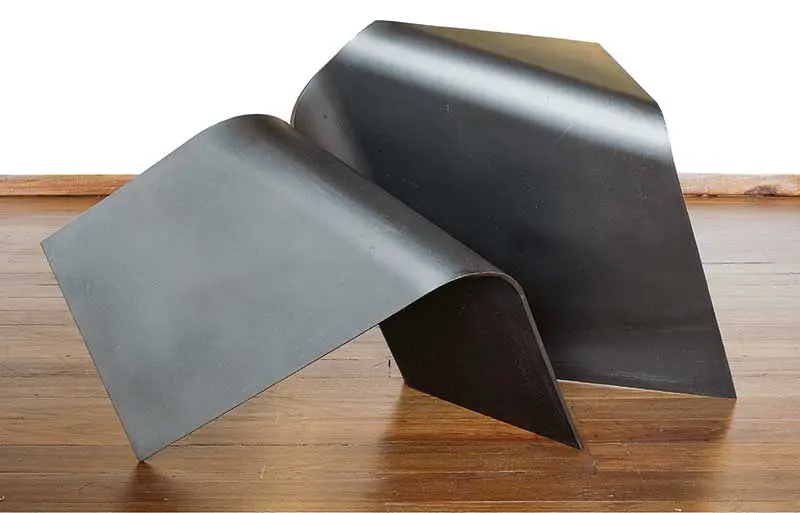
From 2006 on, Castles’ sculpture has prioritized thick steel sheets to create undulations and achieve curved shapes that imbue sensuality into an opaque and cold material. The sculptures based on a single sheet can stand by themselves at the same time they display their austere and elegant form. The gracefulness of their resolution makes them look ironically lightweight, and the metal resembles a fragile piece of paper that unfolds. In this way, Castles not only challenges the physical properties of the metal but is able to construct a poetics for its shapes.
When the Sinuosas series was presented in 2009, with is winding yet firm, potent and precise shapes, Castles’ work not only challenged space and gravity but generated questions about the technical means implied in the achievement of such an appearance of ductility and malleability in a material that seems so contrary to those results. Critic Eduardo Serrano, the closest observer of Castles’ work since its beginnings, wrote on the occasion: “John Castles is Colombia’s most relevant sculptor of recent decades. There are in the local scene no sculptures that can compare with his in terms both of audacity and restraint, of subtlety and presence. Castles’ work has distinguished itself for its sustained and consistent evolution, and for its dual objective: to construct, trim, and fold shapes that follow reasoning’s about the physical nature of iron and its gravitational field, and to at the same time express space, to reformulate, divide, contract, and expand it; this is to say, to involve it in the works according to the assumptions of minimalism yet without its displays of dematerialization or—at least recently—the abstract-geometric intent that characterized the movement.”
John Castles is a sculptor in full possession of his creative energy. He has been able to carry forward the geometric, rational, rigorous practice of abstract sculpture in Colombia whose precedents were Edgar Negret, Eduardo Ramírez Villamizar, and Carlos Rojas. His proposals have marked a difference and expanded the horizon of three-dimensional art in metal, not only for interior spaces but also for urban and natural spaces.
MIGUEL GONZÁLEZ