
POST.EJECT – Exoesqueletos del Límite is the project for Julián Dupont’s first solo exhibition, curated by Miguel González at Casa Proartes. Dupont (Popayán, 1985) arranges a series of sculptures that transcend their own condition as objects, proposing themselves as elements of a total installation that fuses into the space of the gallery, as if the latter were a large body and the artworks its vital organs. The elements negate their own autonomous physical characteristics, inserting themselves in a complex system of allusions, fused by means of a light that becomes matter and atmosphere. The artist creates true environments that resemble the interior of an electronic device, even if they are in reality the exterior of a conceptual instrument.
Formally, Dupont builds two different environments in the exhibition galleries. The dominant neon light of the installations covers the other works and connects them, representing perhaps the neuronal sparks of a moment of inspiration (or how a metaphor would look in the brain). In this way, his sculptures become something like aspects of complex themes that appear as functions of a digression. In the first floor, the chroma-green color of Exoesqueletos del Límite absorbs the other works in the gallery: Móvil (ceramic tiles with grass printed on their surface, on toilet paper); Páramo (topographic reliefs in wood); Performers (PVC pipes wrapped in chroma fabric, set against wood); and Ekathe el Conductor (video of an indigenous man chewing coca leaves juxtaposed with an empty theatre, seen from the stage). On the second floor, the red color of Música engulfs al the other sculptures: Cinta Andina (a large installation with adhesive tape); Paradoja Infra – Leve (sculpture, polystyrene, and superconducting magnets); and a second version of Performers, this time in red.
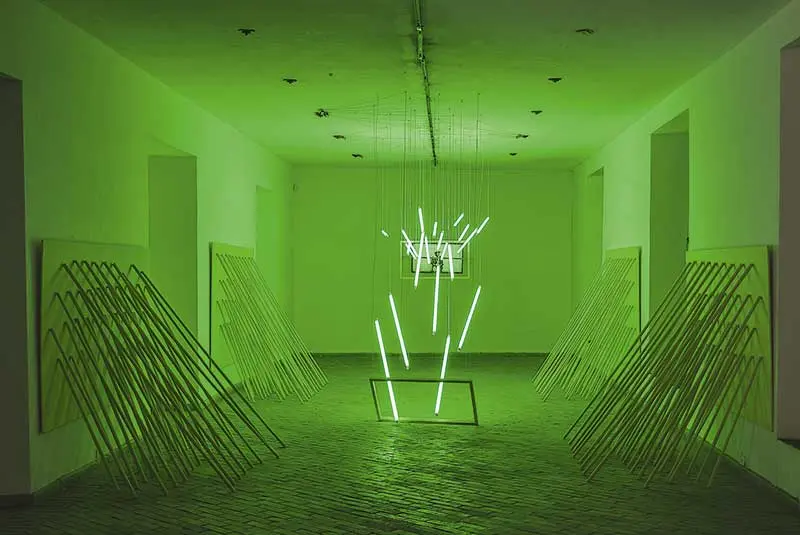
The totality of these installed works creates an impressive environment, green on the first floor and red in the second. Light colors in such a way that each space is a single work; nothing escapes the system, and because of that, the system is disorderly. The baroque character of the proposal is determined by the saturation of elements, both conceptual and material. Between toilet paper (Second Century B.C.E) and the superconducting magnet (1911), an entire history of humanity is gathered up into this project; from the coca-chewing indigenous man to the fine opera house in the video, Dupont’s proposal shrinks a great distance into a moment or a screen flash that can be connected to the spectacle (zapping), or to dreams.
Conceptually, philosophical speculation about the notion of the boundary has a strong metaphorical force (exoskeleton of the boundary), but the artist transgresses the measure of any logic, connecting things to each other chaotically. This loss of measure, which could appear as a failing, is nonetheless part of a certain pessimism represented by Dupont; conceptual (digression) and formal (saturation) deviations are the result of a scaling-up that takes us to the highest reaches of virtuosity but alludes to a hollowing-out of necessity in the objects themselves and the absence of a reason for their being.
Dupont recognizes that the “Post-Eject,” or what is given after the ejected (ejaculated), more than a line of flight is a destabilization of all structures. His disproportionate system of things posits problems in connection to the spatiality of the works, which flow into and fuse with the light in each environment, absorbing the viewer. Matter loses its surface for the simple reason that the point of view is within the system and all things appear as they appear in a dream or a screen.
The neon tubes that are part of the two main installations (Exoesqueletos del Límite and Música) suggest a congealed motion, a truncated flow, also stopping the images that were intended for flowing. Dupont forces the gleaning into permanence, each thing is an inserted bit of the inkling of a topic that, as an artist, he wishes to engage. The Andina-brand tape, the Andes being indigenous territory, along with the indigenous man and the desolate landscape, are nothing but the reinforced relationships of a delirium. These works are part of a conglomeration of small remembrances, outside conceptual guidelines and open to free association, which, like the dream element (exploited in Surrealism), has its elements float in space (be it thanks to superconducting magnets or invisible nylon strings).
One aspect is missing in this complex system and it has to do with the work titled Performers, a term that can mean executers-of-actions: to execute and to eject is to confront a boundary that upon being crossed turns the action into a regression, a process of hypnosis or dream. It could be thought that no boundary exists beyond the very moment in which it is violated, but to recognize a boundary is also to recognize the need for the space or the concept to have a border, so that it is possible to formulate a state.
BREYNER HUERTAS