
The mark of Luciano Figueiredo’s current production is his use of graphic thinking as a starting point for the creation of works that continue to generate unfoldings of Brazil’s constructivist tradition. In his show Cor, Plano: Suspensão, the artist presented previously unseen paintings, all named with the same general title as the exhibition and reinforcing his constructivist intent of the 1980s.
The paintings were made in acrylic, in primary-color hues as well as pinks, greens, and grays, black and white. On the canvases, the artist pulverized torn newsprint paper, in sizes so small that its origin can remain hidden for an observer unfamiliar with the recurrence of the material in his oeuvre.
Permeated with representations of the world, the torn and pulverized paper becomes ethereal on the canvas. Applied onto rectangular and triangular shapes, it is suspended and at the same time creates textured, geometric modules. Figueiredo also uses what he calls “planar dynamics,” a kind of game between geometric shapes and empty spaces. The paintings’ chromatic fields are translucent or opaque; those that tend to transparency refer to fields of light and allow us to visualize the superposition of planes and lines, which create tonalities and shapes and interconnect with the fields of solid colors and the empty spaces in the same painting.
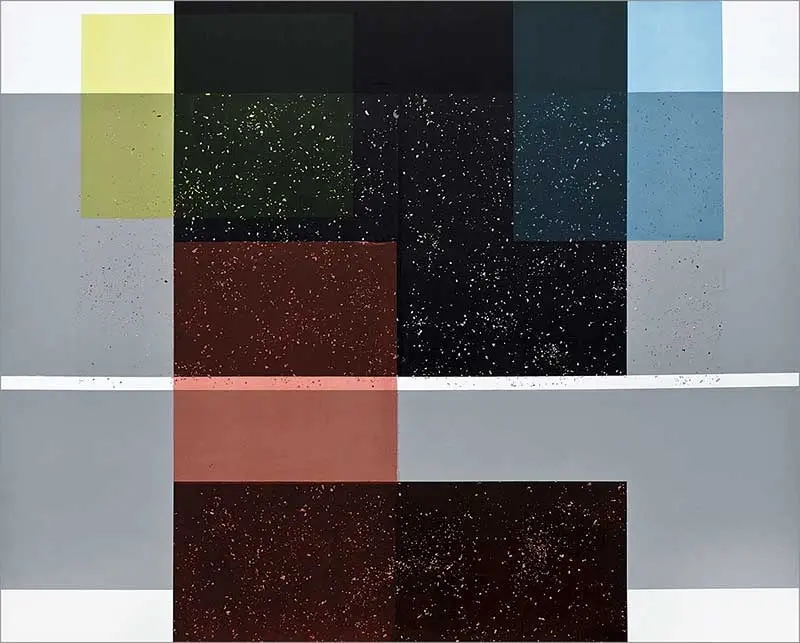
The opposition of light and shadow, opacity and transparency, and an ability to reveal and dissolve forms are repeating resources in Figueiredo’s work. His career is marked by experimentalism and coherence. In 2004, in the series Dioramas e Muxarabiês, the artist presented paintings on wood that show a close collaboration between the graphic and the pictorial orders. The transparencies reveal their support, their organic origin, as well as the overlapping layers of liquid color, and the newsprint paper is present in the diagrammatic structure of the shapes in the paintings.
The narrow range of saturated colors, without strong chromatic contrasts, is another recurring resource in Figueiredo’s style. Three-dimensionality also makes an appearance at times, as in the 2011 series Espaço-Laço, with works created on the basis of foldings, torsions, and super-positions of paper and fabric that suggest motion.
Born in Fortaleza in 1948, Figueiredo began his career as a painter in the 1960s with Adams Fimekaes, a teacher from the Bauhaus who was passing by Salvador y Rio during the Brazilian artist’s formative years. Figueiredo lived in London between 1972 and 1978, studying Art History and English Literature. During that same period he started his investigation of the use of newsprint, with printed pages from newspapers, tracking the flow of his experiments in visual poetry with cut-out words, wire mesh, and monochrome reliefs, presented in exhibitions in Rio and São Paulo since 1984. Figueiredo was also an important figure in the counterculture movement in Brazil in the 1970s, with stage designs for music shows and graphic projects. In those works, the artist created countless possibilities for perception, with a variety of experimental and interdisciplinary aesthetic resources. The start of his path towards planar paintings was already in view; in those paintings, Figueiredo created layers and superpositions of color applied directly onto wood and canvas, inviting viewers to pure contemplation, respectful of each viewer’s own pace.
Figueiredo’s career as a graphic designer happened in parallel to his career as a painter. He retained his interest in the graphic arts always in alliance with aesthetic experimentation, all the while creating works of art using elements identified with precariousness and everyday life. The resulting body of work does not privilege one kind of support or material. The artist appropriates weavings or newspapers, creates reliefs exploring densities, transparencies, and the recomposition of signs.
With such a clear filiation in constructivism and the graphic tradition, Figueiredo uses the graphic stain of the newspaper page to create different plastic effects. Since the early 1980s, he created works that start from the plane, using newsprint and wire mesh on which color was applied. The works’ chromatic density was the result of such a juxtaposition of grids.
In later works, Figueiredo presented reliefs on canvases or on wood, or used newspaper pages and fabric squares, glued to one another, to create visual rhythms. Later still he also created sculptures, like the Objetos-Torres exhibited in 1994, which generated optical effects by means of the symmetric juxtaposition of wood-laminate sheets, exploring issues such as fragility and balance. Among so many artists connected to the constructivist tradition in Brazil, Luciano Figueiredo stands out for his sustained research of a unique, coherent style.
ALESSANDRA SIMÕES