
María Elvira Escallón is an artist who from the beginning of her career has embraced a way of thinking that brings people together. And now in her most recent exhibition, she also incorporates a broad reflection on the different ways in which the imagination creates thoughts—such as emulation, analogy, sympathy, empathy, and curiosity—to establish closeness. All these forms of thought that “bring the other closer” were banished from modernity and replaced by a classificatory way of thinking that placed people and things away from each other: “This is separate from me,” “this is not me,” “this endangers my identity.”
Conversely, the thoughts that bring us closer—such as “I am interested in others in the same manner that I am interested in me”—have the virtue of doing away with classifications and encouraging our connection with others. This is the reason that Maria Elvira Escallón explores, through a documentary approach, forgotten and dilapidated places—like hospitals for waiting and/or suffering—which she transforms into spaces that are like “bodies that matter.” And she succeeds because she chooses vulnerability as a point of view from which to describe things. And vulnerability creates connections with viewers offering them stories in which fortuitousness, deglamorization, and paradoxes of everyday life play an important role.
So anything under the gaze that connects becomes a body whose story deserves to be told. And thoughts that bring people close together must narrate, tell stories because it is through stories that we are able to know others as if they were one of us. Narratives include others in similar experiences, paths that we have taken, and places where we have been.
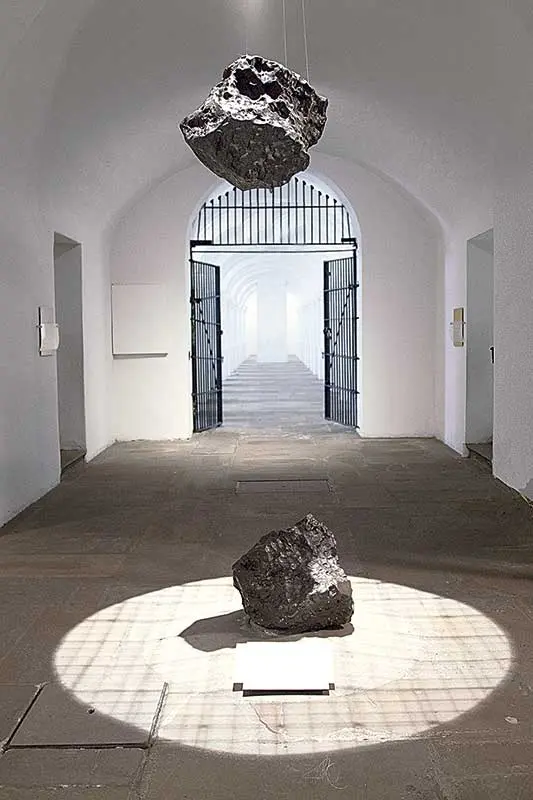
And here is where everything begins: Escallón’s interest in stones leads her to wonder about one in particular: the iron meteorite displayed on the first floor of the Museo Nacional de Bogotá. And curiosity—as a way of getting closer to something—makes her wonder about the manner in which this rock rests on the floor. The way that it has been placed is curious in that the side on which it lays is actually horizontal and smooth and not uneven and rough like the rest of the meteorite. When the rock is lifted, it is possible to observe that it has actually been cut and, therefore, that the piece is only a fragment of a meteorite. It is from that point on, that Escallón begins a detective-like investigation that will take her more than two years. Her inquiries have formed a “small museum of the meteorite of Santa Rosa de Viterbo” that includes documents, letters and photographs, travels, and the formation of a team: Juan Peláez as a drawer, and “a department of replicas” to give an account of the story. It is a museum that will surely continue.
As part of the actions of this small museum, Escallón asked the Museo Nacional to narrate “the singular chain of events” related to a meteorite. And the natural questions this poses are: How to go about the story? How do the visual arts tell stories? By choosing precise anecdotes through which the rock reveals the idiosyncrasies of a country. The story is told through drawings, frames, meteorite replicas—of fragments and of the entire meteorite—suspended over the actual aerolite.
In this manner, through this visual narrative, we learn that the stone is a metallic meteorite that fell from the sky on Good Friday, 1810, in Santa Rosa de Viterbo, a municipality in the northcentral area of Boyacá, Colombia. Through the drawings, which are like a historical cartoon, we also learn that it was found by a peasant girl and was used as an anvil until 1827 when two naturalists passing through Santa Rosa recognized its value and bought it from the girl for the Museo Nacional. We also find out that it was impossible to move it to Bogotá so the town decided to place the meteorite on a “Greek” column in the town’s main square. In 1906, Henry Ward, a US naturalist, and entrepreneur who specialized in trading with museums, discovers it. This elicits the meteorite’s movement to several places, economic transactions, and issues on sovereignty.
Ward makes the town’s mayor an offer to purchase the meteorite and, to make the transaction even more appealing, the businessman also offers a bust of General Rafael Reyes—Colombia’s president at the time and a native of Santa Rosa de Viterbo—as part of the deal. Then the meteorite is removed—and separated from the pedestal—at night while the town sleeps and the journey to get it out of Colombia and into the US begins. In the La Caro train station in Bogota, the strange object gets the attention of a journalist who alerts President Reyes, who prevents Ward from taking it out of the country. Following negotiation between Ward and the government, the meteorite is divided in two: Ward takes one part, which is then divided into several pieces that sold to different museums in the United States; and the other piece stays in Colombia at the Museo Nacional and becomes that museum’s most important object on display.
The story ends with an article by journalist Quijano Mantilla that concludes in this beautiful manner: “The government of the Republic does well in not relinquishing that which has literally fallen on us from the sky.”
The history of this meteorite is part of the history of a mindset of a country; it is a story about surprise, solidarity, ignorance, dignity, celebration, forgetfulness, negotiation, and lastly, about this alert subjectivity of journalist that writes, reports, and proposes—as if calling all artists— caring “for that which has literally fallen on us from the sky.”
NATALIA GUTIÉRREZ