
“Sell your cleverness and buy bewilderment;
cleverness is mere opinion, bewilderment is intuition.”
-Buddha
It is no coincidence that it was precisely in Mexico, a country with a deep documentary tradition in the field of photography, where Mario Algaze (Havana, 1947) steered his work—and thus his life—in a decisive new direction. It is also no accident that the Spanish word for Amazement, Asombro, comes from the Greek words “a” (without) and umbrus (shadow), a combination that means “to leave the shadows,” which also stands for “the base of knowledge” in ancient philosophy—in my opinion, the concept that best illustrates the imaginary of a Latin America framed by the dual condition of intruder and host, local and foreign; the condition of the diaspora.
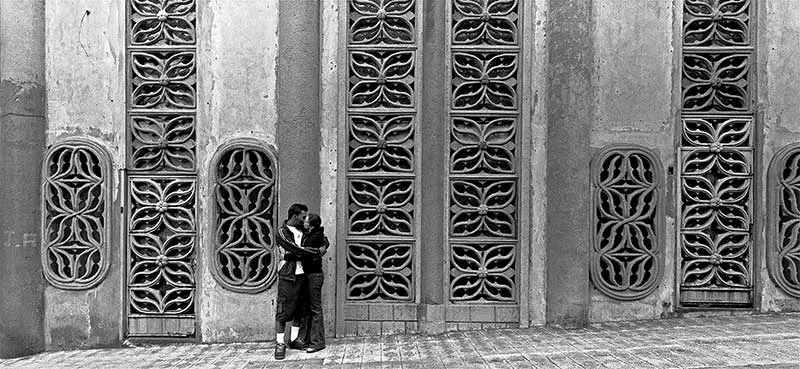
But the truth is that in Mexico, Algaze photographs Manuel Álvarez-Bravo and Rufino Tamayo and, in 1974, begins a long periplus—a journey back—which will take him, camera in hand, across that untamed Hispanic America that expands from the south of the Rio Bravo to the imposing glaciers of Tierra del Fuego. A Respect For Light: The Photography of Mario Algaze, is an exhibition on display at the History Miami Museum under the curatorship of Jorge Zaramillo. It consists of 150 black and white images taken during the last 20 years in 16 countries of the American continent, including his native Cuba where he lived until the age of 13 when his family decided to immigrate to the United States after the triumph of the 1959 revolution.
There are several clues that define the work of this author, but perhaps none as ubiquitous as the title of his latest book that, incidentally, is also the title of this exhibition. Determined to find commonalities that outline the spirit of an entire continent rather than solely the sociocultural landscape of a single country or era, Algaze photographs the cities and landscapes of Latin America through its light. During the early hours of the morning, he portrays the deserted streets with their lone pedestrians, but also interior spaces flooded with intimate scenes, (a) typical situations and characters that are movingly Latinos: he transforms the urban detail—whether architectural or human—into affective layers of information that allow reconstructing an idea of the whole from the synthesis of its particular instants.
Some of his photographs achieve a rare poetic and introspective intensity that is rare in documentary records; others require the complicity and playfulness of the reader to reconstruct the meaning of a scene truncated, for instance, by the renaissance window of the photographic framing. In these cases, the photographer includes a mirror—a photograph within a photograph or baroque trompe l’oeil—that returns the sense and logic of the environment from a reinterpreted perspective.
Although Algaze considers De Chirico and his metaphysical light and shadow architectures an important influence in his work, there is also a narrative element that is similar to the spirit found in the works of photographers like André Kertész or Eugène Atget. His visual intelligence and creative sensibility represent a contemporary take on a seminal tradition of the photographic document whose peak and decline are encapsulated in the retrospective exhibition The Family of Man held at MoMA in 1955.
The peculiar re-enchantment introduced by Algaza in the Latin American landscape from last decades markedly distanced him not solely from the style of some of his contemporaries in the US—namely, authors like Lee Friedlander and Garry Winogrand with their critical views of their cities and of photography itself, during the 1960s and 1970s—but also from Latin American photographers who around the same time found very different visions in their countries and have contributed to the photography of the continent with the necessary nuances for an identity overtly re-presented in a “semiological guerilla against The Photographic Image of Underdevelopment.”
If Mario Algaze’s poetic does not feel superfluous it is because it truly celebrates the delirium of wonder and, to some degree, a childlike innocence. I am speaking of that conditioned ability to see the world “for the first time” or to find in the knowledge obtained from observation the prodigy of an image of mankind and his paths. The continent of his photographs is a self-portrait that manages to reconcile the links between the imagery latent in his childhood memories with an approach to travel as discovery or photography as a human and aesthetic experience. “I’m going to Latin America—Algaze would say—because there is where my affections are.” And with that, he reestablishes the logic of a distorted and halfway written history as visual testimony and documentation of an imagined experience that is ultimately treasured in the classic celluloid films of his Hasselblad camera.
WILLY CASTELLANOS