
In his second solo show at the gallery KaBe Contemporary, Barcelona-based Venezuelan artist Meyer Vaisman (Caracas, 1960) continues his experimentation with commercial and mechanical photo-printing processes on different supports, wood or PDF, to explore issues of identity, duality, coexistence, and authorship as well as themes like artistic identity and the identity of the work of art, self-preferentiality as a possibility in the abstract and the materialization of the theoretical versus the vital.
En la Proximidad de la Historia (In the Vicinity of History, 1988) and Pintura Sin Contexto (Painting Without Context, 1986) are two works from the 1980s that represent the beginning of the use of elements that are reiterated in Vaisman’s most recent series, in which the oval shape along with the partition of the pictorial surface into two planes convey his reflections on painting as in-between space. After nearly a decade of being absent from the art scene, Vaisman recently said in an interview about his “return to art” that his intense religious practice of Judaism had prompted him not to represent human or animal figures, which directly led him to abstraction, a new approach in his work. This gave way to an entirely new series of works composed of graphics and words adorned with linear backgrounds that emulate the grain of the wood, and a color palette tied to the subtractive color model used in printing: cyan, magenta, yellow and black (CMYK).
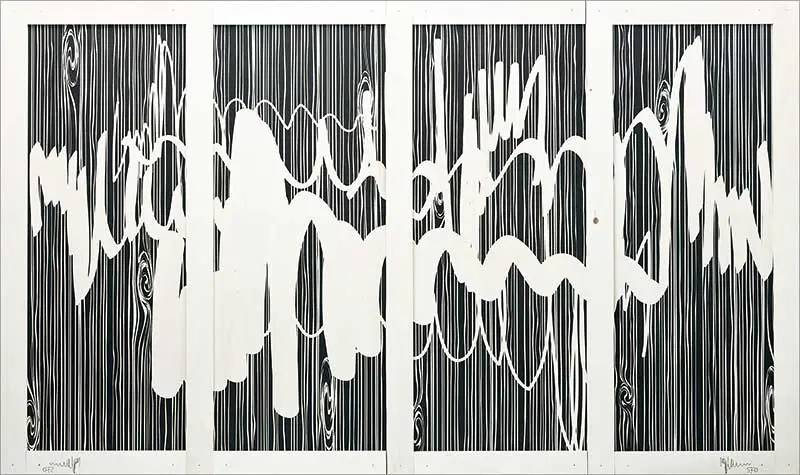
Titled In the Vicinity of History, 5774, the exhibition directly alludes to the Jewish calendar, a reflection on history in general, and on the relativity of time. It does so through a strategy in which wooden stretchers lose their traditional role and are presented in front of the image, automatically generating a grid that divides the picture plane into quadrants. On the other hand, the show focuses on primarily working with three graphic elements: the signature (Vaisman’s), the oval shape, and the fingerprint. These elements are repeated in several studies in which colors and sizes are modified and images are reproduced with an inkjet printer on large wood or plywood panels. Noteworthy of mention is that since the late 1980s, Vaisman’s work by hand completely disappeared from his proposals to make way to a conceptualized and produced approach that was far from the handwork associated with artistic/authorial production.
In these paintings/prints, Vaisman gives the traditional canvas stretcher—usually hidden from view—a prominent role, perhaps with the intention of returning with this twist to the origin of art, to the occult, the beyond. In fact, this idea of inverting the visible and the invisible and the other way around, has been a constant part of his work.
In In the Vicinity of History, 5774, it is through Vaisman’s own signature—reiterated in elongated and deformed versions, repetitions and perspectives—that he continues the exploration of printing, the significance of authorship and the manual gesture that reflects identity; and that, through repetition, superimpositions, enlargements, and layers, he eliminates the gestural element and transforms it into an abstraction. The titles of these works in which he experiments with signatures, Vaisman includes names of artists like Franz Kline or Cy Twombly, but spelled backwards as a nod or referent.
He also relies on the idea of the mirror and arranges written words and other content backwards. An example of this is the Latin sentence—translated from Greek and part of one of the aphorisms written by Hippocrates—Ars longa, vita brevis (Art is long, life is short), which Vaisman rearranged so it would read Ars brevis, vita longa (Art is short, life is long). It is a comment on the role of art and the weight of history, which he uses to convey that while art eventually disappears, mankind will continue to exist. To Vaisman, the aesthetic element in his work becomes discursive and a pretext to examine (art) history and the technologies that shape it.
Constant elements in Vaisman’s work are his criticism of capitalist society, socio-economic inequality—which he first encountered in his native Venezuela—and the art models derived from pop art and minimalism. Art critic Hal Foster was not wrong when in the 1980s he called the artistic proposals created by the Neo-Geo group—of which Vaisman was a member—as doers of “the aesthetics of cynical reason.” Vaisman’s entire body of work reflects on the role of art, its revision, and an understanding of the pictorial space as essential for the distribution of the work. This allows him to challenge—based on the post-structuralist principles of Boudrillard, Foucault, and Lyotard—the role of art as a possibility that is distant from consumerism, products, or everyday life. In In the Vicinity of History, 5774 Vaisman speaks specifically of deconstruction, transformation, of something that becomes something else when reversed, of that which appears instead of ...; something that questions and associates its identity with the sense of belonging, with its everlasting story: always looking to both sides of the same coin.
AMALIA CAPUTO