
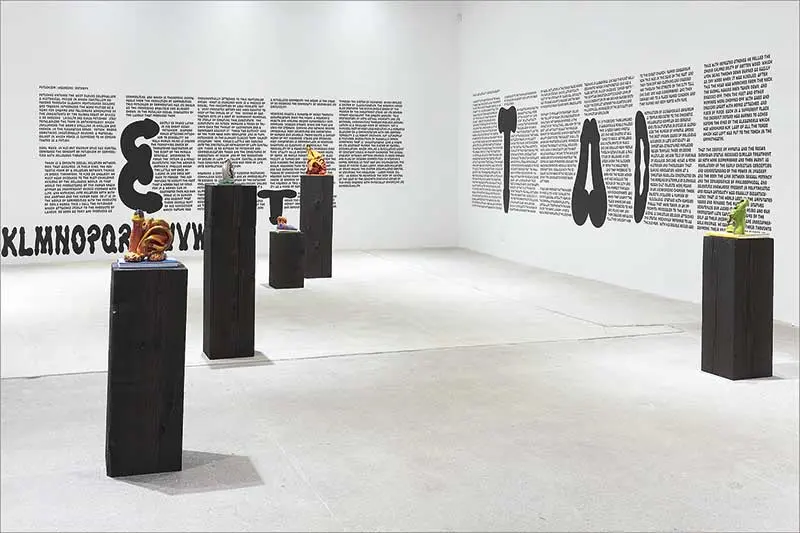
Nicolás Guagnini’s first solo exhibition at Bortolami gallery featured fourteen enameled vitrified ceramic sculptures, a written text on the wall, and a publication. Of the ceramic sculptures, two outsize white heads installed in the final room differentiated themselves from the hybrid figures of ears, noses, penises, feet, and hands that, placed atop modern and contemporary art books on plinths of varying heights, and installed in a second room. Only one of these sculptures—the only one resisting color, in black—was found in the first room and directly on the floor. Titled The Night Porter, it consisted of a raised fist attached to a calf, which ended on afoot. The musculature of the fist and the length of the foot suggested a male body—one that would have belonged, until well into the Twentieth Century, in the public sphere and the spectacle of war, be it favorable or otherwise to any given State. Placed close to the front wall, The Night Porter’s “L” shape seemed at first glance to reproduce the typography of the text on the wall, thick black lettering designed in 2013 in collaboration with Bill Hayden. However, an interruption occurred as soon as the visitor began to read: the transparency of the linguistic signifier had been intervened by typography made exclusively of penises and capital letters. By means of lucid visual and linguistic operations, Nicolás Guagnini, invited us to playfully rethink the relationship between power, domination, and masculinity in the West.
Immediately upon entering the gallery, visitors encountered a newspaper titled Some Notes on Dickface by Nic,” which reproduced the writing on the wall and was given out for free, with a print run of 1000 copies. In this way, the text—a meditation on war, torture, photography, colonialism, fashion, fetishes, castration, and mutilation in antiquity—was, like the ceramic sculptures, inseparable from its penis shape; this produced replacements between the linguistic sign and the visual sign that oscillated between irony and brutal historicity. Early on in the publication, in a fragment titled “Civil War/Holocaust/Photography,” photographic images with no caption depicted remains of skulls, common unmarked graves, and brutally tortured bodies, while the text reminded us of the photographic artifice: how the earliest photographers “portrayed” the dreadful landscape of war. After a while, historians of technical development excused their manipulations, since once the camera was able to shoot at the speed of real events, photographers no longer needed to arrange corpses to achieve eye-pleasing compositions. When he was writing Regarding the pain of others, Susan Sontag wondered about the mediatization of the stasis of bodies mutilated in war; about this, Guagnini writes in his newspaper: “these atrocities (which) were inflicted on someone by someone else, it’s ours. This world is still viable within the world of the photographs (…) Looking at these pictures, which are also artifacts, is to die a little, and to be less human.”
In the second room, the eleven ceramic sculptures placed atop art books prompted viewers to wonder about the relationship (be it specific or fortuitous) between the shapeless figures and the base on which they ironically and heroically rested. Viewers had to ask, why was there an earth-colored sculpture of a hand holding an ear on Monet: Water Lilies, a large-format blue book published in 1988 by Charles F. Stuckey (perhaps the most influential name in Monet studies)? What was the connection between Ad Reinhardt: How to Look: Art Comics, a large-format white book published in 2014 by Hatje Cantz and David Zwirner, and a vermilion-red sculpture where noses, penises, and ears accumulated chaotically to produce a heap of almost uniform chromatic singularity? Having noted from the start the breakdown in the hierarchy of signs, we think that these relationships can be, as the chaos in the sculptures, multiple in character, responding in this case to the fetishization and aestheticization of the arts, as represented in certain exquisite publications.
Finally, in the third room there no longer is text on the wall of multicolored ceramics. On the contrary, a minimalist solemnity—perhaps excessive and, for that very reason, tellingly masculine—coldly wrapped that “final” space in a rigorous white. In two large busts titled David and Ludwig, four penises replaced the eyes, the gaze, the latter understood not as innocent of its culture, arbitrary, or personal, but as a representation of the shared seeing habits of a specific society. In that way, the heads, as Guagnini puts it, “refer to busts of Mussolini, and by extension the entire authoritarian sculpture of the 1930s,” and allude to the legacy, in the West, of a relationship between masculinity and power. In the end, when we detect the fact that in this room the art books have been replaced with sculptural monumentality, we realize that the noun “book” is in turn genetically determined and that its association with the intellect does nothing but insist on the rationality and autonomy of masculinity. With his maneuvers, not exempt from humor, Guagnini—a heterosexual male artist—invites us to rethink not only the narratives of power but also their modes of representation, making use of different media and images in order to invert, time and again, those unitary, solemn, and ultimately catastrophic signs of history and culture.
FLORENCIA SAN MARTÍN