
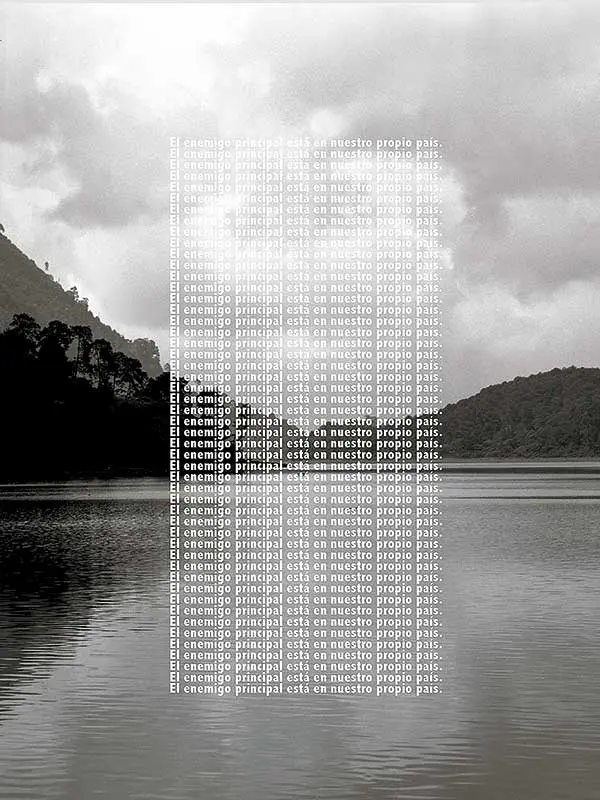
“The main enemy is in our own country” is one of the phrases that Mexico City-based artist Óscar Farfán (Guatemala, 1973) uses to intervene his own photographs of the Necaxa dam, one of the enclaves of the labor movement in Mexico.
This historic site is home to the first Latin American hydroelectric, a milestone of Mexican modernity that was initially a private company but was eventually nationalized and given the name Compañía Luz y Fuerza del Centro. The marked inequalities and abuses against its workers during the beginning of its history gave rise to one of the most visible unions in the country, the Mexican Electricians Union (SME). The institution entered into bitter clashes with the federal government as a result of a 2009 decree by then-President Felipe Calderón to close the state-owned company and the collective labor contract of more than 44,000 unionized workers.
Óscar Farfán focused his creative efforts on the site of the dam and performed a visual exploration of the landscape and the territory. His project analyzes the political dimension of the place and its historical relevance. By delving into an aesthetic reading of the landscape, Farfán dismantles the layers of meaning that form it and problematizes the direct observation of the environment, introducing political questions that destabilize the harmless appearance of the place.
Open to the public from November 2014 to February 2015 at the Museo de Arte de Sonora (MUSAS) in the city of Hermosillo, the exhibition consists of a display of images in various formats and media that fragment the historical narrative of the dam and its relationship with the state-owned company. Without falling into a scenography, Farfán successfully establishes an eloquent visual multiplicity that actives the memory of the site.
The exhibition consists of a triptych of slide projections of photographs that show the dam and its boundaries, forming repetition sequences of the same planes with slight variations that disarticulate the sense of continuity of the horizon along the landscape, a central element in landscape painting. A video installation shows lights going on and off intermittently—an allusion to the outage generated by the presidential decree—in the auditorium of the Electricians Union’s headquarters in Nuevo Necaxa, along with two other videos showing views of the dam that, although established from a conventional aesthetic conception, raised questions to viewers by absorbing the political content that is part of the rest of the exhibition.
A fortunate display on work tables showed photographs of the dam intervened with repeated phrases from Leon Trotsky’s Transitional Program, which the communist leader presented in 1938 at the founding conference of the Fourth International.
The project is complemented by a wall with archival images of the hydroelectric that are accompanied by stories gathered by a former employee of the Compañía Luz y Fuerza del Centro, Wilibaldo Martínez. The stories narrate the uncertain lives of the town locals and former employees, after the abrupt closing of the state-owned company. Here Farfán introduces a powerful dimension of self-representation.
Through these devices, the artist explores a modification of the conventional notion of landscape and proposes instead a symbolic decomposition in which the visible obliterates that which truly shapes the territory and cannot be observed with the naked eye: its political and historical sense. Through a strategy of repetition, Farfán achieves what he defines as “a documentary that through repetition attempts to modify the meaning of the landscape.”
This element of repetition—which structures the entire project—suggests a fundamental problem with the image: the political dimension contained in its aesthetic constitution. It has been suggested that the subversive power of the image lies precisely in the likelihood of its repetition, and this is its most withering significance. In the words of Gilles Deleuze: “Repetition is the transgression. It calls the law into question; it denounces its nominal or general nature in favor of a deeper and more artistic reality.” The possibility of the image flooding the symbolic reality with multiple iterations creates a significant imbalance that threatens to dismiss the prevailing structure of the law.
This subversive power is explored through the printing of a newsletter that accompanies the project and that appropriates the cover of the magazine Solidaridad, a publication of the Revolutionary Union Movement that was published between 1930 and 1980. The pages of the Gazette repeated the images of the work tables which in turn repeated Trotsky’s phrases: the effect is a ghostly communist resonance that fades as a propagandistic impossibility.
The exhibition is the result of a larger project that has been presented twice in the course of two separate occasions and in a different manner: at the Casa Rafael Galvaán, in Mexico City, and at El Parqueadero of the Museo del Banco Nacional de Colombia in Bogota, both in 2013. The entire project addresses in a critical manner the troubled relationship that the neoliberal government has established with the unions in an effort to dismantle them. It is from this perspective that Óscar Farfán’s proposal relies on the landscape as a dislocating tool to activate the individual and collective memories of the cases affected by these policies.
OSWALDO RUIZ