
Let’s begin with a seemingly obvious question: Why the title? Micromegas. A fanzine accompanying Pablo Vargas Lugo’s solo show at Museo Tamayo Arte Contemporáneo (Mexico City) explains: “Micromegas is the name of the young inhabitant of the star Sirius, the protagonist of Voltaire’s 1752 novel of the same title. Voltaire imagines Micromegas traveling with a resident of Saturn all the way to Earth, where they dialog with a team of wise men, even though Micromegas and his Saturnine companion are giants in comparison to humans.”
So it is that for their own interstellar journey, Pablo Vargas Lugo and curator Cuauhtémoc Medina chose, with almost surgical precision, an intricate composition of works by the artist (the show does not follow a retrospective or chronological pattern). Their selection works as a set of indices for the last (first) 10 years of the artist’s career. As though in Morse code, this journey punctuates nodes between consistent linkages and creative temporalities.
Returning to the literary narrative, we could say that Pablo Vargas Lugo is a “character” in himself within that other plot (this is to say, the national and international art scene), nurtured by a plot of his own. A relational condition that in his most recent works becomes expandable to a third party—the viewer—who exercises his or her position and dialogic “right” in the act; step by step. Entrenching their position, breaking down their everyday walking as if forced to, and thankful for the turn to silence, firm, cautious—even methodical—and in the process fine tuning their path with full certainty. Exactly in the way, Vargas Lugo has given shape to his career.
To continue with the relationship between title and artwork, it must be noted that the artist’s work would become/becomes (literarily, but also as matter) shadow or echo of the giant Micromega: Vargas Lugo’s artistic “immensity” is subtly contained and aesthetically distilled, its destiny the formation of a kind of controlled happenstance (almost always his themes seem to overtake all human capacity). This exhibition makes possible a factual understanding of the creation of his “originary” (in the way someone creates an “imaginary”), alternative to the as-signed origin(s).
The show also confirms the solidity and coherence of Vargas Lugo’s body of work, formally and conceptually supported in such a variety of formats and techniques as required by the nature of his themes.
Now, it is necessary to clarify that the visible solidity of the works does not represent the seriality to which the artist adheres by prefiguration; neither does it force the viewer into an organized, integral aesthetic-cognitive tracking of his career. In fact, actually, the opposite happens.
A second question emerges, then: How does Vargas Lugo make us ignore or forget, even if only for a few minutes, everything else when faced with each one of his works?
The answer is as unexpected as the event that triggers it. We say that to stop underneath his Mariposario (2011-14) is assumed as a first reaction to memory loss; it does not suggest a thematic, conceptual, contextual, or technical disconnect in the artist’s oeuvre. It implies that, in spite of his agile interweaving of years and creative processes, the aesthetic experience that each one of Vargas Lugo’s convokes, takes place inasmuch as it is one for each. In this de/recoding, more than a hundred butterflies identified by the artist, reinvent their wings as geometric and colorful patterns, the fragments of which hang from the tree in the back/exterior section of the museum. As though we’d forgotten or lost uncounted nations—perhaps evident now only in their (in)visible existence—Vargas Lugo’s wings/flags (un)position us between hundreds of different regions of our perceptual-mnemonic capacity, leaving as their register new visual codes that erode the certainties of our old knowledge. Each work is a unique, endemic, invaluably fragile species since it offers itself up fully exposed, revealing the accumulation of genius from which it emerges. It is there, in this imprecise yet undeniably localized space-time, that the body bears witness to another presence before itself—a complex condition of invoking without over-evincing the gesture. Vargas Lugo achieves this fully in works like Ombligo (2010), whose center—embroidery uncovered—attracts not only the gaze but the inflection of the body in order to receive and give itself; accounting records as mathematical/manual exercises knotted into the various Quipu (2014); this is how he perceives and confesses, without fail, the echo of existence—astronomically and in a way that both is proper and can be appropriated—in the series Sombras para cráter (2007).
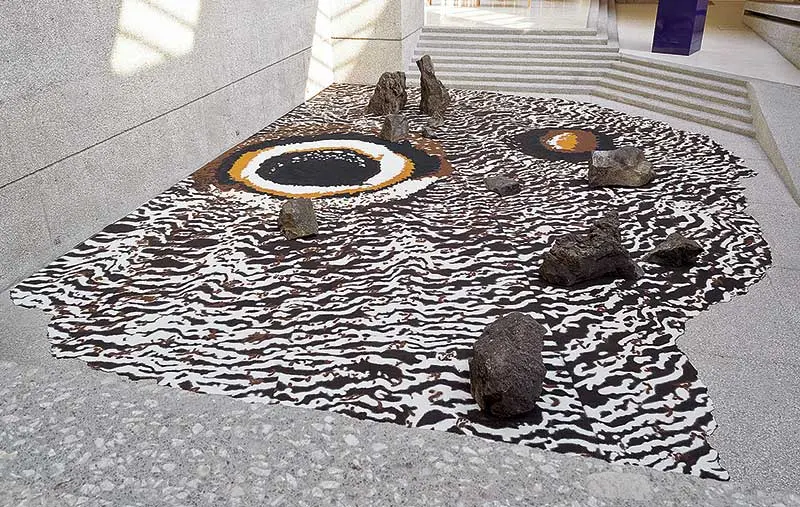
The cognitive process that animates Vargas Lugo’s work rests in an imaginative epistemological methodology that fluctuates between the painstaking care of a positivist scientist and the overwhelming passion of a Nineteenth Century collector. However, the “timeless contemporaneity” with which he “bodily” resolves each one of his detailed and exhaustive investigations, shortens the temporal, disciplinary, perceptual distance in/between the experience—his, ours, and his referent’s. Works like Jardín de piedras (Caligo eurolichis) (2014) bring forth the cancellation of the distance between memory, the work of art, and that which is rememberable; they free themselves from the chronic tenor that, like a fatuous fire, imperfectly illuminates fleeting works.
At this point, the third question seems evident: How can we know that a work of art is capable of “shortening” that “mnemonic distance”?
Were there a single answer, the works gathered in Micromegas would respond to the literalness of the word that names it—assuming each “element” (piece) of the equation, like bodies settled into a successfully ensured immobility. When, in the face of this obscenely tranquilizing reaffirmation that envelops a pre-solved dynamic between work of art and market; between the “creative will” (pace Nietzsche) and the variants of fashion; and the fervors of a kind of curatorial-collector “judgment”, the art of Pablo Vargas Lugo de-pressurizes such symptomatic equations. His works—which we approach devoid of memory—have come to pass in a continued reconfigurable state of variable cadences-by-concentration between (sub)atomic explosions whose sensible intelligence comes from a mind apprehended in its inhabiting of a body that creates, only and always, for the first time.
MARCELA QUIROZ LUNA