
One of the most audacious and irreverent creators of the Chilean cultural scene, Pedro Lemebel died on January 23. He was born in 1952 in La Legua, a working class neighborhood in Santiago. He earned a teaching degree in Fine Arts from the University of Chile.
Lemebel and Francisco Casas founded Las Yeguas del Apocalipsis art group in 1987, and his other prolific career as a writer earned him the 2013 José Donoso Ibero-American Literature Award.
In 1986, Lemebel attended a meeting of the Chilean left “wearing high heels and makeup with the image of the hammer and sickle on his face” to give a lecture on his manifesto "Hablo por Mi Diferencia" (I Speak for My Difference). It was a transgression and display of courage that catapulted him to fame. This provocative intervention at a public event was repeated in 1988—this time alongside Casas as a part of the Las Yeguas del Apocapipsis art group—during the Pablo Neruda Award Ceremony in which poet Raúl Zurita was recognized. The pair then offered a performance titled A Media Asta (Half Mast) during the presentation of Carmen Berenguer’s eponymous collection of poems at the Parque Forestal Book Fair, where they appeared dressed in the colors of the flag and dragging a black veil in mourning for the dictatorship.
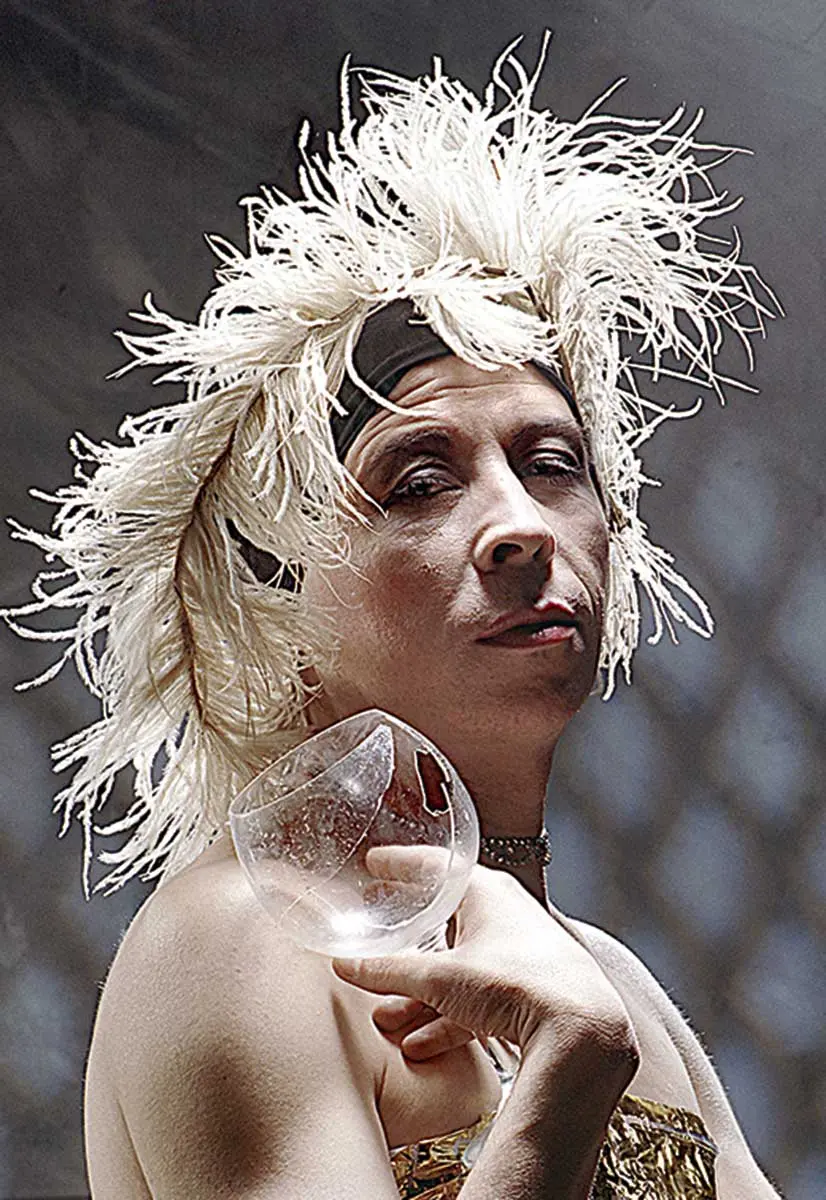
Las Yeguas del Apocalipsis stormed the Santiago cultural scene with the strength of its countercultural fate. They attacked sexism and double standards and made political art. They desecrated the rituality of the art institution and the bourgeois tradition of the last name. They articulated their poetry from the body—the homosexual body, the tortured and disappeared body—more as a liberating and socially critical action than a conceptual one, but still used references and parody.
In 1994, Lemebel participated in the Stonewall march through the streets of New York to mark the 20th anniversary of the gay movement, with his head haloed by a ring—in the style of Frida Kahlo—of hypodermic syringes and posters that alluded to AIDS.
The impact of his works was still felt in artistic circles when I visited Chile in preparation for the 6th Biennial. In that edition, centered on the theme of memory, the work by the group was paradigmatic in their references to the recent history of Chile. The outdoor Patio of Centro Lam hosted their conference-performance framed by a backdrop curtain that had the legend “I speak for my language, my gender and social popular” written on it.
Empowered by events, Lemebel challenged authoritarianism and prejudice from his artistic and political activism. In his work blood spoke about the pain and fire of the consummation of the act or end of being alive, as observed in Abecedario (Alphabet)
Taking advantage of the stable nature of the cancer that he suffered, on the morning of January 11, 2014, Pedro Lemebel made his last performance: he rolled naked inside a wet sack down the steps of the Museo de Arte Contemporáneo previously lighted with neoprene: he was unharmed. That action would decide the title of his retrospective Burn organized by Sergio Parra and Pedro Montes at the Galería D-21 from November 2014 through January 2015, with works produced from the 1980s to today.
More information is available at:
www.artnexus.com/pedrolembel96
Also in: Pedro Lembel, Galeria Departamento 21, ArtNexus 96, página 130.
MARGARITA SÁNCHEZ-PRIETO