
Days after it ended, the exhibition To Burn by Pedro Lemebel acquired double significance. On the one hand, it was the first exhibition that emphasized the performances that the Chilean chronicler created by himself and not as part of a group. Of the major Latin American voices of recent times, Lemebel had been recognized in the contemporary art scene for his work as part of the Yeguas del Apocalipsis group—a duo formed in the 1980s with Francisco Casas that burst onto the art scene with actions to vindicate homosexuality amid the political trance in a country transitioning from the dictatorship to the restoration of democracy. This ephemeral and poorly documented production, today legendary, which ended in 1997 with the group’s participation in the Sixth Havana Biennial, has recently been re-evaluated, in Chile and internationally, in venues such as the Museo Nacional Centro de Arte Reina Sofia in Spain (2012) and at the 31st São Paulo Biennial in Brazil (2014). However, Lemebel’s solo work with the body had not been seen beyond his public incursions as a writer in ceremonies and events, always heavily made-up, wearing high heels and colorful scarves or costumes as symbolic as a necklace made of disposable razors.
The exhibition, which ended on January 8 of this year, was an effort to collect works from the 1980s to this day that would convey certain strategies, recurring elements, and new readings. On the other hand, the show also represented the last exhibition in collaboration with the author of this text. Lemebel died on January 23 of this year at age 62, a victim of cancer of the larynx.
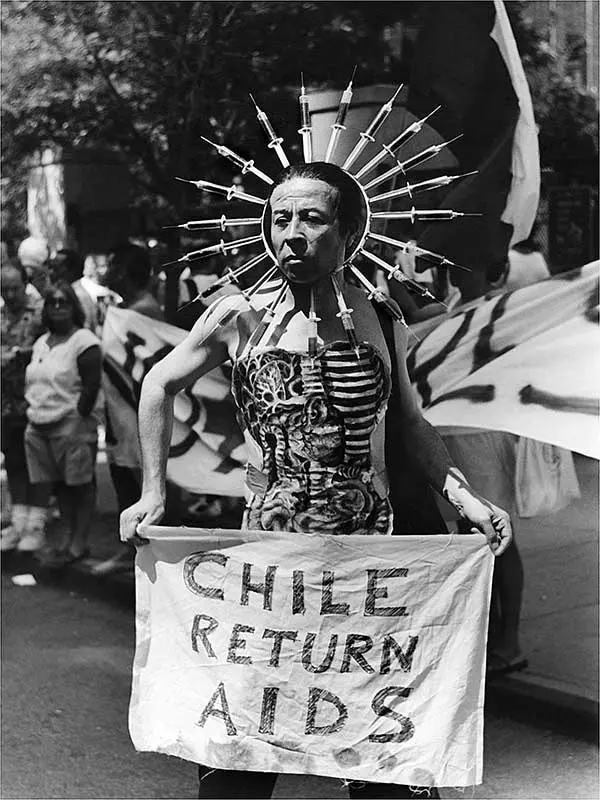
The exhibition offered some photographs of Lemebel appearing invested or cross-dressed. Like the one on the cover of the book De Perlas y Cicatrices (Of Pearls and Scars, 1988) in which he appears with that necklace and his face hidden. Or the famous image by the Yeguas del Apocalipsis referencing the painting The Two Fridas, their own version of Frida Kahlo showing the emphasized eyebrows, the stern face as a transvestite, and femininity as a parody of rage. Also telling is the image depicting Lemebel dressed as the Virgen del Carmen and where we begin to understand this desire to his of cross-dressing, hopefully in public. With the inclement brows and made-up eyes, in a rictus teetering between reproach and disgust, Lemebel perverts a catholic-military icon, the image of the “Queen of Chile and Patron of the Armed Forces.”
Lemebel uses the body as an instrument for the symbolic transgression of the established patriarchal order where the feminine and the masculine converge, breaking known signs in an almost grotesque manner, with kitsch perversion.
Presented in sequence, his last two performances of 2014 were displayed in lightboxes: Abecedario (Alphabet), in which the artist appears in rigorous black and wearing his emblematic high heels, moving forward across a footbridge right next to the Cementerio General, as he outlines with fuel every letter of the alphabet on the ground and then lights them on fire so as to leave only a charred line behind; and Desnudo Bajando una Escalera (Nude Descending a Staircase), in which he recorded himself in the nude and covered by a sack amid the flames that he ignited at the exit of the Museo de Arte Contemporáneo. This work in particular was a true act of immolation that was reminiscent of both Marcel Duchamp’s painting and the body of Sebastián Acevedo, a Chilean miner who burned himself in front of the cathedral in the town of Concepción during the dictatorship to protest the detention of his children.
Between the poetic and the political, there was also a sound intervention, a sort of homage to another victim of the military regime: Ronald Wood. In this work visitors could listen on a pair of headphones to Lemebel’s chronicle of this young student who died a victim of the repression; and a video in which Lemebel walks barefoot on a white sheet with his heels on his hand, leaving a footprint of blood with each step as he advances forward to face the vast sea of Pisagua, a town in northern Chile that used to have a detention center and where mass graves containing the remains of political prisoners were found.
While homosexuality, marginalization, and even biography are elements that flow in his literature more openly and in a more baroque and irreverent way, they are also persistent themes in the appearances that his body made in photography and in the context of the commercial gallery. But sabotage has operated here in other interstices, away from the impact of a disruptive act, in the silence of contemplation, in the poetry of an image that remained, as we are presented with constants such as the use of fire, the presence of blood and cross-dressing, as well as symbols of art history and contemporary Chile; in particular references to the violent repression of the dictatorship as if it was urgent talking about it, remembering it and even being immolated or burned because of it, despite the fact that the transition to democracy was attained years ago.
CAROLINA LARA