
Regarded as an experimental artist but, most importantly, as a pioneer in the history of video art and video dance in Mexico, Pola Weiss (1947-1990) like any other forerunner had to overcome several obstacles, such as few available spaces for the exhibition and promotion of her works, little credibility and scornful criticism from those who at the time did not consider video a medium with the potential to generate a new expressive language.
Much of her work remains unpublished to this day. This is the reason that the exhibition titled La TV te ve (TV Sees You) represents an excellent opportunity to make her work and thinking known. After several years of archival inquiries, researcher Edna Torres was entrusted with sorting and organizing the legacy of this artist, which consists of 38 art videos in addition to performances and videodances, numerous documents, photographs, slides, and negatives.
This archival material was donated for conservation and study to the Centro de Documentación Arkheia of the Museo Universitario de Arte Contemporáneo (MUAC) in Mexico City, where curators Aline Hernández and Benjamín Murphy developed an exhibition not intended as a retrospective but to promote an approach to the core elements that guided Pola Weiss’s creative processes.
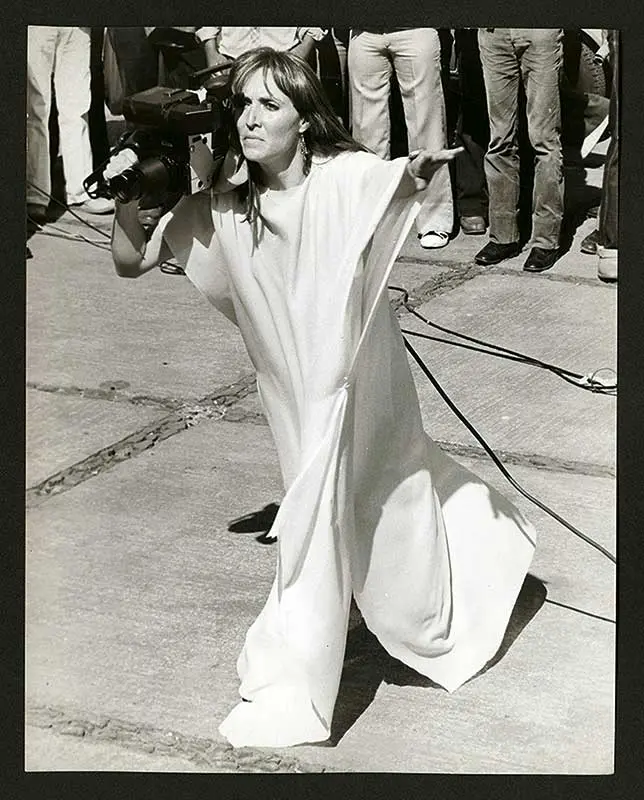
Born in Mexico City and with a background in English literature and communications, Weiss graduated in 1975 with the first video thesis ever presented at the Universidad Autónoma de México (UNAM). Arduous experimentation based on the use of video ensues.
In 1977, in New York, Weiss meets Korean artist Naim June Paik, who is considered the father of video art. His influence and the close relationship that Weiss develops with his wife, Shigeko Kubota, a pioneer of video sculpture in her own right, are central to Weiss’s continued interest in exploring video art as content, form, and a way to generate interactions with viewers.
In 1979, she exhibits nine works at the Centre Georges Pompidou in Paris, France, where her experimental efforts generate great interest in Europe, which resulted in subsequent invitations to the old continent to participate in over forty encounters and exhibitions centered on performance and video.
This exhibition, 25 years after her death, offers a selection of videos, posters, photographs, and materials that address the relationship between video and television from various angles, in order to approach her proposal as a form of the public sphere.
Taking the title of an article she wrote in 1978, TV Sees You approaches to video as a negotiation between the intimate and personal aspects of her life and, at the same time, her relationship with the mass media.
She proposes two dimensions: the subject that produces images and his transformation into the subject of the image. This particularly occurs in Weiss’s videodance performances, in which she carries a video to record the viewers, their reactions, and the environment from their perspective, while the action is also documented by another video camera. By carrying a video camera herself, she also generates another reflection in which a close relationship between body and technology is established.
Through her writings, Weiss defines herself as a teleasta (TV maker, as opposed to cineasta or filmmaker) and proposes the notion of a TV-based art of “present feelings” in which a connection between the artist and her audience is generated in real-time and space.
Her creations are based on an attempt to express everything that in her view is hidden in television. She relies on the technique of television but used it in the opposite direction to generate a communicative stimulus-response exchange, in order to—according to her—generate a new type of worldview.
To achieve a closer look at her worldview, the exhibition was divided into three sections: Pola Weiss, the Deployment of a TVmaker, in which viewers get a closer look at the central role that television played in her artistic career, as they seek to understand the various ways in which that medium was used as mass media in order to modify and expand the horizons of video art.
The second section, Towards a Synergy of Body and Video, delves into the relationship that Weiss established with video dance, the relationship between body and camera, and between introspective elements and the public sphere, as in the work titled Video Danza, Viva Videdanza (Video dance, Hurray for Video Dance).
The third section, Documentary Essays, explores the ways in which Weiss used documentary and film technical resources in some of her works, encouraging experimentation with reality and the imaginary. This is present in works like Cuilapan de Guerrero (1979) or Los Muertos de Etla (The Death from Etla, 1979); proposals that play with intimacy but also with reality and different ways of approaching it.
In addition to her videos and performances, her writings reveal her reflections and conceptualizations about her works and her own identity. This exhibition brings us closer to her world and her essence:
I am a TV maker above all else
Television and video art
Are to me, my other voice, my
Another gaze, my other self.
ISAURA RUIZ