
With the title Rafael Vega: Recent Works, San Juan’s Walter Otero gallery presented in April 2014 an exhibition of non-figurative art. It featured sixteen works in acrylic and aerosol paint on birch wood, some with incisions made by a circular saw.
Rafael Vega’s paintings contain images of diamond shapes, ovals, crosses, and rectangles of blurry contours that cover a large portion of the pictorial space and create the impression of receding in-depth or affirming the planimetry of the surface. The edges of some of his works show monochrome gradations in bands that contrast, in the subtlety, with the imprecision of the geometric shapes. The hues of those color ranges shine like flashes from the center of the composition.
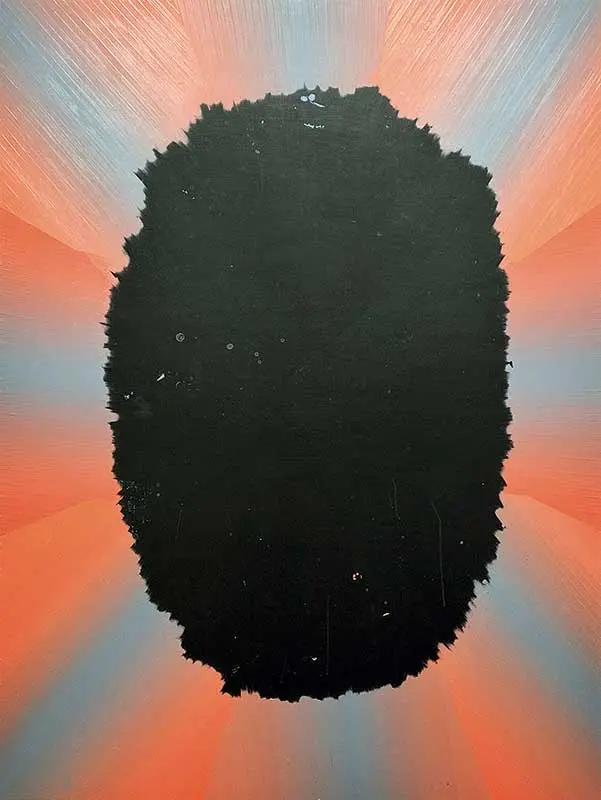
Vega creates a space suggestive of the infinite and the immeasurable through shapes that expand to insinuate a desire for freedom. His painting, even in small formats, tends to largeness and elevation, in the sense of transcendence. The version of abstract painting practiced by Rafael Vega seems connected to that of Kandinsky, Mondrian, Gorky, and Rothko, marked by a quest for spirituality and transcendence; in that sense, it is exceptional in Puerto Rico. Yet, Vega’s work is not guided by religious ideas. It is a unique exploration for a Puerto Rican artist educated in a formalist tradition and in a local cultural context where very seldom does abstraction evoke an obscure, profound, cosmic space suggestive of “sidereal landscapes” or places beyond the confines of the Earth. Cosmos and chaos, as order and vacuum, are—according to the definitions developed by the Greeks in Antiquity—antipodeans to what Vega paints. The vacuum insinuated by the dark space contrasts with the rigorous order of the edges that seem to dilate beyond the boundaries of the pictorial space.
It would seem that the various versions of non-figurative art, after a hundred years of centrality and irruptions at different points in the history of contemporary art, has disappeared thanks to some people’s intention of burying painting, and particularly abstract painting. The debates around the possibilities and specificity of the medium, as well as its representational function, confronted by some artists of the historical avant-garde and later by the New York abstract expressionists, culminate in a series of revivals in the late Twentieth Century and the early twenty-First. Today, after deep debates about the relevance of painting, it seems that it is back in its multiple variants, including abstraction, to validate the human. Rafael Vega understands painting as a way for the individual to be in the world. He seems to be telling this when he insists that “I want to see how I represent myself in the world, not how I represent the world.” His way of appearing, of representing himself, is through an image that reaffirms new, sometimes antagonistic processes. He paints with care and delicacy those portions of the image that show the range of colors. Yet he attacks with a circular saw, rudely and carelessly, the wooden surface of the work. Care and effort are the counterpoints to the aggression of the saw, which leaves a groove or a carving in the noble wood that the artist will later fill with pigment. However, the contrast described is not repeated in every work. Vega surprises us like a magician who had a different deck of cards under his sleeve. One of the ideas guiding his art is that of going after that which is uncomfortable and unexpected as the solution to a given work. Vega doesn’t rely on previously tried strategies, but constantly faces the work from a distance, filled with anxiety before the question of its resolution. His answers open the path for other, equally unexpected solutions.
INGRID MARÍA JIMÉNEZ MARTÍNEZ