
New York-based Argentine artist Raquel Rabinovich presented her first solo exhibition in fourteen years at Y Gallery in New York City. Her previous solo show took place in 2000 at the Trans Hudson Gallery, where she had several earlier exhibitions. For her return, Rabinovich includes two groups of works: one that belongs to her previous series titled Gateless Gates—oil, wax, and pencil on canvas, 1995-1997—and the other, River Library—mud from different rivers around the world on paper, 2002-2014—which is part of her new artistic production developed in this century. It is conflicting and confusing that the title of the exhibition refers to the first group, not only because it has almost no conceptual or formal relationship with the most current proposal, but also because it was relegated to the gallery’s last walls. So, the decision for the title would appear to respond to a desire to emphasize her works on canvas—which are more marketable—rather than her more recent production on paper.
Upon entering the gallery, viewers are welcomed on the left by an installation of eight small wood boxes displayed horizontally on the wall. These served as containers for small sheets of Essindia paper colored with very thin layers of sediment (mud) taken from the Ayeyarwady, Hudson, Urubamba, Ganges, and Mekong rivers. Titled River Library, the installation appeared in the list of works consisting of ten pieces, so two were missing. A few steps later, at a lower level, a long shelf slightly atilt displayed another series consisting of four open books titled River Library with Rivermaps, created with mud from the Nile river and pencil. These notebooks were displayed as if they were the travel logs of an expedition in time of flowing water.
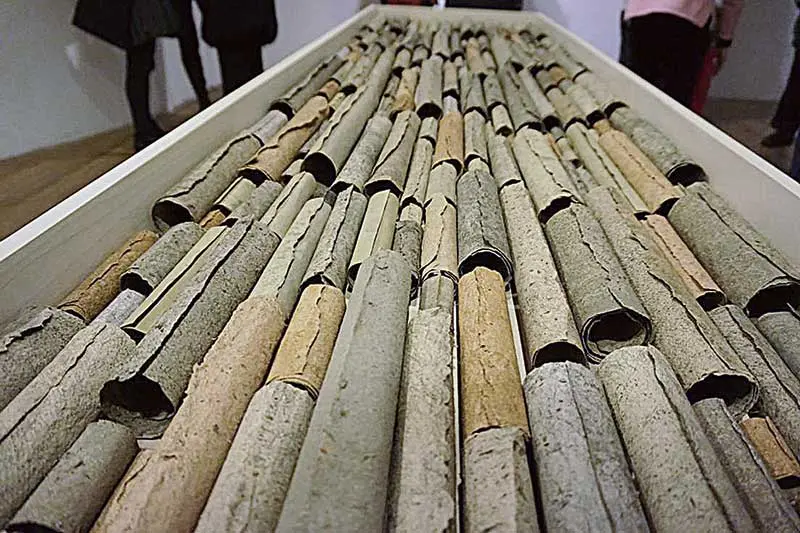
Rabinovich’s third and most ambitious proposal belongs to her most recent group of works. It consists of a long cabinet placed in the center of the gallery that contained countless rolls of paper. Reminiscent of historical scrolls, the papers were differentiated from one another by their color, length, thickness, and texture, which resulted from the materials used. Here Rabinovich again used sediments from rivers as pigments with which she achieved peculiar colors. Besides the bodies of water already mentioned, the work also included the rivers Imjim, Tarangire, Mississippi, Menderes, Paraná, Urubamba, River Plate, Arno, Orinoco, Tarqui, Rio Grande, Jordan, Ayung, Sunga, Campuan, Araucania, and San Julian. With such a collection of samples, Rabinovich evokes the vastness of a natural universe that it also finds poetic resonances on the memory, history, and culture of mankind. Renouncing the iconographic anecdote, the artist however does not discard the metaphor of the river sediment as a record of the passage of entire civilizations. She gives her work meaning through the symbolism of materials rather than through specific stories. Nonetheless, viewers are able to imagine such narratives in the abstract language of the scrolls and the coarse surface of the paper notebooks.
The three remaining walls of the gallery were dedicated to the paintings from the series Gateless Gates, gray monochrome paintings of equal dimensions but arranged in groups of different sizes with the legend “Gateless Gate” inscribed on them. The works on paper and these paintings have a connection that is more metaphorical than thematic: namely, the processes of accumulation of glazes that on the paintings are created with oil and wax, while on the paper are sediments of rivers. Another aspect they share is an emphasis on subtlety, something that greatly interests Rabinovich. Like the sheets of the river maps, the paintings forced viewers to concentrate on the very fine ribs of the pigment or on the graphite applied on the canvas.
It is not that Rabinovich has been totally absent from the New York art scene, since her work, after all, has appeared in numerous group exhibitions. Nonetheless, the fact is that her most important projects during this period of her career have been presented in outdoor locations alongside the Hudson River, which historically—along with the homonymous valley—has been a source of inspiration for artists and writers. These projects consist of in situ stone installations that Rabinovich places on the banks of the river so that they are covered or uncovered by water according to the variation in the water level. Rabinovich has called them Emergencies, having made the first one in Rotary Park, in Kingston (2001), and later in Dutchmen’s Landing Park, in Beacon (2002), and in Nyack Beach State Park, in Nyack (2007), among others. The exhibition is important because it presents for the first time in the city works that the artist has created in parallel with her in situ installations. Therefore, the show would have been significantly enriched by including the documentary video made by Camilo Rojas that shows the modifications made to the Emergencies installation.
Y Gallery is an emerging and modest venue that has been doing a commendable job with Latin American artists for whom it has been difficult to find venues to showcase their work in the city. However, it is possible to employ more subtle signs so works like these are treated and showcased more adequately.
ELVIS FUENTES