
The young artist Rodrigo Braga turns photography and video into borderless visual narratives. A scenic style, highly crafted, and even a suggestion of sculpture are included in his act of creating multiple images and sounds, where the boundaries between languages are tenuous and feed each other. Photography and video function more like methods than aesthetic genres. His seal is a plurality.
In a recent exhibition titled Agricultura da imagem, presented at Sesc Belenzinho in São Paulo, Braga reasserted his position and deployed the concept coined by renowned Canadian artist Jeff Wall, who divides photographers into two categories: hunters and farmers. This has been the largest exhibition, with 32 photographs, three videos, and objects found in the course of Braga’s field research.
“According to Wall, the hunter-photographer captures images she finds in the world, and the farmer builds them before photographing them. A work process that is constant for Rodrigo, who seems to be searching for images that already exist in his head, a permanent magnetic déjà-vu,” notes Daniel Rangel, curator of the exhibition (which was conceived by the ICC – Institute of Contemporary Culture).
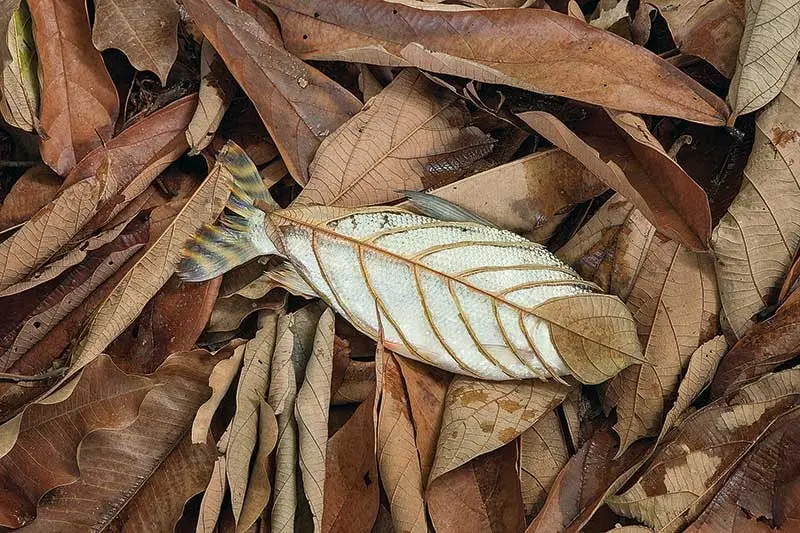
Braga frequently uses the resource of construction and montage in his works. A singular creative method became the mark of his career as an artist: he goes to natural environments in search of scenes and elements for the composition of his photographs and the realization of his videos. His immersion in each location lasts for about a month, during which, working alone, Braga selects the landscapes to be featured in his photographs and combines elements found along the way such as leaves, rocks, and flowers, as well as others he purchases in local markets and fairs, like animal skeletons.
For his latest exhibition, the photographer explores Rio Negro in the Amazon region, the coast of Pernambuco, and the waterways of the Tijuca neighborhood in Rio de Janeiro. “I work with the concept of mimesis,” he says. During the conception of his photographs, Braga combined those elements and showed the ways in which they complement and resemble each other. A fish can transform into a leaf and a leaf into a fish. For this exhibition, Braga gathered fish left behind by fishermen or found in the low tide. The use of skeletons, a mark of his work, also helps him portray the cyclical meaning of death, transformation, and integration, so present in nature and in this show.
“My photographs are fictions, entirely produced,” Braga, the winner of the MASP Emerging Artist Award in 2013, explains. “I explore the region in order to find inspiration, and in my notebook, I make drawings that will later become the final work.” Those sketches were on display in the exhibition, which featured a kind of artist’s cabinet where the viewer could see Braga’s creative process.
Rodrigo Braga was born in Amazonas in 1976, moved at the age of two to Pernambuco, and lives in Rio de Janeiro since 2011. His travels around these three states during the past four years, and his experiences with different biomasses and cultures in each, serve as inspiration for his work. According to Rangel, “Rodrigo’s relationship with nature is even more direct in his audiovisual production. In his performance actions, where the videos originate, he seeks a direct dialog between man and nature.”
Graduated in Fine Arts from the Federal University of Pernambuco (UFPE), Braga has seen his work be included in collections such as the Museu de Arte Moderna in Rio and the Museo de Arte Moderna in São Paulo. He participated in the last editions of the São Paulo Biennial and in the Cerveira Biennial, in Portugal. In 2012 he won the Pipa Visual Arts Prize in the Popular Vote Exhibition category.
Despite his multidisciplinary language, Braga’s education in fine arts strongly dominates his work. Spatial composition, color, and texture are elements that this masterful farmer of images always takes into account. In a good number of his works, he is one of the main characters, always in a profound relationship with the environments and elements portrayed. His poetic force resides in a visceral vision of nature and its connection to human beings.
What can we say when the artist lays down in a boat, on a blackwater river, and rests with his eyes closed in the bosom of a large fish that is trying to breathe? Intense and profound actions had him filming his mud-covered arm trying to get into a crab hole, alongside the crab, all always at the pace of nature. In communion with a visceral organicity, the artist’s body mingles with parts of dead animals in scenic photographs, as in the ironic sequence in which he appears nude and embracing an ox, both lying down, or even with their pained heads. From his craft of farming images emerge what seems to clamor for our most profound and savage ancestral condition.
ALESSANDRA SIMÕES