
Sometimes it seems Sebastião Salgado is a giant—literally as well as metaphorically. He often looks over earth from a high vantage, snapping images tinged with the celestial and charred by the infernal.
In an interview with Ken Lassiter, Salgado famously said, “If you take a picture of a human that does not make him noble, there is no reason to take this picture. That is my way of seeing things.” This latest work represents a departure from his earlier series on famine, displacement, and manual labor. But the trademark lyricism he found in strife and suffering is ever-present in these new idyllic scenes.
The subjects of 238 black and white photographs displayed at ICP (and traveling extensively) are pristine landscapes and the indigenous peoples, animals, and plants that inhabit them. The colossal, culminating project named Genesis was realized over a period of eight years and is divided into five geographic sections. The Brazilian photographer’s wife Lélia Wanick Salgado curated and designed the exhibition.
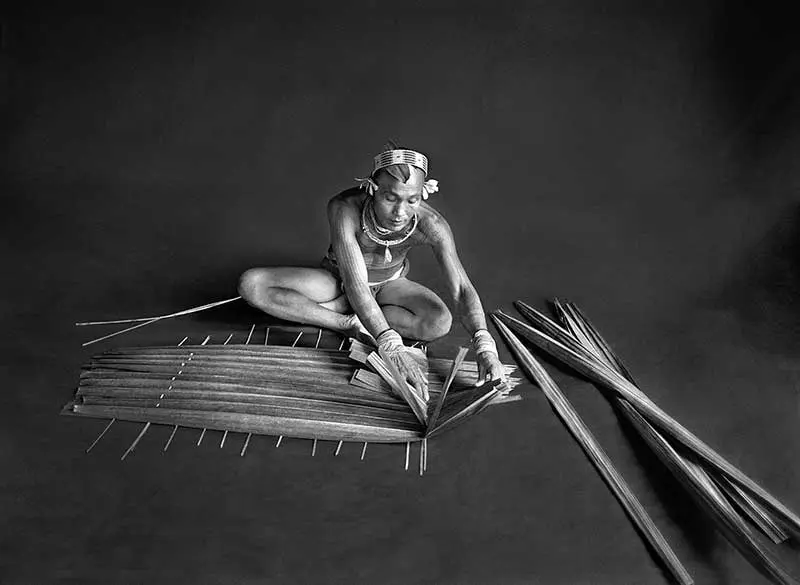
The aim was to portray the planet’s still unspoiled areas and thereby stir our collective consciousness. True to its Biblical name, Genesis is a spiritual endeavor. It is a Sistine Chapel for our age. Salgado appeals to our aesthetics but he also appeals to our sense of duty.
Entering the “Northern Spaces” section the first caption stated: “Bighorn Creek in the western part of Kluane National Park, Canada, 2011.” In this horizontal print (35.4 by 48.4 inches), black and white contend in alternating ridges of rock and snow that stretch to the horizon. Rhythmic and mesmerizing, the glacial scale imposes a sense of immersion. Looking over the scoured valley, our orientation in time and space is altered, our perspective enlarged.
Striations and marked contrasts are recurring motifs. Following the Nenets of the Siberian Arctic, Salgado took sweeping aerial shots of reindeer herds. Below, black dots stretched out over miles of snow, slashing across the picture. In a closer shot, reindeer walked several abreast, forming banded columns, their contours flickering against the endless white.
Viewed abstractly, the images can form geometric tropes. In several photos of African Dinka cattle farmers, big horns form surprising circular patterns as they emerge from burning cow pat smoke. Galloping zebras appear through slatted planes of dust. A magical, wind-carved ice castle’s right angles challenge the possibilities of nature.
Salgado always imparts an overall auratic effect, often using backlighting. The tones become so warm they can look hand-drawn. In a group portrait of Kamayura (Amazonian) shamans, the background falls away into dramatic shadow, propelling the figures forward and enveloping them with mystical dignity. Given the subject matter and technique, these depictions can evoke the uncanny sensation of viewing a three-dimensional diorama.
While a custodial and inventorial methodology structures the work, most of the photos are imbued with personality. Patience pays off as Salgado waits for a lizard to show up or a cloud to rest like a cap on a volcano.
In a scene of a Korowai man drinking from a brook (West Papua, Indonesia), Salgado’s compositional élan is evident. Framed by broad leaves, the kneeling figure’s longbow is slung across his back activating a compelling matrix of diagonals. Not all of the work is so singular and the show could have benefited from more discerning editing.
In subject and format, the style is overtly anachronistic, referencing the work of Ansel Adams and socially committed photographers like Edward Curtis, Lewis Hine, and Dorothea Lange. Salgado echoes the ethos of what Cornell Capa called the “concerned photographer” — and to great effect. Unsurprisingly perhaps, Salgado’s been criticized for making images some see as formulaic and sentimental.
The art versus reportage dialectic has been admittedly problematic for him. But there is no doubting his activist impulse and political impact. His work about African drought resulted in his becoming a board member of Doctors Without Borders.
By and large, the collection is a gorgeous tour de force. It reflects the optimism of a heroic vision. It’s a real treat for viewers, a global holiday. Simultaneously, it’s a grave attempt to instill morality and foment change regarding the environment and sustainability.
Regarding purpose, Vilém Flusser wrote: “The task of a philosophy of photography is… to think about how it is possible to give meaning to human life in the face of the accidental necessity of death. We need such a philosophy because it is the last form of revolution which is still accessible for us.”
Salgado is a revolutionary, fighting the good fight. In one of his most endearing images, a string of chinstrap penguins slips down an iceberg’s slope. The leader has already glided off toward the roiling sea below and is suspended in midair. It is easy to identify with the situational symbolism — we too are stuck between worlds, suspended by Salgado’s grand masterpiece.
JEFFREY CYPHERS WRIGHT