
Very interested in the photographic work of Sergio Fasola, a gallery owner announces through an emailed attachment the exhibition about this Argentine artist; not surprising given the quality of his work. An all-white wooden portal next to a windowed façade, in a very attractive neighborhood of the capital city, leads to a hall—formerly a garage—with antiques and some contemporary artworks, which in turn leads to a beautiful large space where Fasola displays his worlds of magical realism.
The Arthus Gallery presented a selection from Fasola’s series Painted Women, From the Countryside, Immigrants and Landscapes, a total of fourteen works, and a large table with catalogs and international magazines that provided the available bibliography associated with the artist. In this regard, according to one of several stories that emerged from the exhibition: A collector acquired two works, one that was part of the exhibition and another reproduced in Photo World-China—part of the literature mentioned. The article and interview in that publication were titled “Painting with Illogical Light,” a heading that accurately describes what constitutes the core of the technique and vision found in Fasola’s intense proposals.
Fasola was born in the province of Santa Fe, Argentina. After a period of intense work in Buenos Aires, not only as a photographer but also as a solid painter and successful television screenwriter—inventing stories about a character involved in ironic situations associated with Argentina’s political reality—he returned to Santa Fe where he currently lives and works. He continued working with analog photography while teaching himself to transition to the integration of the digital processes to achieve a distinctive mastery of that new media. Fasola has already won all the prizes that Argentina has to offer and has exhibited abroad on several occasions. He keeps a low profile and continues to focus on exploring all the possibilities of photography, painting, and also the three-dimensional object. What is the exhibition at the Arthus Gallery about?
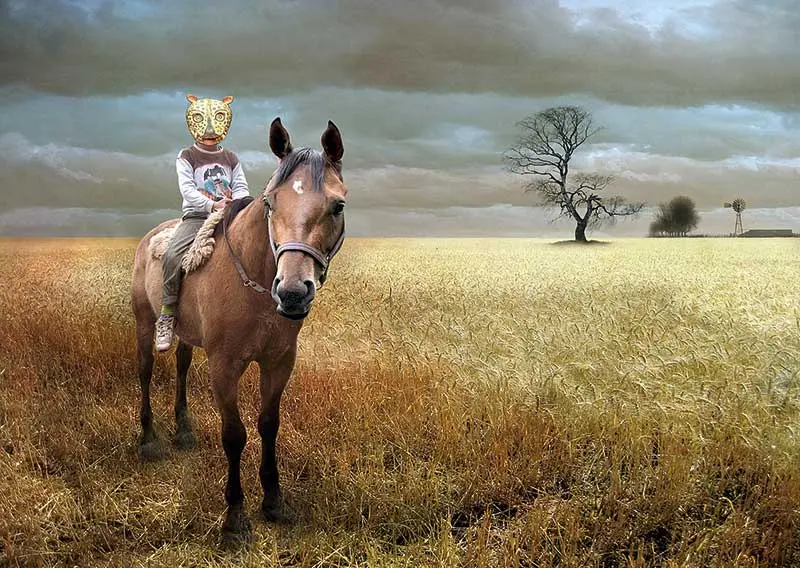
The Painted Women series includes references to the history of art from various periods. Fasola intervenes each image differently, in all instances including elements that offer clues to the work’s recent creation. Landscapes is a series that attains chromatic lucidity and where the artist incorporates the ecological elements he has focused on before. Only that now he approaches them through the lens of minimalism or land art, with the elegant humor that characterizes his work. If creating atmospheres is something that distinguishes Fasola’s work, here in his depiction of broad daylight scenes, he confirms that it is one of his most valuable aesthetic gestures. Each of the photographs captures the synthesis of that which can be understood as landscape. The balance is perfect, but it is curiously achieved through several tensions that motivate and support each other. In the piece titled El Tigre (The Tiger), from The Countryside series, it is possible to visualize the world-renowned saying: “The Argentine countryside as the breadbasket of the world.” In this photograph, the promising grown golden field is accompanied by a stormy sky that looms over the scene. The equine lineage, the horizon only inhabited by isolated trees and loneliness, strengthen the scene that ends in the sharp tiger mask; a mask that contrasts the lack of indigenous roots in the southern country—as all the indigenous people were exterminated during the campaign of 1852—with the rich pre-Columbian cultures of other countries in Latin America.
The Immigrants series offers unusual points of view on Argentina and essential acknowledgments about the identity of the country. Once again by resorting to humor, Fasola confronts us with everyday life reflected through a mirror that adds spices to the known. The works Biutiful Buenos Aires and The Best Choripan are two relevant examples. The spelling errors in the former are on purpose, while in the latter the mixture of English and Spanish—which could even be called an idiom—represent the reality of migrants. People from neighboring countries come to Buenos Aires determined to find a better way of life. It is a sort of migration shown through the artist’s lens as an illusion prevailing over reality. The other side of the coin refers to the many Argentines that left their homeland without many options other than to usufruct the daily habits of cooking grilled meat, even if they shape it and give it an appealing name. And the grammatical errors on the poster menu confirm the point of encounter between those arriving and those leaving. That midway point leaves the illusion floating and brings everyone back to reality.
GRACIELA KARTOFEL