
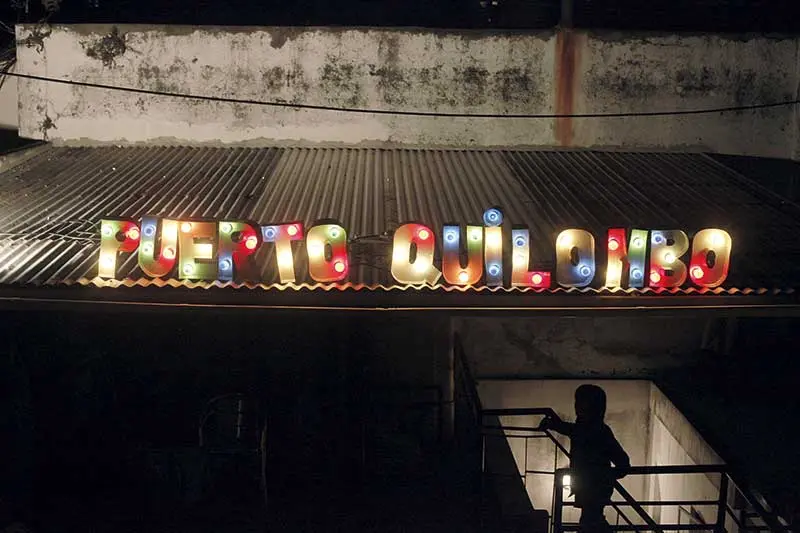
A precarious neon sign on the night skyline of a city of low buildings announced the arrival to Puerto Quilombo. A city imagined by Sub Cooperativa de Fotógrafos, a group of artists who have been working for over ten years in the vanguard of documentary photography. In this exhibition, their images expand and overflow the language to invade the space of the exhibition room 12 at the Centro Cultural Recoleta.
In the antipodes of the “white cube,” white-walled paradigm of a supposedly neutral space, Sub Cooperativa de Fotógrafos intervened the exhibition room with images of earlier large works that covered all the walls from floor to ceiling. On a white wall with the graffitied word dollar—a record of Argentina’s economic and social crisis of 2001—a group of intimate images of Latin American suburban experiences were mounted on a backlight. A mother helping her teenage daughter to dress, a couple tenderly kissing and a young mother and child inside their home were exhibited in lightboxes that appear as outdoor advertising.
As it was already mentioned, the new photographs were hung on billboards and arranged with some carelessness, not appropriately preserved they had suffered some damage as posters do in public places. This is not the first time that the Sub Coopertativa works with billboards; in October 2013 they intervened the streets of Buenos Aires with oversized portraits sought to question passersby on migration issues. These photographs were installed outdoors, exposed to weather and pollution, but also to the interaction with the street and those who live and travel in them daily.
Another billboard that covered the walls of the exhibition room depicted the image of the interior of a home on which family portraits, ornaments, and a mirror—showing the reflection of a woman’s face—were mounted. In addition, and continuing with the domestic imagery, a mirror that stared back at viewers placed their reflections in the same space as the woman portrayed. Something similar occurred in the exploration of the relationship between the photograph of a woman placed on a rusty metal sheet and the montage of this image in the show, on a sheet of the same format but without paint damage.
All of them, both the billboards and the images on backlight, documentary explorations as well as poetic images, were part of Puerto Quilombo. They constituted this imagined city constructed from various stories and experiences that the group gradually captured with their photos and creative pursuits in this language.
This group was formed in late 2004, in Buenos Aires, and consists of seven members: Gisela Volá, Nicolás Pousthomis, Gerónimo Molina, Martin Barzilai, Verónica Borsani, Gabriela Mitidieri and Olmo Calvo-Rodríguez in Madrid—who also work in collaboration with various journalists, historians, and designers depending on the needs of a specific project. For this exhibition, in particular, they once again worked with curator Victoria Verlichak. As indicated by the name of the group, they chose to highlight individual anonymity in favor of group work of a horizontal nature. They focused their gaze on historical events, social issues to suburban stories, updated by the questions of contemporary art that allows them to interpellate different spaces of movement and to develop exhibition devices that repeatedly break with the traditional model of presenting photographic works.
AYELÉN VÁSQUEZ