
A major solo exhibition of the work by Thomaz Farkas (1924-2011), one of the most important modern photographers in Brazil, was on display in São Paulo at the Luciana Brito Galería, the first gallery to represent him commercially since 2013. Curated by his son, João Farkas, and Sérgio Burgi, the exhibition was organized three years after the artist’s death. Occupying the two floors of the gallery, it consists of a collection of 100 photographs that allow for a panoramic view of the great commitment of this Hungarian-born artist who arrived in São Paulo at the age of six. The group of works by the photographer is kept on loan at the Instituto Moreira Salles (IMS). This exhibition includes a selection of works from the IMS collection along with images—some never before published—that belong to his family.
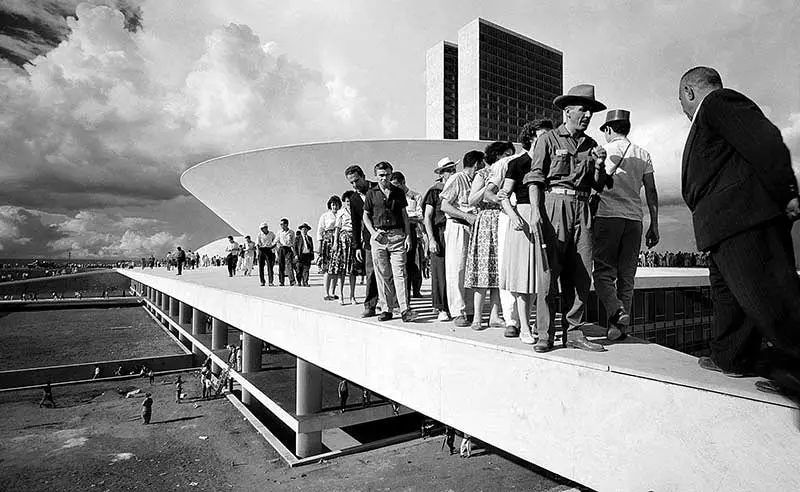
The exhibition offers a survey of an artistic production that expands over thirty years, beginning with his first photographic experiences in the 1940s. Standing out among the group of works are landscapes and urban scenes, architecture in Rio and São Paulo, images of the construction and inauguration of Brasilia, essays on ballet, popular culture in Brazil, and experimentation with filmmaking (works from the 1970s) centered on documentary cinema about everyday life and popular culture in various parts of Brazil, produced in organized trips that lead to the Caravana Farkas series.
Many of the photographs in this exhibition have never been shown before. They belong to the artist’s family and some of them were rediscovered by João Farkas as he searched his family archives. Rare photographs, vintage copies of ballet rehearsals captured by Thomaz Farkas at the Unión the Estudiantes (UNE), are displayed alongside works produced during the artist’s involvement with the Foto Cine Club Bandeirantes. These works reveal the great influence of photographers like Edward Weston, Ansel Adams, and Paul Strand. This influence is evident in the series of images of dancers that he photographed in 1940. Standing out among these photos are the images of María Angélica Faccini, a member of the UNE youth ballet.
The exhibition includes six photographs from the MoMA collection; images that reveal Farkas’s search for unusual angles, like the facade of the Ministry of Education in Rio de Janeiro, a close-up image of the dam of a hydroelectric plant, or the iconic image of the Mirador del Trianon, made in 1945.
The exhibition offers a look into Farkas’s creative process through the presentation of some original master copies in which it is possible to observe his notes for their reproduction, the quality of the reproductions, the type of paper that he selected, and the rigor of work. The images shown are small runs that ranged from 6 to 17 copies each.
One of the highlights of the exhibition pertaining to his cinematic experimentation is a historical record of a concert by Pixinguinha during the celebrations of the 4th Centenary of the City of São Paulo, 1954.
Thomaz Farkas was one of the first photographers to record the birth of Brasilia. In that series, he captures the beginning of the construction project and its development from 1950 to 1960. His gaze focuses on the workers as the central characters of Niemeyer’s epic architecture. He reveals working conditions, the migration effort, and an anthropological look at the population that rose and formed the new city. Even in the images of the inauguration of Brasilia, the focus of the artist turns to the village men climbing the ramp of Palacio de la Alvorada. In this manner, Farkas diverts the attention from the architectural element and directs it towards those who gave their blood for the construction of the new capital of Brazil.
The obsession of this photographer for the sector of the population socially and politically marginalized resulted in his incarceration in 1968, during the military dictatorship. The purchase and distribution of his documentaries in government-run stations were prohibited for presenting the struggles of the poor that the dictatorship did not want to show. These works are also included in this exhibition. Despite all the difficulties that were imposed on him for his aesthetically expressed political commitment, Farkas did not stop his work or expressing his convictions. Throughout the period of the dictatorship, the photographer insisted on focusing on the forgotten Brazil. In an expedition to the Amazon during the 1970s, he photographed coastal populations, and those images are also represented in this exhibition.
Thomaz Farkas, together with Geraldo de Barros (1923-1998), German Lorca (1922), and Gaspar Gasparian (1899-1966) formed a group that revolutionized Brazilian photography and established modernist photography in Brazil. They stood out in the Foto Cine Club Bandeirantes as the marginalized of photography, since they sought with their aesthetic proposals an escape from the standards set by academic photography.
The exhibition is accompanied by a homonymous book with more than one hundred reproductions and texts by curators and researcher Rubens Fernandes Junior, among others (220 pages, bilingual: English and Portuguese). The catalog was created by graphic artist Kiko Farkas, also the son of Thomaz Farkas.
Thomaz Farkas was the son of the founder of Fotoptica, a company that pioneered the marketing of photographic equipment in Brazil. His first solo exhibition was in 1949 at the Museu de Arte Moderna in São Paulo (MAM-SP). In the same year, the photographer had selected works for an exhibition at MoMA in New York, which at that time also bought seven of his works. Four times elected a Brazilian representative to the Photographic Society of America, Farkas was also crucial in creating the departments of photography at MASP and MAM-SP. In addition to the Museum of Modern Art, the photographer’s work can be found in collections such as the Pinacoteca do Estado de São Paulo, the Maison Européenne de la Photographie and the Instituto Moreira Salles (which devoted an anthology edited in 2010-11), among other institutions.
HÉLCIO MAGALHÃES