
Strength and softness have the same weight in the work of Tomie Ohtake1, the Japanese-Brazilian artist who for six decades has remained firm in her purpose of reinventing herself. This is what her most recent show, at Nara Roesler Gallery, reveals; there, Ohtake presents previously unseen paintings that explore monochromatic effects and optic games.
The highest expression of informal abstraction, the artist was born in Kyoto in 1913, arrived in Brazil in 1936, and only began her life as a painter at the age of 40. In the 1960s, after becoming a naturalized Brazilian citizen, she opted for informal abstraction. Since then, Ohtake prioritized a reduced palette, dominated by two or three colors. In that stylistic terrain, the artist devoted her efforts to constantly exploring the relationship between shape and color, composing variations of expressive poetic force, in painting, printmaking, and sculpture.
In her recent exhibition, Tomie extracts silence and rhythm from a minimalist universe, in contrast with the rigor of Brazil’s constructivist tradition. Be it with her seemingly chaotic brushstrokes that almost fuse the elements with the ground, be it for the almost invisible gestural concision in figures that stand out in the monochrome or the bi-chrome, the artist is able to impress subtlety and subjectivity on her works.
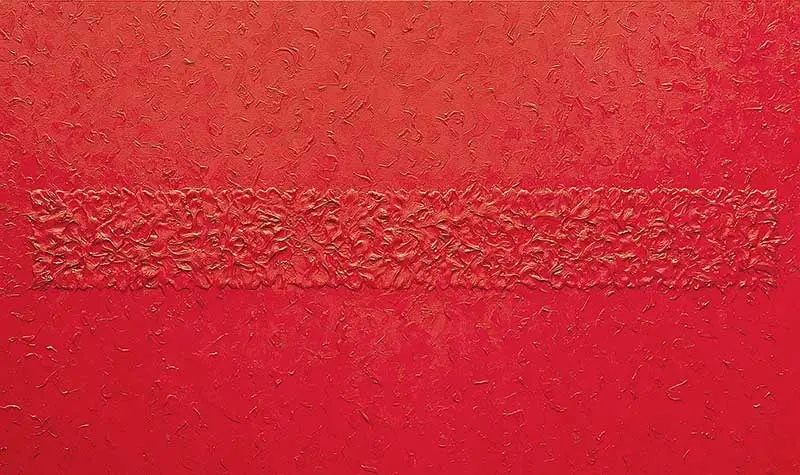
The pictorial possibility of taking the gaze by surprise revealed in the materiality and the density of the pigment is a constant in Ohtake’s career. The register of the visible brushstroke, in a play of rounded and rectilinear shapes, geometric figures, and blotches, results in optical effects suggesting shifting forms. Proposing variable relationships between ground and surface, the volume of pigment, and color, the artist enhances the trompe l’oeil effect on the basis of the monochrome.
Since the beginning of her career, Tomie has participated actively in the main art spaces, both nationally and internationally, and her presence is constantly widening. Her hundreds of exhibitions and awards attest to her popular charisma; her language attracts positive opinions both from the general public and from critics. An example cited often in the bibliography regarding her popularity is her first retrospective, held at the Museu de Arte de São Paulo (MASP) in 1983. Over 4,000 people attended the show’s opening. Tomie Ohtake’s relevance in the visual arts scene in Brazil was reasserted with the opening of the Tomie Ohtake Institute, a tribute to the artist in a building projected by her son, Ruy Ohtake.
The core of her style always includes an economy of elements and the maximum visual effect, conquering the viewer’s gaze with its surprise effect and tactile possibilities. These characteristics took shape in Ohtake’s work starting in the 1980s when she imbued her pictorial universe with diffuse features and cosmic references to natural elements and their organic shapes. Instead of fields of solid, closed colors, there emerged juxtaposed and superimposed blotches of color. Starting in the 1990s, transparency and depth were emphasized.
Ohtake also created a series of large-format prints, rendering them almost as objects. She began practicing silk-screening and lithography in the 1970s, and, according to critics, this helped revitalize her pictorial work, which gained curves and organic shapes. In her works dated from the 1980s on, Ohtake used a warmed range of colors and intense chromatic contrasts.
There are also large-scale sculptures for public spaces. Ohtake created, for example, the Estrella do mar (1985), placed at the Rodrigo de Freitas lake in Rio de Janeiro. After the 23rd São Paulo Biennial, when her sculptures were exhibited in a special room, her three-dimensional production has grown. She proposed unexpected interventions in urban spaces, producing large sculptures like Ondas, an homage to 80 years of Japanese immigration in Brazil, installed in 23 de Mayo Avenue in São Paulo. In more recent sculptures, Ohtake worked with narrow tubes that follow sinuous trajectories in space, as seen in the works on display in the cultural center named after her; their generous dimensions contrast with their delicate drawings in space and their subtle pendulous motion.
The main characteristic of Tomie Ohtake’s work is, precisely, the contrast between strength and delicacy, which is emphasized in the disturbing, ghostly ambiguity of her recent monochrome paintings. Nothing seems definite; everything changes according to the angle of observation. Ohtake builds her works reconciling the wisdom of the Eastern tradition with the visual experience of the modern subject, revealing an intense dialog between history and the contemporary moment. In her interviews with journalists, Ohtake always emphasizes the importance of Eastern art in her painting, especially Japanese art, saying that this influence is to be found in her search for a synthesis where a handful of elements can say many things. Ohtake also claims that what she makes is “silent painting.” A silence that nevertheless suffices to reveal the vigor of her art.
NOTE
1. Tomie Ohtake died on February 12, 2015.
ALESSANDRA SIMÕES