
"–Until this moment you had never considered what is meant by existence. I will put it more precisely. Does the past exist concretely, in space? Is there somewhere or other a place, a world of solid objects, where the past is still happening?
–No.
–Then where does the past exist, if at all?
–In records. It is written down.
–In records… And, where else?
–In our mind. In human memories.
–In memory. Very well, then. We, the Party, control all records, and we control all memories. Then we control the past, do we not? "
With this exchange between Winston and his torturer, characters in George Orwell’s novel 1984, Voluspa Jarpa invites us to her exhibition In Our Small Region of Over Here, presented during the month of October 2014, at Archivo Distrital de Bogotá. It is an attempt to continue exploring the meaning of those versions of history that we are taught as unequivocal and unalterable.
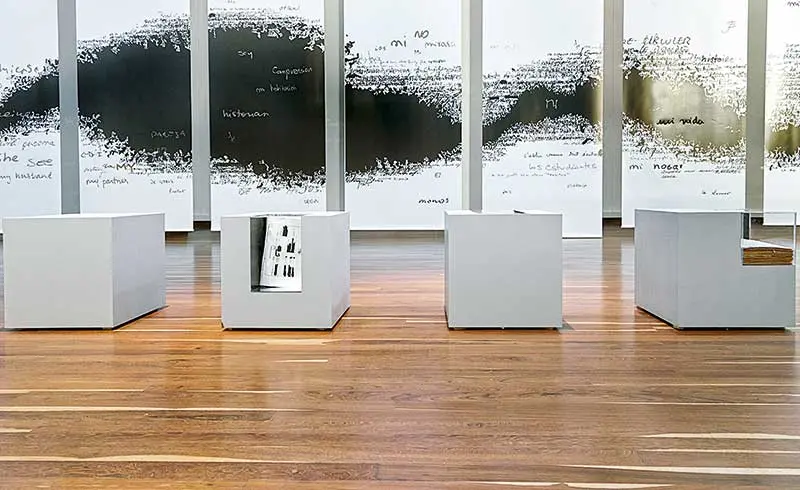
As if to conclude or expand a period in her career, the exhibition displays all the devices available to and from memory that the Chilean artist has ever used since the beginning of this millennium, in order to demonstrate the manner in which memories—and oblivion—are imposed. In the enormous and complex exhibition space of Archivo Distrital, Jarpa displays furniture charged with symbolism, historical photographs, declassified documents, a video, and a great 15-meter long backdrop.
In an installation that seeks to be narrative, Jarpa gradually reveals clues through documents that expose the assassinations of several Latin American leaders between 1960 and 1970—and even one in 1948, to include Jorge Gaitán’s murder—during a time of dictatorial regimes led by governments that were fearful of the “communist threat” or of the social positions advocated by communism. These assassinations were part of a well-orchestrated regional agenda that, as Jarpa pointed out during a lecture she gave in Valparaíso about the exhibition, was aimed at “maintaining control over certain economies that sought to gain control of important raw materials and, in doing so, went against the interests of the United States,” Her hypothesis is clear: “It is associated to the question of when and how it becomes possible to manipulate the course of history and for what purposes. What causes this in societies? What happens when the natural leaders of society are eliminated, who is left, and who are those who replace them?”
In other earlier compelling pieces that are central to her work, Biblioteca de la No-Historia (No-History’s Library, 2010) and La No-Historia (No-History, 2011), Jarpa makes sense of the insane amount of declassified CIA documents. She turns them into books, fragmented books, strikethrough or secret, dystopian or chaotic documents; books that become confusing images, like the memory which they are part of. Those who show an interest in them or try to read them will only have access to a version of history that will not be truly revealed and that is extremely difficult to access. Nonetheless, they are a relief, a revelation that was necessary to understand that black hole in national history. So much so, that those who have taken them have written to Jarpa about their reasons for doing so: “I will talk to my students about the things that have been hidden and give life to the words that have killed;” “Memory;” “For my partner (who disappeared).” Jarpa turns the sum of those words into a sort of drawings-stains, into a poetic translation of the drawings resulting from these declassified documents.
However, in Bogota that emotionality is not felt as powerfully, despite Jarpa’s use of virtually the same resources of her earlier works (in fact, the curtain of words from others is one of the pieces of this current exhibition and its reflection on the wall is powerful). Maybe it has something to do with the fact that Jarpa on this occasion presents five different pieces that ought to be connected but are not necessarily so. She offers one of her elaborated dossiers of archives that include, on the one hand, the utopian discourses of the aforementioned leaders and, on the other, the plaques with information about their collective funerals; followed by, in the nave, a wall with portraits of the leaders and, once again, images of them already dead. The curtain already mentioned is at the front. In the center of the room, there are several tables with open files and, on the opposite walls, enlarged copies of texts that reveal their contents. Added to this already complex piece—because of the large amount of information that it contains—there is Jarpa’s intention to quote/question Donald Judd. She breaks with the asepsis of minimalism by introducing an archive in one of her pieces of furniture that is impossible to read (as those declassified documents are to a certain extent). And finally, in the back of the room, a video depicts the artist taking an English class in which the reading material is comprised of the documents in question. In this manner, for instance, there is a letter that contains a request for information on the methods of torture used in Chile. It eventually becomes effective through repetition—as it is initially read by the professor, then by the student, and then back to the professor several times to be corrected and, finally, there is the matter of its translation, of viewers having to listen to the content.
It is an enormous cluster of information that is difficult to process and that, paradoxically, feels distant in the enormity of the exhibition room. In any case, once it is clearly understood that this exhibition represents an exercise of synthesis of a moment in her artistic career, Voluspa Jarpa will undoubtedly continue to work to express her concerns in the most poetic possible manner so each idea is threaded like a piece of embroidery.
DOMINIQUE RODRÍGUEZ-DALVARD