Bordering experiences marked the retrospective exhibition titled Imagetic by Brazilian artist Ana Vitória Mussi (1943), at the Palacio Imperial in Río de Janeiro. Navigating between fiction and documentary, journalism and art, aesthetics and ethics, and photography and video, Mussi’s works are the product of a long artistic trajectory that began in the great Brazilian press and continued with strong aesthetic production. Born in the southern Brazilian state of Santa Catarina and a resident of Rio de Janeiro since the 1960s, Mussi revealed in this exhibition the motif that has been part of her work for decades: the relationship between violence and media culture.
The exhibition, which took up the entire third floor of the Palacio Imperial, presented works never before exhibited along with pieces from Mussi’s personal collection, all of which cover the period between 1968 and 2015. Twenty works displayed in four exhibition rooms included installations, photoserigraphy, and objectual photography, among other media. According to Adolfo Montejo-Navas, curator of the exhibition alongside Marisa Flórido-Cesar, the exhibition “represents decades of visual deconstruction that offer numerous images on a variety of supports.”
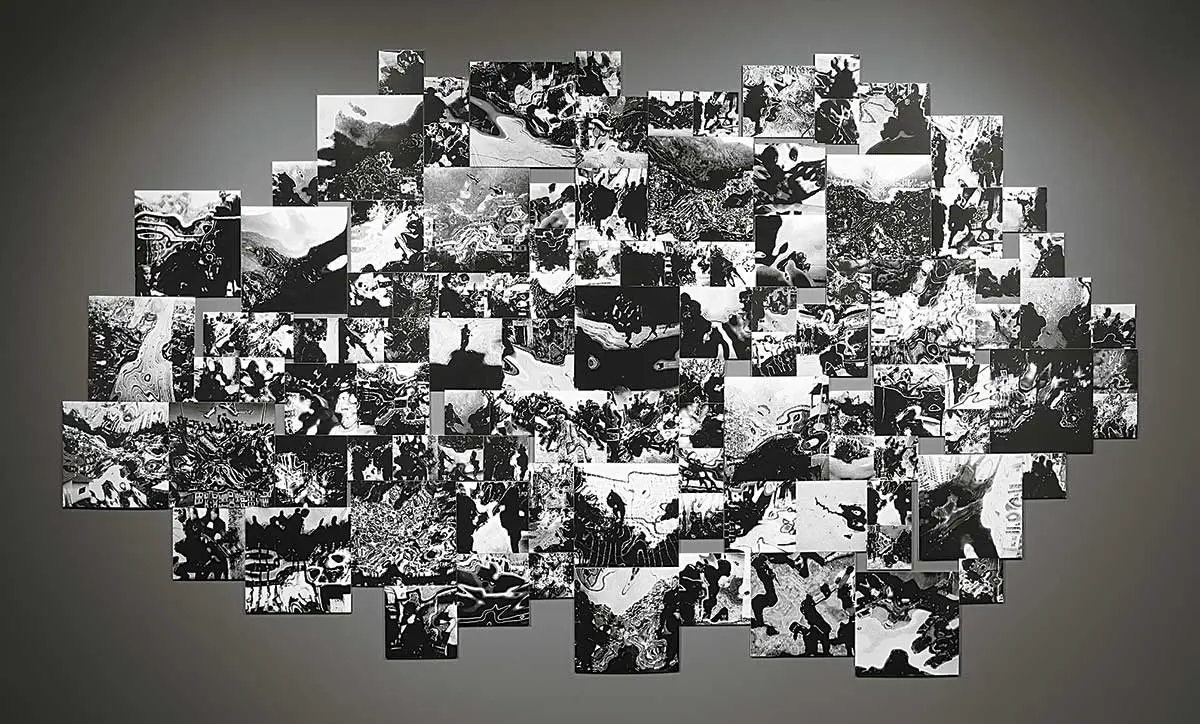
The themes suggest the influence of Ana Vitória Mussi’s journalistic background: the trivialization of violence, tragedy as a spectacle, visual violence, the frenetic urban iconography, and so on. They are rescues achieved through an inventory of images that discovers repetitions over time. “I see patterns and relationships between images from different times,” Mussi pointed to curator Navas. In this manner, she rescued archival images, war records, current reports, etc., composing a mosaic of overlapping and confusing information and signs.
However, instead of confusion and chaos, the artist bestowed rhythm and harmony upon works that were reorganized in this exhibition to compose a continuum with deliberately underlined moments and passages. Ana Vitória Mussi did this using overlapping photographs and simultaneous projections as well as extrapolating spatial and language boundaries. In this manner, and being consistent with her aesthetic universe, she eliminated the comfort of the visual linearity that prevails in the media, in works like Por um Fio (By a Thread, 1977-2004), which consists of thousands of negatives of images of events that she has captured for social columns throughout her photographic career.
In the piece titled Bang (2012), Mussi establishes a semantic play rich in associations, such as the relationship between guns and cameras. Scenes of urban warfare in the hills of Rio de Janeiro are interspersed with scenes from films and documentaries about the Second World War, the rhythm of the song Bang Bang (My Baby Shot Me Down) that is part of the soundtrack of the movie Kill Bill I (2003-2004) by Quentin Tarantino. According to Marisa Flórido Cesar, Mussi disrupts the narrative flow and the temporal continuity of TV and film images through photography, editing and arranging them in unique combinations: the jump of an Olympic athlete in Leni Riefenstahl’s documentary and flying combat aircraft; the complex composition involving the direction and triangulating of the gazes of people with war machinery and images of binoculars and cell phones; the tenderness and redemption of love in times of insane brutality.
For over four decades, Ana Vitória Mussi has worked on the exploration of images through photography, testing their limits and possibilities beyond their conventional uses. She studied painting and drawing with Ivan Serpa from 1968 to 1971; photography at SENAC in 1972-1973; and serigraphy at the Escola de Artes Visuais do Parque Lage from 1989 to 1990. From 1979 to 1989 she worked as a photo reporter for newspapers in Rio de Janeiro, especially covering social events. In 1990 she resumed her work as an artist, taking advantage of the vast amount of waste materials from her earlier career, especially negatives, and using it as support for her work. Ana Vitória Mussi was a pioneer in the field of video art in Brazil during the seventies, and often it was her handling the video camera. She chose to free images from the temporal confines that are part of the media (video and film) and other images from their original pace (newspaper, TV, movies, etc.) in order to inquire about those themes kept in the shadows and question the ones that are selected to be shown.
In the series Trajectory of the Bone and Barriers, created in the sixties and seventies during the military dictatorship, Mussi covered newspaper images with black spots and then photographed those compositions. As stated by art critic Paulo Herkenhoff, Mussi “concealed what to her was the essential issue that she wanted to underscore,” thus shedding light on censorship. In the end, the black ink was the allegorical color for censorship as well as mourning.
Ana Vitória Mussi is among the Brazilian artists who have spent more time exploring the poetic possibilities of photography beyond the limits of its usual and conventional use. The vastness of her creative freedom is the result of an artistic education during a crucial period for the expansion and overflowing of artistic mediums, working materials and supports allowed in contemporary art. This retrospective exhibition compellingly reveals Ana Vitória Mussi’s decisive leap from journalism to art.
ALESSANDRA SIMÕES