The solo exhibition titled Colony by Brazilian artist Daniel Lannes (Niteroi, 1981) was presented at the two spaces of the Baró Galeria in São Paulo during the months of May and June. While the term “colony” can activate the memory of the public in various ways, those who have been closely following this artist’s work for some time would probably associate it with one of his recurrent interests: the history of images associated with Brazil.
With an institutional trajectory of nearly ten years, Lannes continues to explore the language of painting and its potential correlation with iconographies that in the historical course of the construction of the Brazilian identity have reached the category of symbols. Halfway into the 2000s, he seemed more interested in the imitative and even realistic possibilities of painting and relied on the fruit imagery recurrent in Tropicalism—like watermelons and bananas—as he also referenced the great names in the history of art and of Western mass culture, from Manet to Zé Carioca. Pinups and pink flamingos appeared in subsequent historical explorations, with images in which the brushstrokes are already looser and the color is freer and more expressive, in narrative compositions in which the human figure usually plays an important role.
Lannes’s interest in the still current intellectual dichotomy between “high culture” and “low culture” is clear and capable of providing visual works that combine different visual cultures; through his gaze, the funk dances of Rio de Janeiro could very well have been painted by the great masters of nineteenth-century “Brazilian painting,” in the same manner that macho photographs that transform the body into monumental images—the female buttocks, to be more precise—can become the motif for the—still—noble profession of painting. This type of blending is the fuel for the artistic explorations of Daniel Lannes and, just like a blender, the relationship between figure and background, tradition, and appropriation become a pasty mixture that sometimes literally drips through chromatic experiments that increasingly demand from Lannes a specific place of exploration.
How does Colony dialogue with this trajectory of Lannes? A greater historical distance would be necessary to answer this question with greater certainty, but an off-the-cuff response can be found in some of the works selected for the exhibition.
On the right, the small painting title Cadeirinha (Small Chair) depicts a white woman seated in a typical litter, a traveling vehicle carried by servants that was very common in Rio de Janeiro during the nineteenth century. She is flanked by two standing black men: one of them looks down while the other stares right at the viewer. This composition is based on a photograph from the 1860s that documents the clear social inequalities that plagued the capital of an empire that was no longer Portuguese, but that since 1822 had become the republic of Brazil. The colony was already a nearly 40-year-old ghost, but working conditions and life in Brazil continued to be ravaged by the enslavement of blacks.
Across from this work, to the left of the entrance, the painting titled Os Modernistas (The Modernists) was based on a photograph from 1922 taken one hundred years after the independence of Brazil. There they are, three decades after the Brazilian republic was founded, some of the artists and intellectuals that contributed to lay out the foundation of Brazilian modernity, whether it was through their work in the field of the visual arts or through their philosophical reflections on the history of Brazil. And it is at the very least intriguing to note that the figure that appears kneeling—and the most visible person in Lannes’s composition—is Mario de Andrade, one of the intellectuals that contributed the most to define Brazilian identity, and a student of the same (Brazilian) colony that gives the title to the exhibition.
The relationship established between painting and photography, portrait and pose, appears to be one of the connecting threads between the postcolonial images by Lannes. Walking through both exhibition spaces, where the paintings were displayed across from each other along the walls, it became evident that the images appropriated by Lannes were pre-arranged photographs that required a studio, a still pose, and a direct relationship with the camera—something that was typical of nineteenth-century photography. These records of Brazil demonstrate the various ways of cataloging the social classes in the country: a group of indigenous people, the Brazilian royal family, and another image in which a white woman rests on a sofa while a black woman sits on the floor.
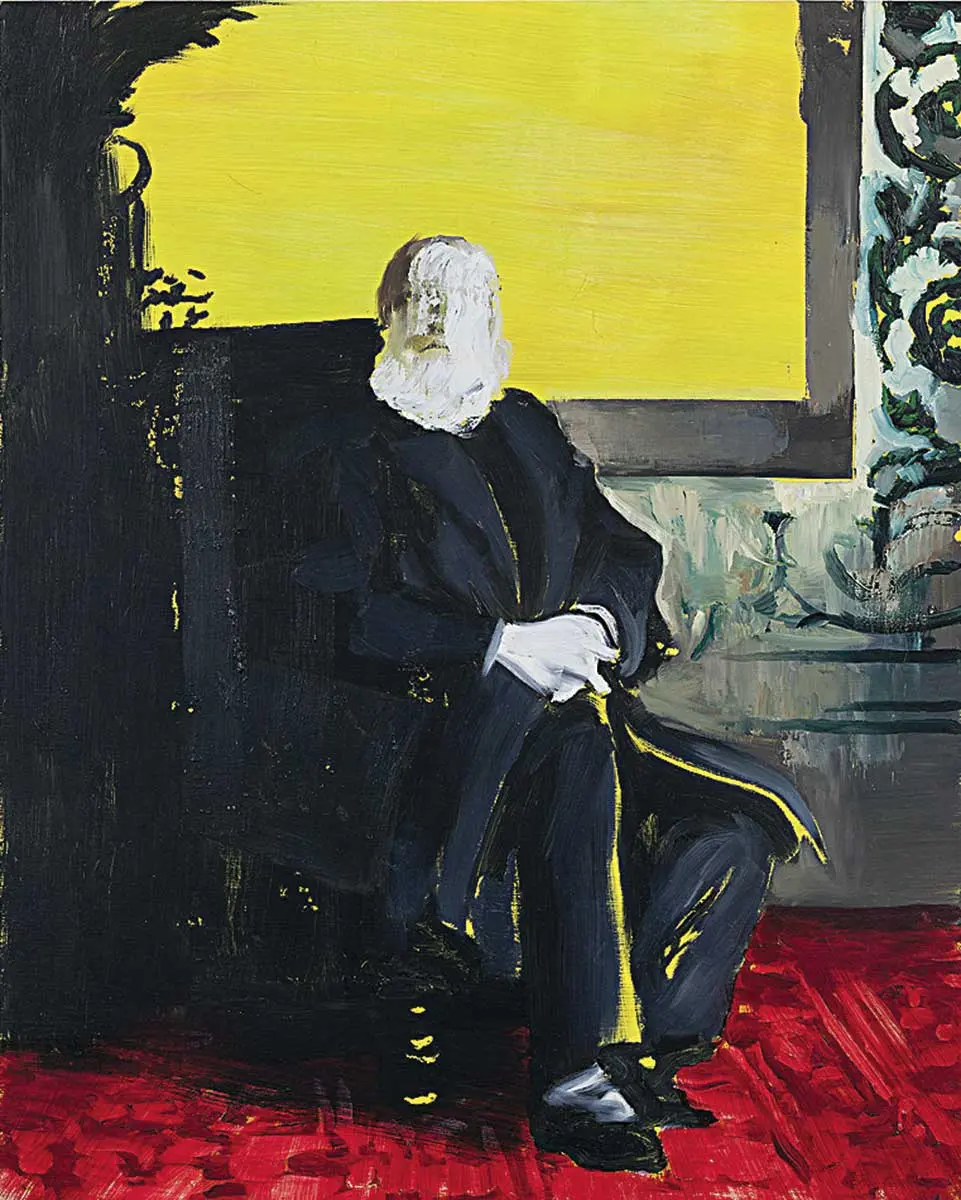
However, far from being configured as an exhibition of agenda-driven images that preach an explicit revision of the history of Brazil, the images function like triggers that allow Lannes to recode those bodies photographed in fields of color that jump at the viewer and that scare those famous or anonymous biographies that make up the cultural melting pot of Brazilian culture. The face of Pedro II, the last emperor of Brazil and one of those responsible for the dissemination of photography, is nothing more than a lump overshadowed by a broad yellow and red surface. It is in this play of colors that the Empire disappears and gives rise to the Republic and to other human figures that for the viewer of today and yesterday’s photographer are captured in moments of non-theatrical action.
One of the works included in the exhibition showed a self-portrait that appeared in front of a large painting, inside a space that appeared to be a museum. This image can be interpreted as a sort of allegory for the modus operandi that Lannes has established: if the figure portrayed is in the foreground, then there will always be an iconic painting behind the person portrayed that is bigger than him/her. I find that it is through this flow between fascination, observation, and the impetuous approach to the images that Daniel Lannes is able to construct, frame by frame, a singular vision.
RAPHAEL FONSECA