
At first glance, the exhibition Monomyth shows a series of pieces made out of figures that are apparently not related to one another. They nonetheless inform us about one of Dr. Lakra’s most deep-rooted facets and/or interests, while also allowing for a better understanding of the creative process of this Mexican artist.
Dr. Lakra is an avid collector of all kinds of objects. This hobby is fueled by a continuous search for parts or materials that can function as work surfaces or as extensions of his work. All the objects that he collects become tools to build new discourses or languages with which to express his work. This very eclectic collection may contain a wide range of objects such as toys, insects, books, etc., which, ultimately, can be combined to formwork whose meaning is given by the sum of its parts. It is in this manner that Monomyth was created.
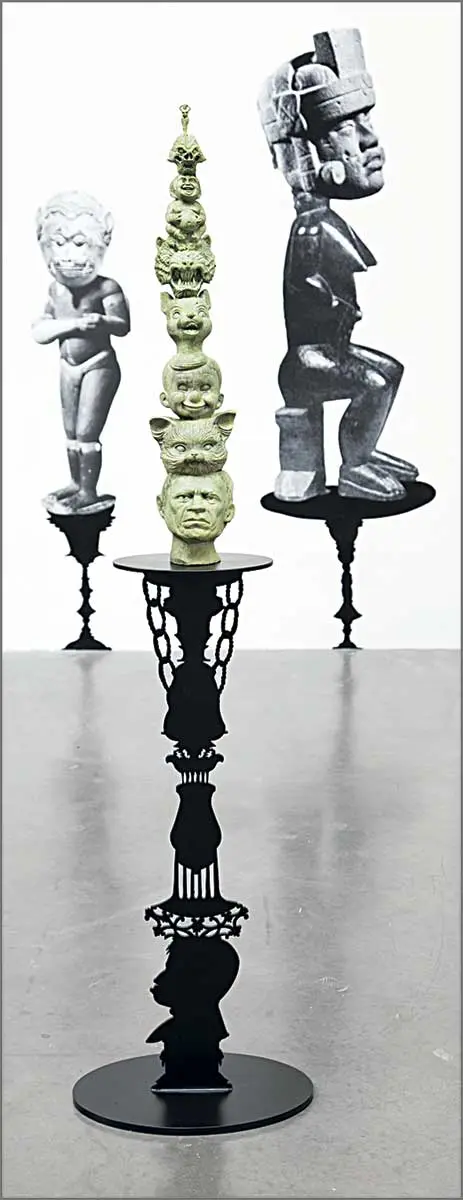
The monomyth concept is based on a theory developed by Joseph Campbell, who argued that the most important deities in many religions and mythologies have many characteristics in common in terms of personalities and behaviors, despite the temporal, ideological, or geographical distances between them. The reason for this inquiry stemmed from observing the remarkable and significant parallels among cultures that were never in contact during their heydays, but that nonetheless end up having many amazing things in common. This denotes an inherent human behavior that manifests itself in an important need to offer a supernatural or religious explanation to those things which we cannot fully understand.
The series of works that are included in the exhibition follow this pattern of generating relationships between objects that, at first glance, appear not to have anything in common with one another. However, they are pieces that can be completely identified by almost any person, because they belong to a global culture of mass consumption that has, directly or indirectly, influenced us and that is connected to our past. Among the sculptures that are part of the exhibition, we can find religious deities from the East, Mexican heroes like Benito Juárez, or fantastic characters from movies or cartoons like ET or the head of Ultraman. All of them are united in a narrative presented in the form of totems whose function is to serve as collective symbols of worship, either because of their votive attributes or because of the nostalgia that they generate, and with the protective value that is intrinsic to the totem’s function.
The result of this project is consistent with the tenor that has always distinguished Dr. Lakra’s work: the final creation of irreverent objects charged with highly sexual connotations, provocative images, and a break with the established norms that confront viewers, who find themselves before a paradox of attraction and repulsion of the object contemplated. His constant concern for finding new ways to approach his work has led him to explore drawing, painting, tattooing, mural painting, collage, and sculpture. The use of multiple disciplines, and the manner in which he connects them, represent an extension of the very monomyth concept.
The show is a display of apparent contradictions that demonstrate a deep understanding of concepts, in order to find the connecting link that gives meaning to the result.
In the end, the exhibition is presented as a project that connects opposites, that plays a little with the sanity of viewers while challenging those values learned during a lifetime, by interconnecting seemingly disparate objects that share certain profound meanings or attributes.
HÉCTOR TAPIA