Commissioned by the Miami Dade College’s (MDC) Museum of Art + Design (MoAD) under the curatorship of Jeremy Mikolajczak, the solo exhibition by Florencio Gelabert titled A Dialogue with Time, should be construed as a journey, as a route on which to pave roads, difficult and dissimilar trails that shed light on this artist’s trajectory, on Cuban identity and the contemporary individual.
The exhibition A Dialogue with Time consists of large-scale installations, sculptures, and drawings displayed in three exhibition spaces on the second floor of the MoAD. They are immersive environments where light becomes an active component in the works. Interested since the beginning of his career in the unconventional treatment of sculpture, Gelabert’s work is a combination of architecture, sculpture, and ephemeral art. Renouncing conventional materials, he incorporates the notion of objet trouvé to reclaim everyday environments. Bathtubs, pipes, rebars, water tanks, furniture become the nucleus from which the new institutions embodied by these pieces of Florencio Gelabert are structured. In this sense, two works stand out: The Site and The Wall, both from 2015.
The Wall is a compact concrete structure lined with white tiles and split in two at the center. The two heavy fragments, the result of a schism that we know nothing about, are connected by an architectural structure (rebar) that, like a spine, seeks to uphold the dignity of the collapsed wall. The polysemic title constitutes a clin d’oeil of two levels of the lecture. On the one hand, it is associated with the metaphor of impossibility or personal barrier; on the other, the wall with an ideological containment barrier.
In the interplay with the material, an essential component in Gelabert’s proposal, it is essential to distinguish between two levels. The first is associated with discarded or waste material, which at a conceptual level involves notions such as reclaiming the city as a fundamental human enclave and the urgent need to recuperate the historical memory. The second entails the incorporation of falsification, a disturbing sign that introduces imposture as an aesthetic attitude.
Ruin II and Ruin III (2014), created with polyethylene foam, stucco, brick, and acrylic paint, demonstrate this concern with forgery. Conceived as monoliths and suspended on transparent pedestals, both structures recreate traces of ruins that appear to stand as the sole survivors of an extinct distant culture that nonetheless feels close to our own. They are arcane witnesses of our own existence and offer unmistakable traces of self-annihilation.
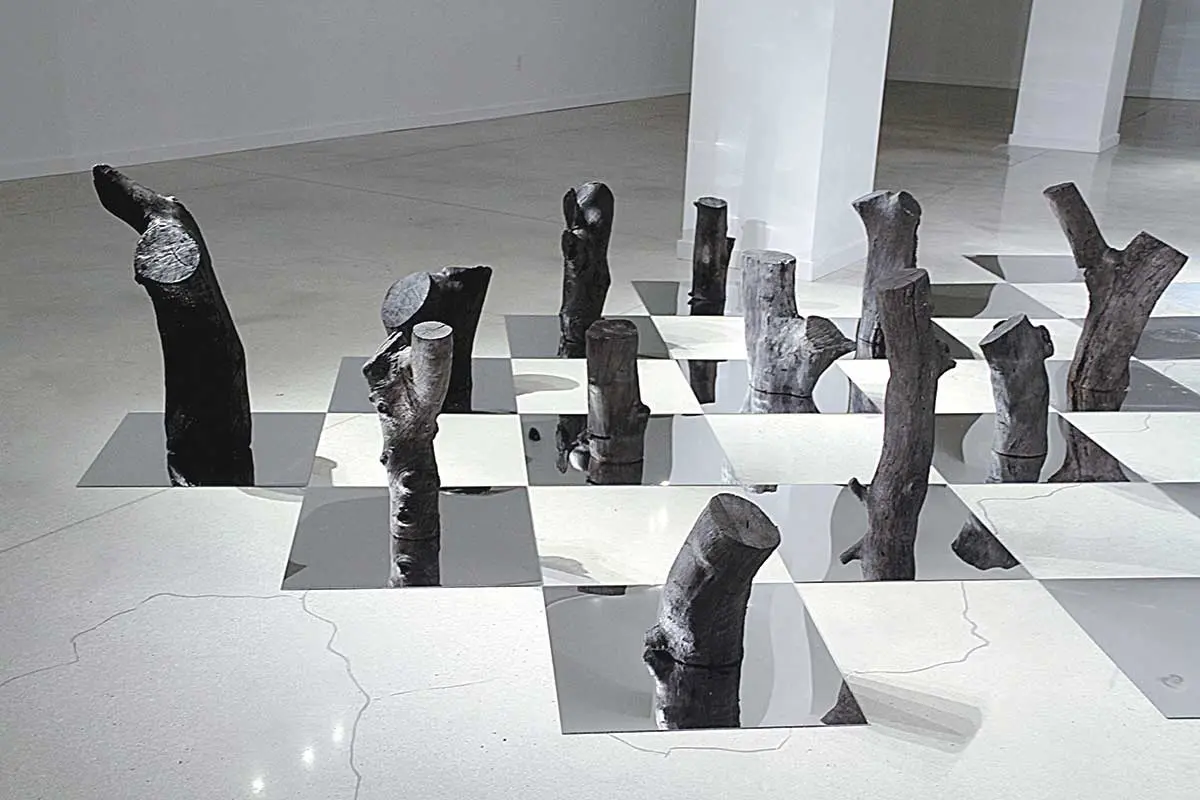
Stella and The Rest, both from 2015, introduced another central element in A Dialogue with Time destruction by fire as a therapeutic and creative tool. While Gelabert has been interested in the recovery of natural elements since the beginning of his career, these works show a fundamental turning point. The cheap materials once used to replace natural elements are now replaced by the remnants of logging which are transformed solely by fire—a purifying, liberating, and regenerative element. Stella is an incisive installation that like ivy populates the gallery as it integrates into the architecture of the place. Instead of avoiding the columns, Gelabert has incorporated them into the installation (which gives the impression of having been there even before the architectural space that houses it). Like Atlases carrying the invisible weight of our era, the burnt logs are mounted on a minimalist lattice structure that consists of alternating squares of mirrors and of the marble floor, the gallery’s. The use of a grid references two vital historical moments. On the one hand, the grid plan, the urban planning principle adopted by ancient Greece, and on the other, the Renaissance notion associated with progress and faith in mankind. It represents the physical foundation of the installation and the conceptual basis of Western culture, the truncated and scorched trees act as an inescapable historical simile of a historical course, where destruction, slaughter, and ecocide based civilization have marked the history of the West. Stella is a reflection and warning cry concerned with the debauchery on which we built our existence, while it also stands as a tribute to the forgotten, the excluded and the silenced.
Structured from existential antithesis such as preservation and destruction, memory and oblivion, beauty and destruction, ecology and pollution, Florencio Gelabert: A Dialogue with Time is a journey through the career of this artist. A Dialogue with Time is the second solo exhibition presented by Florencio Gelabert at a museum in South Florida and follows his 2009 exhibition Intersections.
JANET BATET