
The recent exhibition titled Iole de Freitas. The Weight of Each One at the Museu de Arte Moderna do Rio de Janeiro (MAM-RJ), offered a fresh look at the over forty-year artistic trajectory of Brazilian artist Iole de Freitas, who used this opportunity to celebrate her 70th birthday. Curated by Luisa Canongia, the exhibition in the Monumental Space of the museum presented a new installation specially created for the venue, composed of three large sculptures in polished and matte stainless steel—two of them suspended and one placed on the floor—that altogether weight nearly four tons.
The novelty is that on this occasion Iole de Freitas worked with steel plates instead of with the polycarbonate and stainless steel tubes that had characterized her production in recent times. According to de Freitas, she wanted to “remove any material that had the imprimatura of lightness, of the see-through, the translucent. And added, “I wanted to use another matter or corporeality so the work could acquire a different type of body. This is the reason why I chose this metal.”
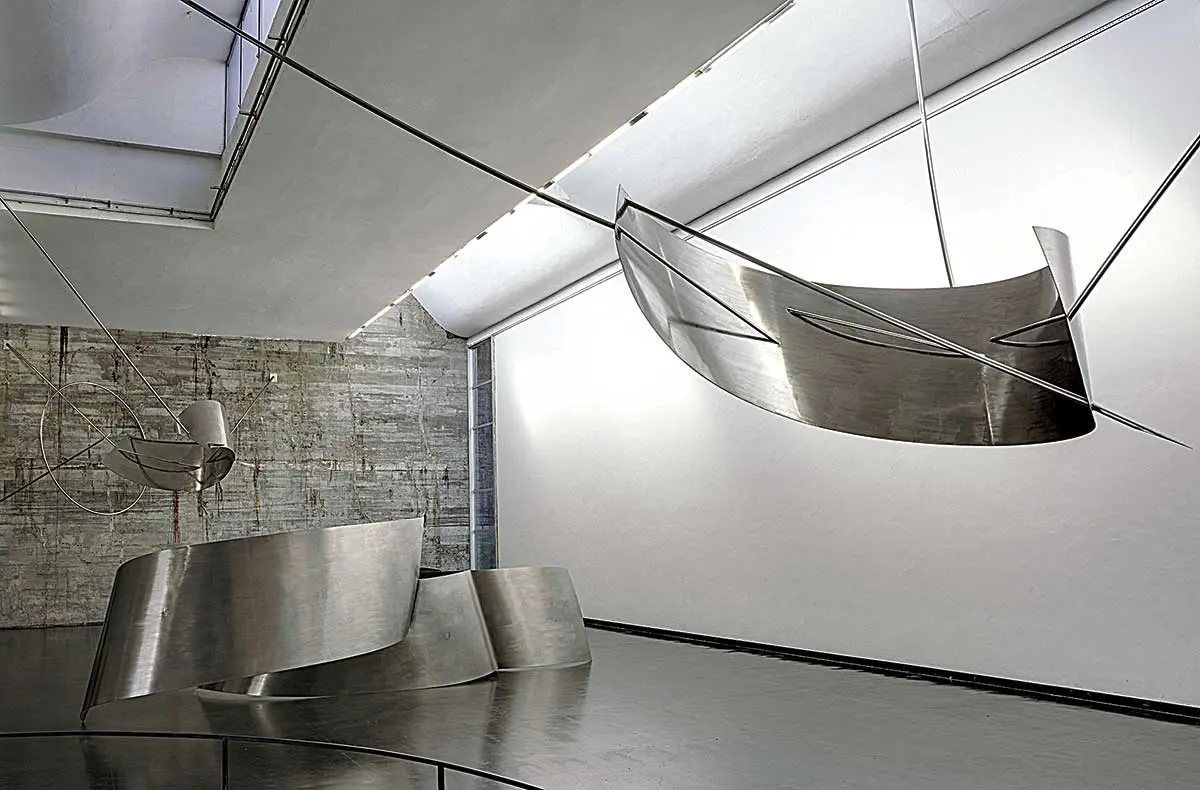
This idea of avoiding transparency led Iole de Freitas to give one side of the surface of the plates a very smooth and reflective finish while keeping the other side opaque. “I wanted to ensure that the viewer—and I—could see his reflection on the surface of the works.” Although her proposals with polycarbonate in the last decade also had a reflecting surface, these current sculptures are even more reflective. The theme of mirroring was also present in her works from the 1970s, such as in the 1973-1974 photographic series titled Introvert/Penetrate: Extrovert/Penetrate, and in the series Glass Pieces/ Life Slices from 1973 to 1978. At that time de Freitas was living in Milan, Italy, and was interested in exploring issues of identity, femininity, and body art.
Iole de Freitas always works closely with the architecture of the space, as she explores the possibilities of structural systems and the best approach to enhance the spatial language. The relationship with space is an essential issue for this artist—who has been exploring the purpose of museum walls since the 1990s—and was the central theme in the exhibition at the MAM-RJ. In the same manner that she has approached spaces designed by architects like Grandjean Montigny (Casa Francia-Brasil, Rio de Janeiro), Francisco Joaquim Bethencourt da Silva (Casa Daros, Rio), Alvaro Siza (Funación Iberê Camargo, Porto Alegre), and Simon Louis du Ry constructions (Fridericianum Museum, Kassel, Germany), among others, Iole de Freitas immersed herself in the architectural project by Affonso Eduardo Reidy, who made the MAM-RJ one of the referents of Brazilian modernism.
Even when challenging twists and surgical engineering calculations are required due to the rigidity and weight of the steel, the work by Iole contains unexpected attributes, such as mobility and elasticity. According to curator Ligia Canongia, lightness and movement are characteristics found in the dance field, in which the artist also worked. So, Iole de Freitas transformed body gestures into visual elements that activate the space and allow interactions between forms and the environment.
Born in Belo Horizonte (1945) and based in Rio de Janeiro, Iole de Freitas studied at the Escola Superior de Desenho Industrial in Rio de Janeiro (1964-1965). From 1970 to 1978 she lived in Milan, where she worked as a designer at Olivetti’s Corporate Image Studio. In 1973 she began producing and exhibiting an artistic production closely associated with her work as a designer.
Despite the change in the choice of material for this exhibition, Iole de Freitas has not deviated from her intention of showing some ambiguity in her work. As explained by Ligia Canongia, the fine line between the expressive gesture and the formal precision that has always accompanied Freitas’s work continues to be present in this exhibition, but with the slight recovery of reflections and glossy surfaces that she used during the 1970s. De Freitas herself has explained that all her work retains an aesthetic legacy from earlier works, whether through photographs, performances, sculptures, etc.
Suspended on the air, the sculptures in this exhibition revealed a kind of fluctuating dance, a rich movement that contrasted the actual weight of the material. As it occurs in many other works by de Freitas, the pieces in this exhibition revealed a subtle line between gestural and geometric elements, expressiveness and precision, between the lyrical and the structural. And it is precisely this suggested vagueness that characterizes the richness of her poetry.
ALESSANDRA SIMÕES