The meaning of the avant-garde, adventures of the avant-garde, avant-garde..., three ways of referring to Jaime Davidovich’s work and to the title of his exhibition at the Bronx Museum. It is a full, expletive, and concentrated title, as it should be when coming from this conceptual artist, painter, installationist, pre-minimalist, the precursor of the site-specific work, video artist, and creator of intellectual TV entertainment. Any preconceived notions aside, anyone who attends an exhibition in which there will be works with video or video-only pieces, is prepared to be “detained” in one or more darkened rooms, wondering how much time he/she should spend watching the videos as opposed to the amount of time spent in the rest of the exhibition. Curated by Julieta González, the exhibition by Jaime Davidovich has resolved this in a consistent and original manner. The role of video in this show is abundant and significant but it does not trap viewers. In this regard, Jaime Davidovich is delighted to say: “Of course! To me, the video stems from painting. Because video is a moving extension of painting.”
Born in Argentina in 1936, Jaime Davidovich taught art in Bahia Blanca. Every weekend, the hours spent on the train back to Buenos Aires exposed him to the monochromatic landscape of the immense plain. Back then, he painted truly large—2 by 2.5 meters—landscape paintings rendered in yellow and white, for daytime sceneries, or in dark blue and black, for nightscapes. “I could not find a place in the traditional and decorative Buenos Aires of that time.” Even in the fifties, most of the artists from Argentina who went to study in Europe attended very traditional schools, like that of French painter Andre Lhote. Galleries would predominantly show academic drawing and tonally pleasant works. The vanguardist currents from Europe or the United States had not arrived in Argentina yet. Davidovich traveled to Brazil, where he discovered and experienced other realities. In the museums in Rio de Janeiro, he is exposed to works by Jean-Paul Riopelle and Jackson Pollock, among others. Excited, Davidovich understood that it was necessary to find a new direction.
In 1963, Davidovich arrives in New York where he will reside permanently. The city belongs to local artists and there are not real opportunities for Latin American artists. Realizing how difficult it would be, he decided that there was no use in pretending that there was a place readily available for him from which to compete with US artists. Although he understood that it would be very hard to become part of the local art scene, he was nevertheless determined to somehow make his own luck. The few times that he was able to participate was by insisting—persistently and with creole vivacity—that he intended to show his work in spaces that nobody else would use: staircases, sidewalks, parts of closed down windows. “It was like eating leftovers. It was impossible to compete. The same happened to African artists. Before arriving in New York my work was centered on my monochrome paintings. At home, half an hour before the television began transmission, I would already be sitting before the TV to watch those lines—the bars used for testing the signal—that was fascinating to me. The TV was located in a high place, on top of a piece of furniture, like an altar. I was mesmerized, it was magical to me!”
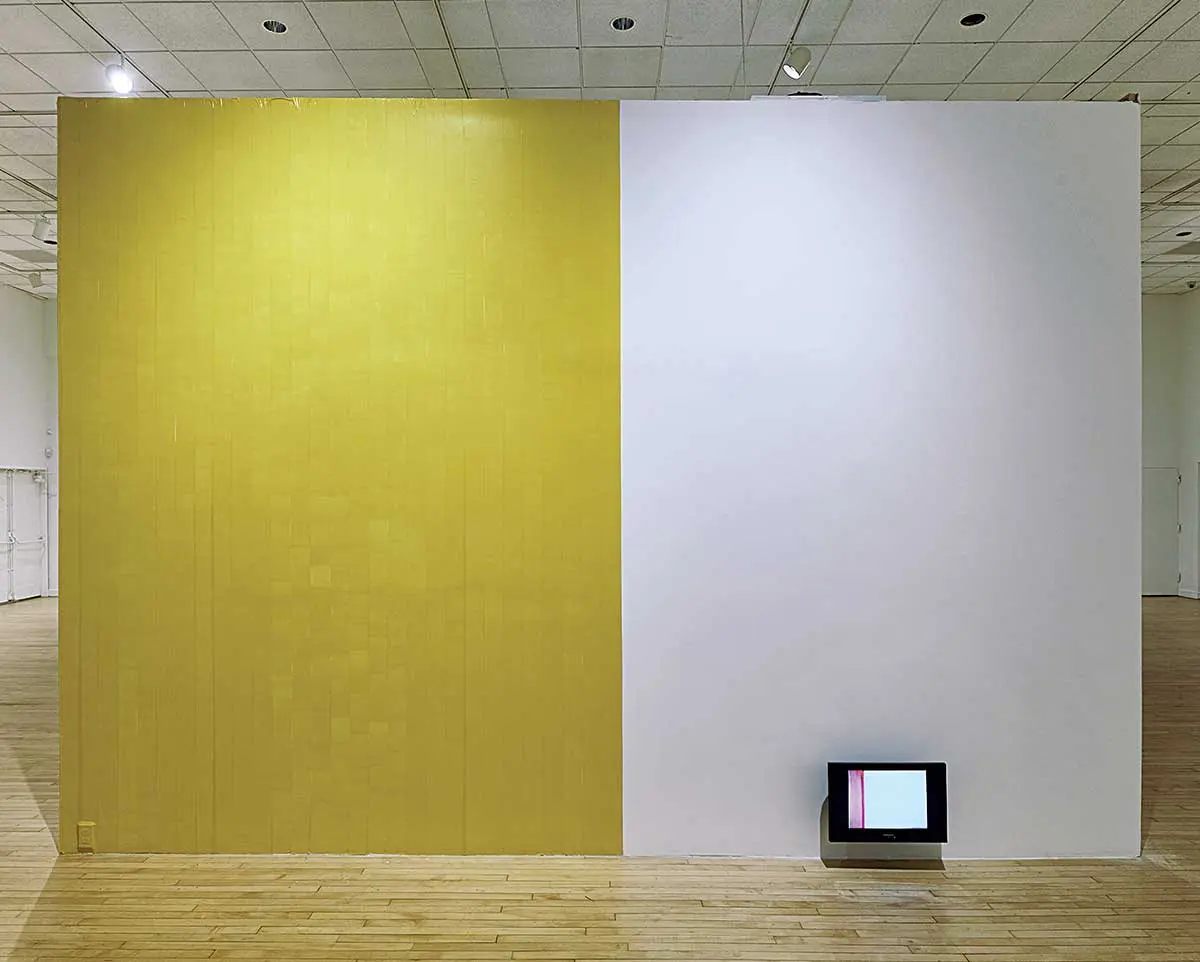
Lines from a flat and expansive landscape, television bars, the use of adhesive tape to demarcate spaces not used by other artists, work placed in areas where artworks are not exhibited, the creation and outline of nonexistent paths, the production of ephemeral art and working with highly pictorial materials, are all conceptual conclusions reached by Jaime Davidovich, an artist with a sharp and critical sense of humor who is not bound by the conventions of the hyper-commercialized art scene. Two simultaneous exhibitions with different content, one at the Bronx Museum and another at Henrique Faria Fine Art. How to place the work of an artist presented in those two different settings? The remarkable images on paper, walls, televisions; the use of mixed media, intervened photographs—some treated with oil or graphite—are reflections that offered new ideas to the public of the second half of the twentieth century; ideas that continue to inspire us today.
The tape that indicates becomes the tape that silences, covers, and tortures. It is the other side of the tape. This is another facet of an artist who continues to feel Argentine despite spending most of his life in New York. Jaime Davidovich’s honesty verges on innocence. While many artists like to cultivate the myth of international artists, this is not the case with Davidovich. He knows that he comes from the southern country of Argentina, acknowledges that he was raised and educated there. He does not deny it and has incorporated this background in the development and evolution of his oeuvre. The transcendental aesthetic, social and political situation created by Davidovich has expanded the conceptual realm.
GRACIELA KARTOFEL