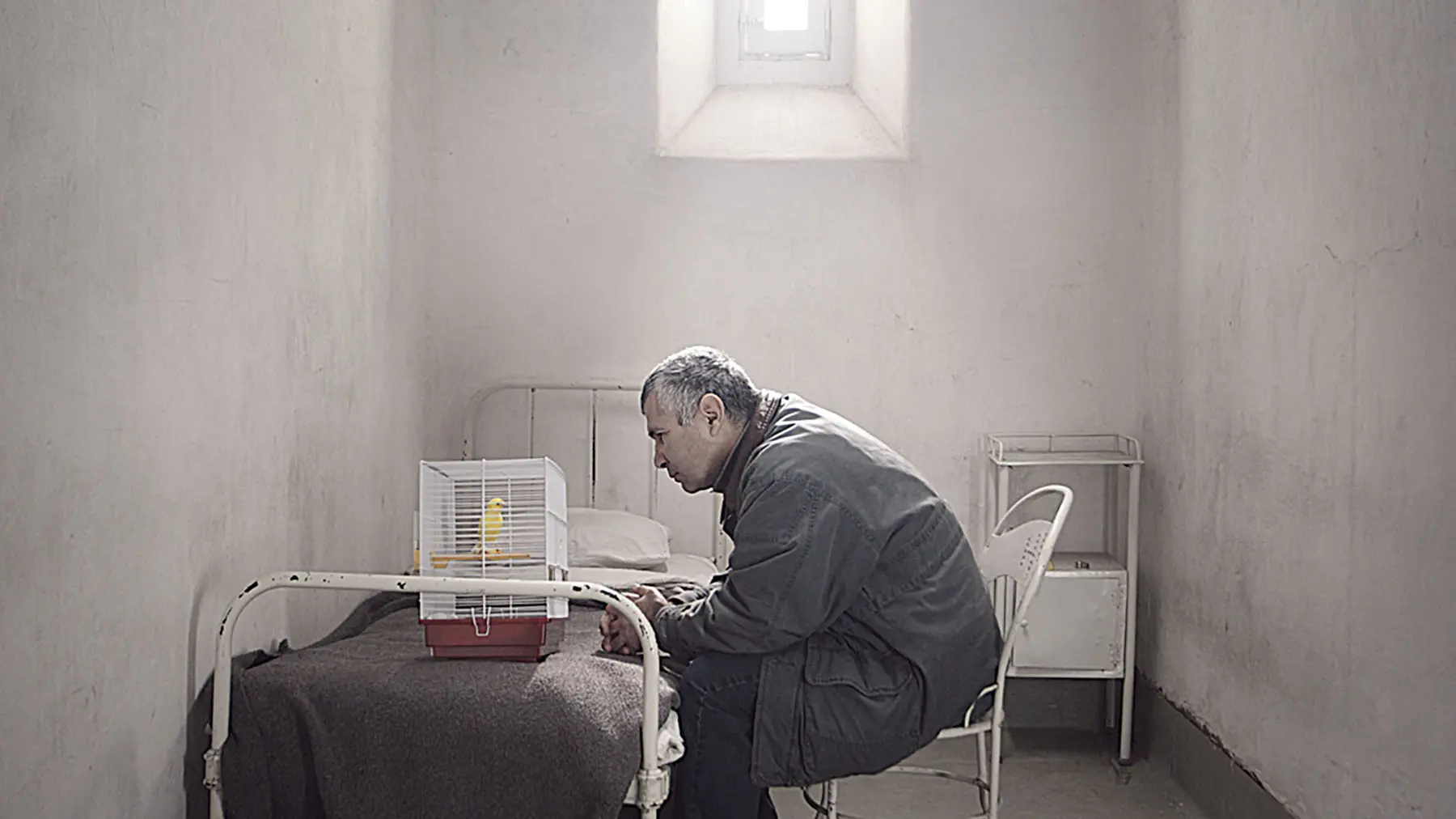
The Western philosophical tradition from the Enlightenment onwards has been predicated on the supremacy of reason. Modernity, progress, and development—concepts that define a Eurocentric worldview—presuppose a well-ordered system in order to fulfill their promise, where the individual parts function for the betterment of the whole. The work of Javier Téllez challenges Western rationality and the resulting normativity that structures society by choosing outcast communities as his subjects. The mentally ill, the blind, refugees, and the urban poor all feature prominently in his films and videos. Indeed, Téllez’s work is emphatically representational, not only for the ways in which it engages with “reality,” but also for serving as a mouthpiece for those whose voices are muted.
Born in Valencia, Venezuela, Téllez has lived in New York since 1993. Though much of his career has been spent abroad, his work in Venezuela offered significant new directions to his country’s artistic tradition, whose representative artists were the painter Armando Reverón early in the twentieth century and the geometric abstractionists of mid-century (Jesús Rafael Soto, Carlos Cruz-Diez, and Alejandro Otero, as well as Gego, who occupied a secondary position at the time). Though belonging to different moments and practicing diverse pictorial idioms, the work of these artists has in common the emphasis on form over content. Reverón’s celebrated paintings involve the dissolution of subjects into light through a blinding effect produced by whites and light colors that evoke the sensation of the tropical sun on the retina. Though Reverón’s work never abandons representational elements, his paintings are traditionally praised for their innovative formal qualities. Abstraction as it came to be practiced later was emphatically non-figurative and courted universality. In the words of Soto, “To make a truly abstract art—when I say abstract, I use this word in all its meaning—it is necessary for the situation of each individual not to matter anymore.”1 By contrast, Téllez not only embraces representation, and with its content and narrative, he regards it as an ethical practice. For him the situation of the individual matters deeply, and time and again, he gives voice to those whom society has silenced.
The Extraction of the Stone of Madness (1996), his first major work, originally presented at the Museo de Bellas Artes in Caracas, was an installation that recreated in the museum galleries a dormitory of the Bárbula psychiatric hospital of Valencia, where his father, a psychiatrist, had worked. The artist inserted rusty beds, soiled mattresses, mismatched furniture, patient histories, television screens projecting video portraits of the inmates, and artwork made by them, including piñatas representing boxes of psychiatric drugs, into the sacrosanct space of the museum. During the opening festivities, the piñatas were broken by children, and the galleries remained in disarray for the remainder of the exhibition. In addition to the visual chaos, the installation included an auditory component, made up of recordings from the hospital, further violating the expectation of the museum as a temple for silent aesthetic contemplation. The piece could not be further from the values that had been celebrated by Venezuelan art and architecture in the second half of the twentieth century: modernity defined by economic development and rational structures, projecting an image of Venezuela as a progressive industrialized nation, and evinced by such monumental projects as the campus of the Universidad Central de Venezuela and the public works of Soto, Cruz-Diez, and Otero dispersed throughout the country. Many contemporary Venezuelan artists have questioned how the country’s identity has been tied to its industrial and architectural modernity, suggesting the failure of such a modernist project, but what distinguishes Téllez is that his critique almost invariably involves exploring the potential of representation, as opposed to abstraction, to challenge dominant ideologies and bring to the fore issues of an urgent nature in contemporary experience.
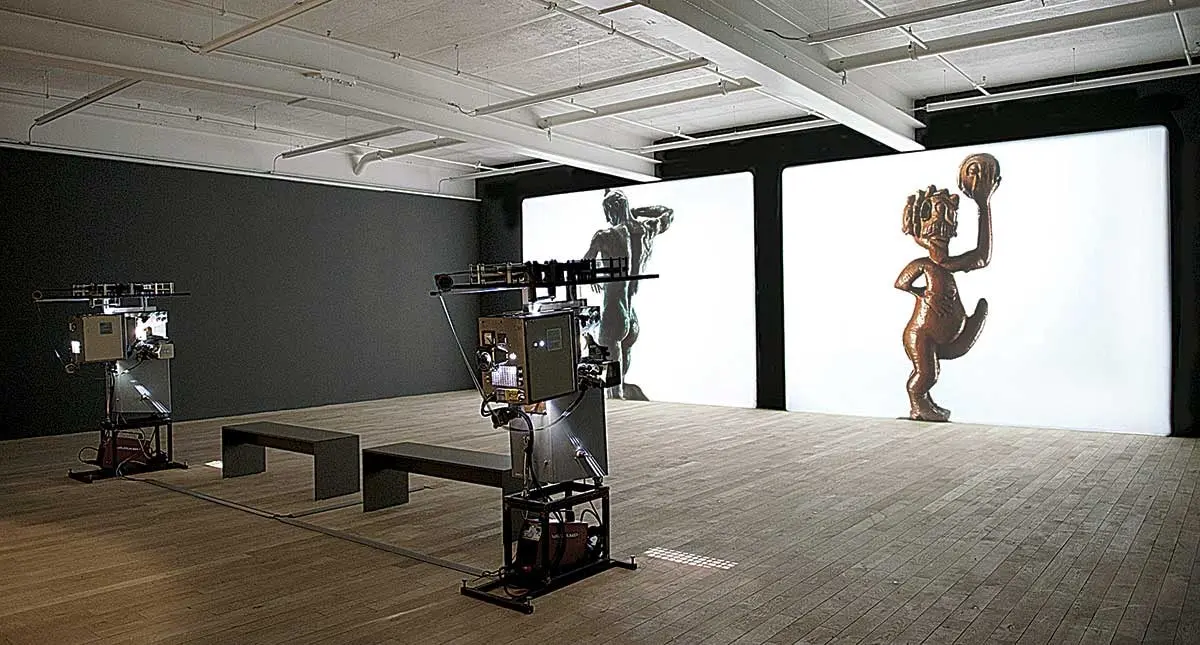
Time and again, Téllez’s work offers a complex meditation on representation. His recent work juxtaposes paintings and sculptures from different eras or styles, often in dialogue with photography and the moving image. In Rotations (Prometheus and Zwitter) (2011), the films in the round two early twentieth-century German sculptures of a human figure that could not be more different. Prometheus (1937), a bronze by Arno Brecker depicting the celebrated hero of Greek mythology through classical proportions and a virile stance, was a highlight of the Grosse Deutsche Kunstausstellung or Great German Art Exhibition mounted by the Nazi party in Munich in 1937. The carved wooden sculpture is known as Zwitter (1920) of a hermaphrodite, disproportionate and humble, made by the psychiatric patient Karl Genzel was included in the counterpart exhibition Entartete Kunst or Degenerate Art, which aimed to present an image of avant-garde art as debased and corrupt by exhibiting works by the German Expressionists and other European modernists (Picasso, Matisse, Chagall, etc.) in dialogue with the work of individuals the regime deemed as degenerate, such as Jews and the mentally ill. Projecting the side of the sculpture by side, Téllez not only suggests that the Genzel piece is conceptually and formally more interesting, but that the values of any artistic canon are determined by prevailing ideologies.
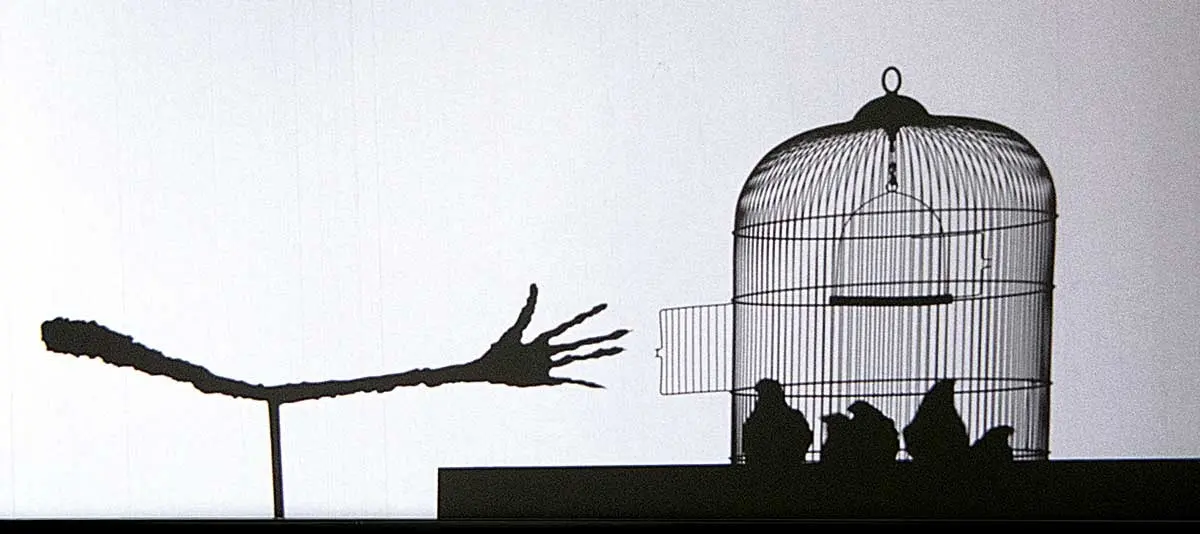
Another recent series features Alberto Giacometti’s sculpture La main (The Hand, 1947) in various situations involving refugees who have resettled in Switzerland. Shadow Play (2014) is a 35mm black-and-white silent film composed exclusively of projected shadows (except a brief scene at the end). The protagonists are the refugees whose bodies appear as silhouettes acting out different scenarios—a woman walks across the screen carrying a large sack, a man in uniform asks another for his passport—or else their hands propel the action through gestures and shadow puppets. The original plaster version of La main, whose emaciated appearance and fragmented form is the quintessential expression of post-World War II existentialism, is placed in dialogue with the hands of the subjects. Some scenes are straightforward: the hands appear across from each other poised for a handshake or as if to play rock, paper, scissors. In others, however, Giacometti’s hand takes on a sinister quality. In one instance, it opens a cage with birds inside (really, hands mimicking birds) and sets one of them loose. The bird flies away only to be caught in a spider’s web. In another, a snail painstakingly moves a boulder up a hill, but as soon as it gets to the top, La main pushes it down. Though it is merely a fragile static object, Giacometti’s sculpture has greater authority and power than the healthy, living bodies of the refugees.
La main appears again in Bourbaki Panorama (2014), a short film set in Lucerne at the site of a circular panoramic painting by Edouard Castres from 1881 with the same title as Téllez’s piece. The painting depicts the retreat of the Eastern Army into Switzerland in 1871, an event that marked the end of the Franco-Prussian War. A monumental canvas with the proportions of a mural (14-15 m high and 114 m in circumference), the panorama occupies a specifically designated building, with a circular walkway around the painting for proper viewing. In addition to the painted scenes, actual objects, including rifles and a railroad car, and costumed mannequins continue the action into real space. Set in winter, the scene stresses the devastation of war, with dead and wounded soldiers and animals strewn about in the foreground and the retreating soldiers on their horses lining the perimeter. The film provides an overview of the painting before focusing on its own subjects, Giacometti’s La main (bronze version) and a group of young refugees, who were also the protagonists of Shadow Play. They face the panorama and then walk around the perimeter, led by a woman, who pulls the sculpture with a rope attached to its base, and a man in tow, who holds it steady. The camera zooms in on the faces of the refugees as they silently walk across the frame, making no eye contact. The procession is then filmed again, with the camera at a greater distance to capture the marchers’ entire bodies. In this film, Téllez ponders different representations of war. The realism of the panorama and Giacometti’s abstracted and disembodied hand allude to suffering in different ways (the sculpture is said to have been inspired by a body fragment Giacometti encountered while fleeing Paris upon the Nazi invasion of 1940). Téllez’s approach to the consequences of war in the twenty-first century includes little pathos, but by focusing on young individuals of different ethnicities and highlighting their isolation through the formal elements of the film, he gives an actual human face to what is in the other artworks an abstracted view of human suffering.
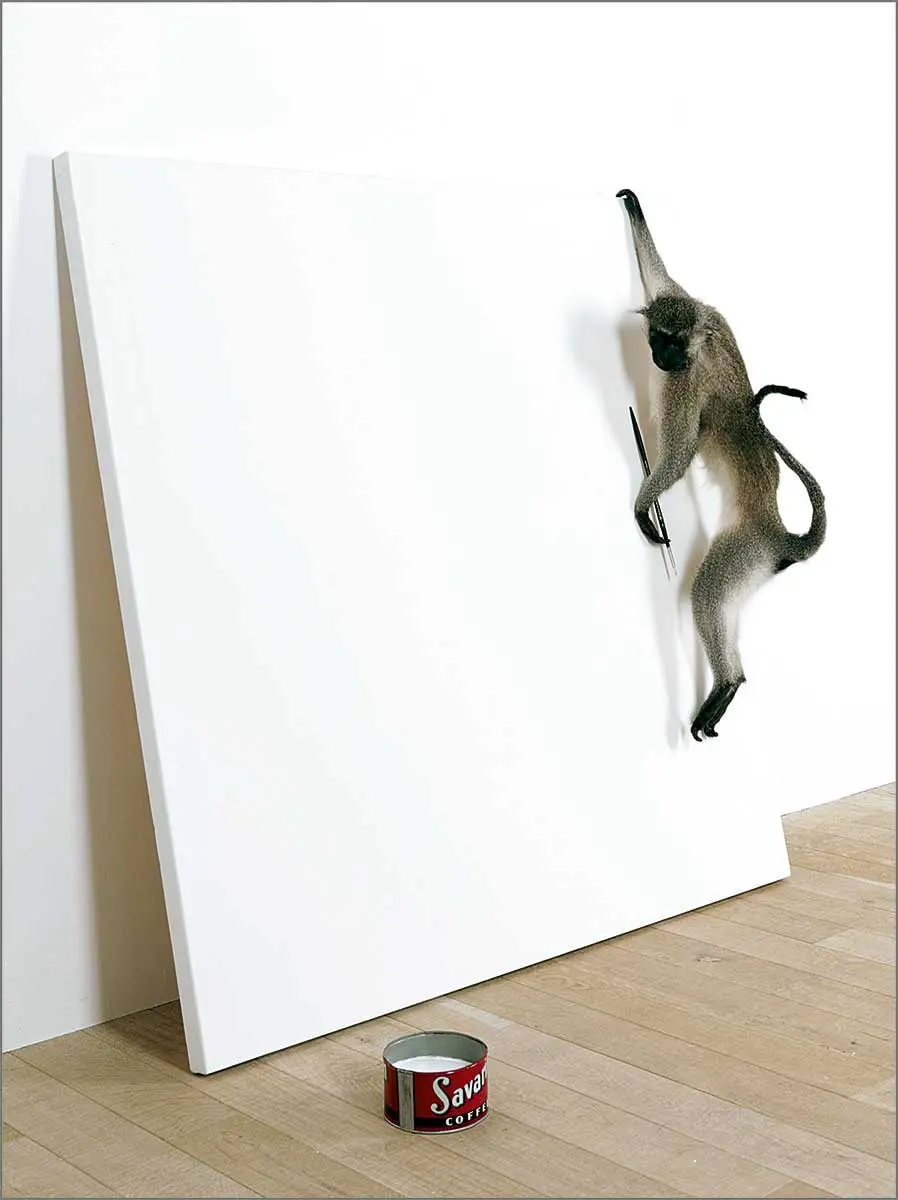
Though deeply philosophical, Téllez’s work also contains elements of humor, especially in his pieces involving animals. Neither More Nor Less (2013) is a recent sculpture consisting of a taxidermied monkey hanging from a white canvas. Holding a long paintbrush, the monkey looks towards a can of Savarin coffee that rests on the floor and is filled with white paint. The work amusingly makes reference to descriptions of the art of painting as “the ape of nature,” which proliferated in the Middle Ages through the Enlightenment. Instead of creating a mimetic painting, as would be the expectation, however, Téllez’s monkey has produced a white monochrome. The Savarin may be read in dialogue with Jasper Johns’ Savarin (1960), a bronze sculpture replicating the coffee can with paintbrushes stuffed inside, which itself alludes to the readymades of Marcel Duchamp, and the monochrome carries with it a number of referents in twentieth-century art, from Kazimir Malevich to Robert Rauschenberg, Robert Ryman, Yves Klein, and Piero Manzoni. While open to multiple interpretations, on one level, the piece pokes fun at abstraction’s lofty aspiration towards the sublime by contrasting an abstract canvas with a primate of a lower order on the evolutionary scale.
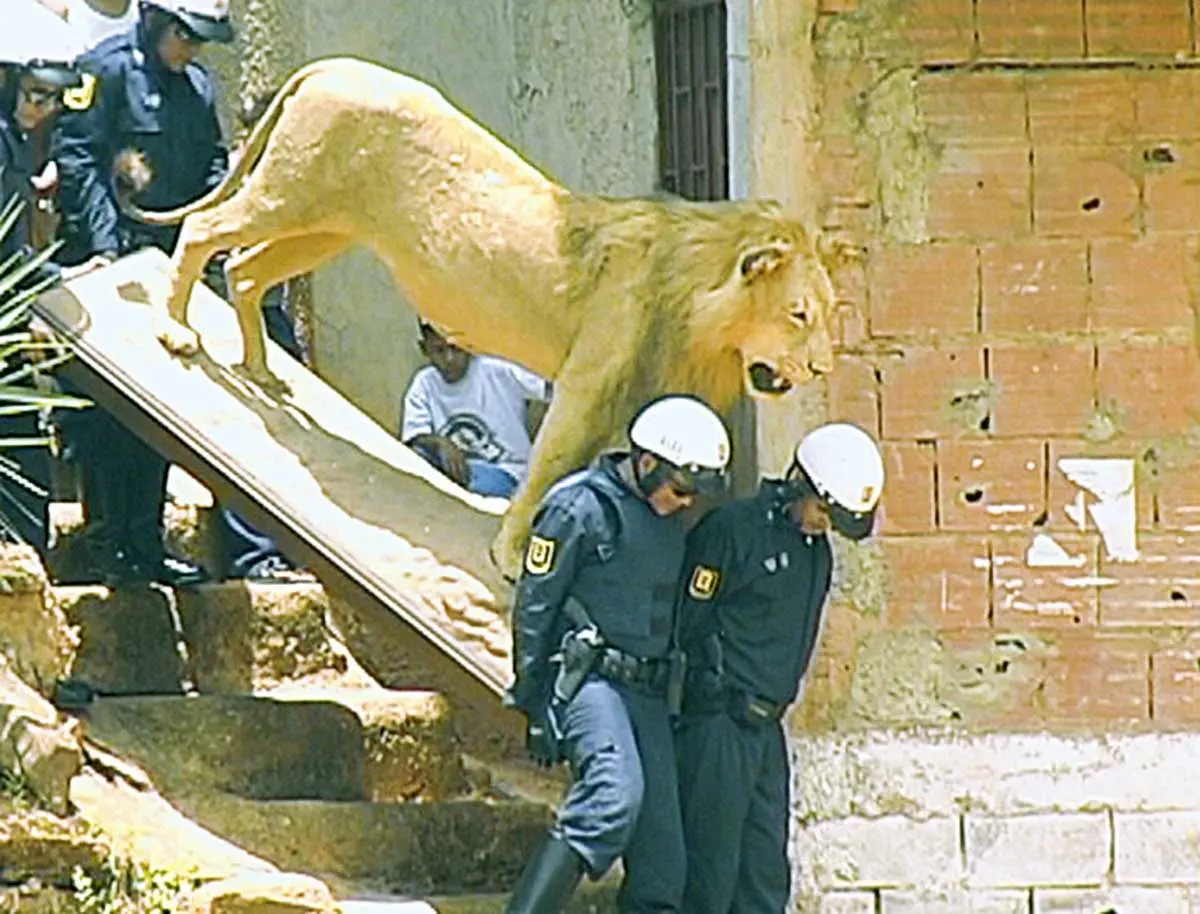
Taxidermied animals are featured in other works by Téllez, including the videos El león de Caracas (2002) and Dürer’s Rhinoceros (2010), structurally similar pieces in which a stuffed wild animal is paraded in an utterly incongruous setting. The animals serve to call attention to the disconnect between representation and reality. They were once living beings that have become sculptural objects, radically decontextualized from their original habitat, just as the people depicted in the films have become images, suspended in time and space. In El león de Caracas, four fully uniformed policemen carry a lion, the symbol of Caracas, through one of the city’s informal settlements on the mountainside, known to locals as a barrio. They are followed around by children and observed by curious inhabitants. While the policemen and the lion are all emblems of power, they stand out for being completely out of place. Instead of projecting authority, the officers come across as slightly ridiculous, struggling to keep their footing on irregular terrain while the inhabitants around them move freely. In one scene, they precariously descend a staircase with no railing bordered by a precipice, while residents on a balcony irreverently stroke the lion’s head. Once the lion is set down, it is surrounded by children who touch it all over, a display of spontaneity that draws a stark contrast to the stilted movements of the policemen.
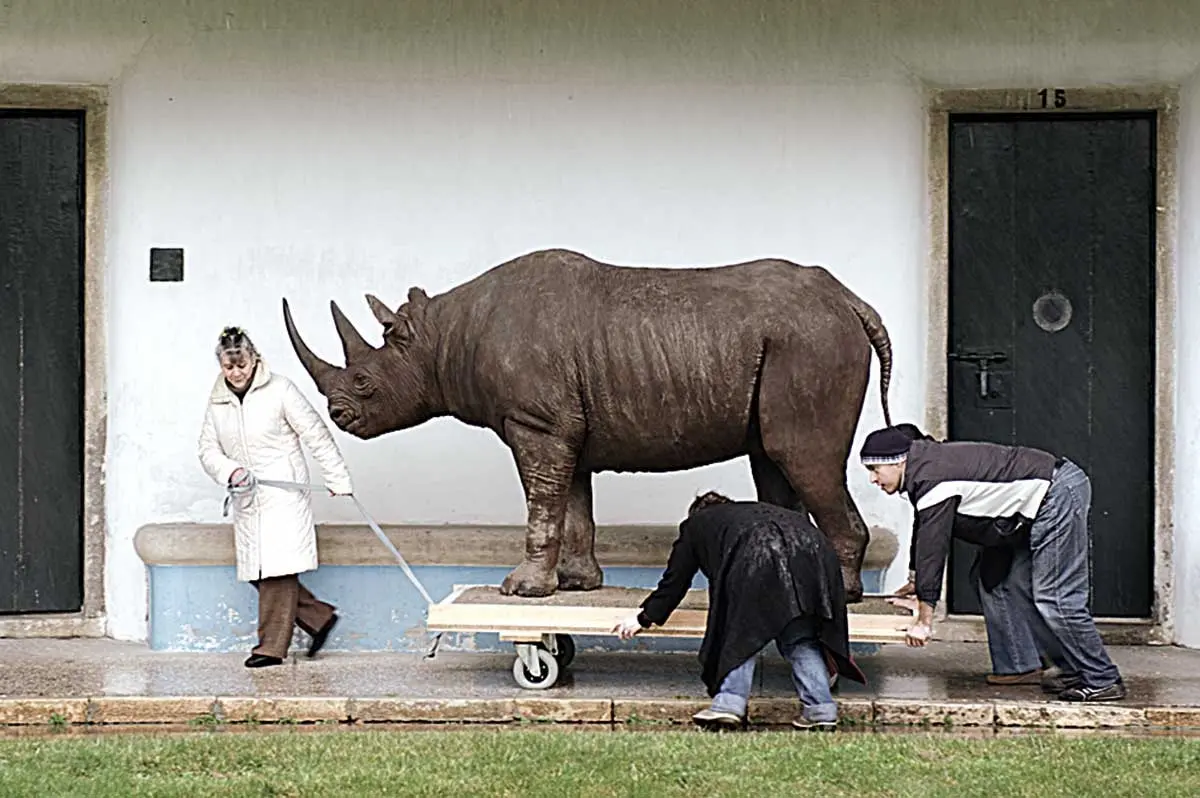
Authority is invoked in a different manner through Dürer’s Rhinoceros (2010). Set in the former Miguel Bombarda mental hospital in Lisbon, Portugal, whose architecture is in the form of a panopticon, the film features a stuffed rhinoceros resting atop a wheeled platform that is pushed around the circular structure by psychiatric patients. The rhinoceros makes reference to an episode from Portugal’s history when in 1513 King Manuel I received a live rhinoceros as a gift—the animal was until then practically unknown in Europe. He, in turn, sent it to Pope Leo X, but the animal drowned in transit as a result of a shipwreck. Some accounts allege that its body was recovered, stuffed, and presented to the Pope in this state. Contemporary descriptions inspired the artist Albrecht Dürer to create his famous woodcut of a rhinoceros, dating from 1515.
Though Téllez’s film begins with an overview of the building’s architecture followed by the rhinoceros being led along the circular path that demarcates the courtyard’s perimeter, much of the action takes place in the small, dark cells that line the walkway, where the resident patients used to live. The artist films their private moments—exercising, listening to music, sewing, putting on makeup, dancing—juxtaposing interior and exterior space, looking and being looked at, light and dark, private and public. The mood is calm and meditative. At times, the background noise is punctuated by the voices of the inmates reading passages from diverse sources, including Plato’s Republic, on the allegory of the cave, which describes the human state as a kind of prison in which what is known is only a flawed projection of the real. The action corresponds in intriguing ways to these passages, where doors, windows, and peepholes underscore how perception depends on framing devices, and how nothing is really knowable in its totality. This is certainly the case for Dürer’s depiction of the rhinoceros, which was based on eyewitness accounts rather than the actual animal.
Téllez makes a similar point in his celebrated video Letter on the Blind for the Use of Those Who See (2007), which features six blind people touching a live elephant and describing their perceptions of the beast. He later created the sculpture Beulah (2008), a representation of an elephant based on these descriptions, with a brick box for the body, tires for the legs, a suit jacket for the face, sleeves for the trunk, hats for the ears, and a rope for the tail, suggesting that the blind interpreted the world through objects previously known to them. Though Dürer’s rhinoceros is remarkably “accurate,” much more so than Téllez’s elephant, it fails to capture the beast’s presence and magnitude, as opposed to the stuffed rhinoceros of the film or the sculptural elephant.2 In the end, all systems of representation are shown to be flawed.
As is common in Téllez’s practice, Dürer’s Rhinoceros portrays institutionalized patients in a deeply respectful manner, suggesting a deep level of trust achieved between the artist and his subjects. The mood is so subdued as to lead the viewer to wonder why must these people be isolated from society. Certainly, the tone is utterly different from that conveyed in Eugène Ionesco’s well-known play Rhinoceros (1959), an icon of the French Theater of the Absurd, in which all hell breaks loose when the inhabitants of a village turn into rhinoceroses except for the protagonist, a man named Berenger. While Ionesco’s play points to social conformity and the manifestation of a herd instinct among humans, Téllez’s film further suggests that social outcasts (Berenger, the mentally ill) may indeed be the wisest of all.
The scripted nature of Téllez’s more recent work, which yields a tightly controlled narrative, significantly contrasts with the more improvised, disorderly form of earlier artistic interventions, in which the artist deliberately courted entropy. In a 1996 interview related to the presentation of The Extraction of the Stone of Madness, Téllez compared the museum, which “attempts to detain the entropy proper to objects,” to the hospital, which “detains the entropy of bodies,” affirming that “detaining entropy is useless to work. Each object comes inscribed with its own entropy."3 In Usted está aquí (You Are Here, 2002), the artist created an enormous (over two meters in diameter), colorful ball of a soft cloth and set it loose in the courtyard of a psychiatric hospital in Venezuela. The camera follows the patients as they run around keeping the ball in the air and passing it over the walls of the spaces that confine them to eventually liberate it by sending it over the gates of the asylum. The resulting atmosphere is pure chaos. Some of the people are clearly disturbed, there is much yelling, and one woman runs around naked. The ethics of representing people in such a state of agitation and vulnerability for the consumption of a museum audience is an issue that comes to the fore.4 In response to a similar question posed by Guy Brett, Téllez responded, “I think there is a moment of emergency when one faces a traumatic social situation. Then one has to choose—to paraphrase Hannah Arendt—the lesser of two evils. In my case I have chosen to represent something that has been condemned to invisibility."5 That the piece is filmed in Venezuela is also significant in that the work, in the words of the artist, “extrapolates the theme of insanity as marginality and exclusion as a condition, contextualizing these meanings [in relation] to the extreme crisis of contemporary cities, that failed in the face of the promises of modernity, be they Caracas or Mexico City."6 Nevertheless, most of Téllez’s recent work with psychiatric inmates is scripted and emerges from dialogue and close collaboration, as opposed to improvisation and entropy. According to the artist, “The patients are the main actors, they work on the scripts, choose the props, review the footage, and comment on it."7
Indeed, Téllez’s engagement with representation extends beyond the visual to encompass narrative mediums, including cinema and theater. The films La Passion de Jeanne d’Arc (Rozelle Hospital) (The Passion of Joan of Arc, Rozelle Hospital, 2004) and Caligari und der Schlafwander (Caligari and the Sleepwalker, 2008) are based on icons of film history (La Passion de Jeanne d’Arc, dir. Carl Dreyer, 1928 and The Cabinet of Dr. Caligari, dir. Robert Weine, 1920) that have been reimagined with psychiatric patients, blurring the boundaries between fiction and “reality” through the incorporation of testimonials relating to the lived experiences of the actors. The Conquest of Mexico (2012) stages Antonin Artaud’s 1934 play of the same name with outpatients from the Fray Bernardino Psychiatric Hospital in Mexico City. In addition to acting out scenes from the play, with such iconic characters as Cortés, Moctezuma, and Malinche, the actors also enact life in the hospital, transitioning between the conquest story that has become the stuff of legend to the wholly mundane. In so doing, the artist affirms the heroism of quotidian experience, especially for those who have suffered marginalization and exclusion and who occupy the lowest rungs of the social ladder. In his engagement with different mimetic strategies, be they visual or narrative, fact or fiction, grandiose or humble, Téllez poses viable new directions for socially inflected representational art.
NOTES
1. Soto: Cuarenta años de creación (Caracas: Museo de Arte Contemporáneo de Caracas, 1983), 17.
2. Further connecting Dürer’s Rhinoceros with Letters from the Blind… and Beulah, it is significant that Manuel I had previously gifted the Pope a white elephant, which became a beloved pet before its untimely death two years later. The king had also put his rhinoceros to battle against an elephant to see what would happen upon such a confrontation; the elephant ran away in fear.
3. Carmen Hernández, “Javier Téllez: Arqueólogo trickster,” Estilo, Year 7, No. 29, (Caracas, November 1996): 67-70, http://www.plataformadearte.org/JavierTellez/CarmenHernandez.htm. Accessed May 8, 2015.
4. See Pam Johnston, “Where You End I Begin – The Multiple Ethics of Contemporary Art Practice” in Antoon van den Braembussche, Heinz Kimmerle, Nicole Note, eds., Intercultural Aesthetics (Berlin: Springer, 2009), 177-78.
5. Quoted in Guy Brett, “Worlds Real and Imagined” in Javier Téllez 4 ½ (Cologne: Snoeck; Kunstverein Braunschweig, 2009), 29.
6. Quoted in Yasmín Monsalve, “Javier Téllez lleva su arte transgresor a Ciudad de México,” El Universal (Caracas, January 29, 2004), http://www.eluniversal.com/2004/01/29/imp_cul_art_29267A, accessed May 10, 2015.
7. Quoted in Brett, 30.
* All images illustrating this article are courtesy of the artist and Galerie Peter Kilchmann, Zürich.
TATIANA FLORES
Associate Professor of Art History at Rutgers, The State University of New Jersey.