The tumultuous historical and artistic events that marked the art scene in Brazil during the 1950s of the twentieth century can be understood through the work of a particular artist: Judith Lauand. A portrait of this important period by the artist born in Pontal, São Paulo, in 1922, her recent exhibition at the spaces of the Instituto de Arte Contemporânea (IAC)1 and Museo Belas Artes de São Paulo (MUBA)2 included over one hundred works produced between 1950 and 1959, a crucial period in the development of Lauand’s artistic career.
Curated by Celso Fioravante, the exhibition presented works from twenty-two private and institutional collections in São Paulo and Rio de Janeiro. Paintings, drawings, gouaches, tapestries, woodcuts, woodcut woodblock, and sketches on several types of paper; as well as photographs, notebooks, catalogs, and other material that constituted a body of work which not only showed her concretist production but also her artistic process and the stylistic transformations that her work underwent through that decade.
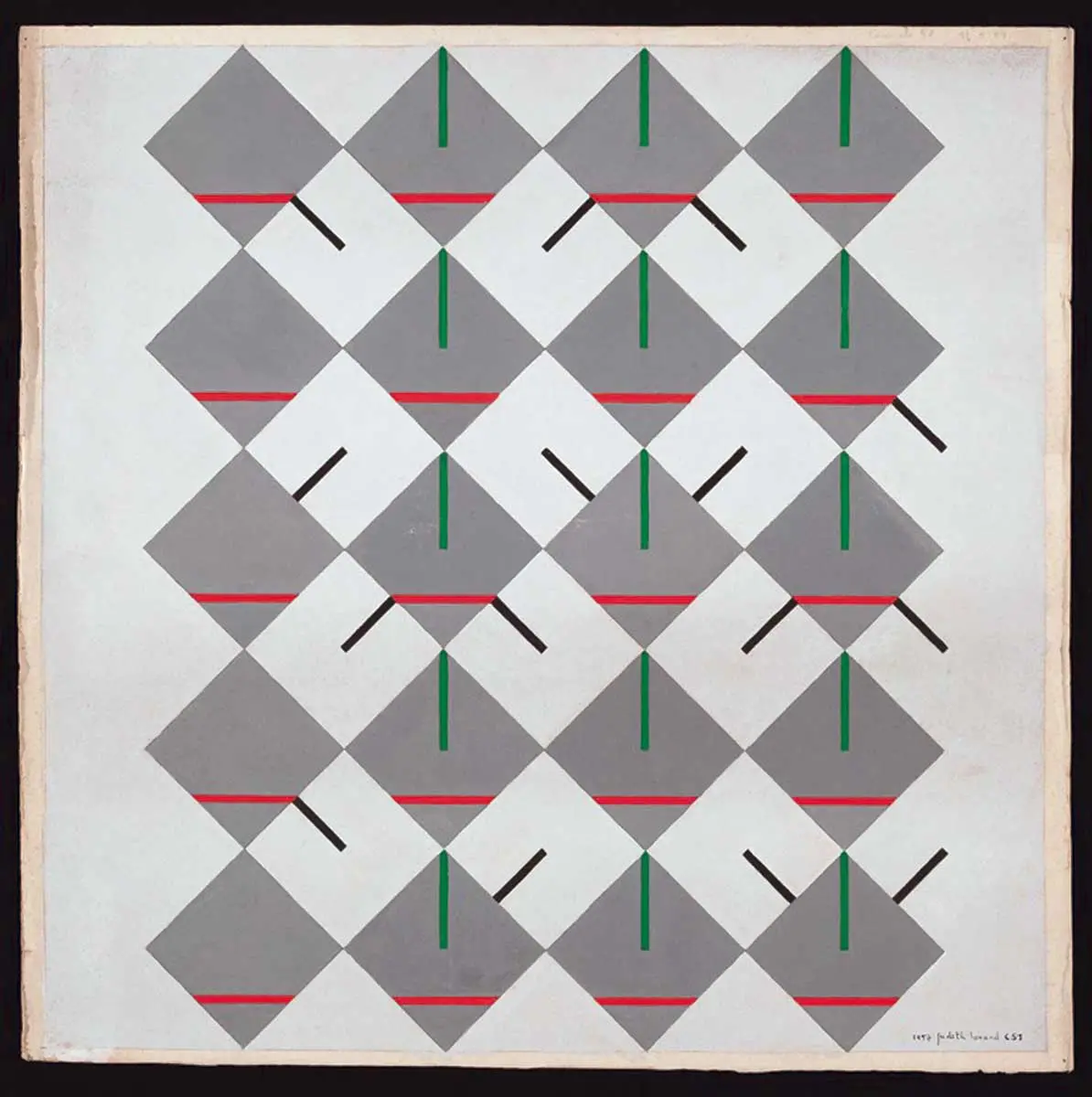
The exhibition provided an opportunity to learn her methods of artistic exploration and production, as well as to observe Lauand’s journey through academic painting, figurative expressionism, lyrical abstraction, and, finally, concrete art, in which she established her artistic identity. But despite being framed by concrete art, her work is unique for the subtle and feminine manner with which she approaches the rational, mathematical, and formal rigor of her compositions.
In the seventies, for example, Lauand still produced geometric paintings that nonetheless were looser and favored color overdrawing. At the same time, one can say that Judith Lauand brought a rationalist female touch to traditional techniques such as embroidery and tapestry, which in her hands became bold works of art created with technical rigor and unusual forms.
In 1950, Judith Lauand completed a degree in Fine Arts at the former Escola de Belas Artes in Araraquara (state of São Paulo) and began her artistic career. During the period that immediately followed, her life and work began to undergo major transformations. Lauand left Araracuara with her family—of Lebanese origin—and moved to São Paulo. There she met, interacted with, and was influenced by artists like Waldemar Cordeiro, Luiz Sacilotto, Geraldo de Barros, Hércules Barsotti, Lothar Charoux, and Willys de Castro, among others. The personal archives of Charoux and de Castro remain in the IAC. In addition, Lauand witnessed the birth of the São Paulo Art Biennial, founded in 1951, and participated in it, first as an advisor (1953) and then as an artist (1955). In 1952 she showed her work for the first time at the Museu de Arte Moderna in São Paulo, in the exhibition Young Painters of the Escola de Belas Artes in Araracuara. On that occasion, Sergio Millet wrote in the El Estado de São Paulo newspaper the following: “Artists like Judith Lauand, Sydney, and Amêndola would not do badly here or in Rio de Janeiro.”
In 1954, the year that marked the fourth centennial of the city of São Paulo, Judith Lauand presented her first solo exhibition at the Galeria Ambiente, and was invited to integrate the Grupo Ruptura, the group responsible for the introduction, in 1952, of concrete art in Brazil, with the exhibition titled Rupture at the Museu de Arte Moderna in São Paulo. Lauand was the only woman in the group, thus the epithet “Lady of Concrete Art.”
She also served as an advisor in the exhibition From Caravaggio to Tiepolo, organized by the Italian government in honor of São Paulo, the most Italian of all Brazilian cities. Two years later, in 1956, she participated in the National Exhibition of Concrete Art presented at the Museu de Are Moderna in São Paulo and, the following year, at the Palacio Gustavo Capanema (MEC), in Rio de Janeiro. In the same decade, she won four awards at the São Paulo Salon of Modern Art and, in 1959, participated in the exhibition Leirner Contemporary Art Award–Six Concrete Artists at the prestigious Galeria de Arte das Folhas.
Interestingly, in a short period of ten years, Judith Lauand managed to stand out in an art world completely dominated by men. She did so by entirely devoting herself to her artistic production as if it were the only way forward. At a time when young women would only leave their homes accompanied by their husbands, Judith Lauand’s artistic trajectory was also defined by her daring attitude. She broke her engagement to fully pursue her true vocation: art. She loved the simplicity of concrete art and brought to that language subtlety that was very much her own.
NOTES
1. Instituto de Arte Contemporáneo (IAC).
2. Museo de Bellas Artes de São Paulo (MuBA).
ALESSANDRA SIMÕES