Designed by the artist and by curator Jérôme Sans, the first major solo exhibition by Pablo Reinoso (Buenos Aires, 1955) in Paris proposes a recent exploration that dialogues, questions and disrupts the architectural space of the Maison de l’Amerique Latine. Through sculpture and design, from the entrance to the famous oval courtyard, past the ground floor and basement, Reinoso’s work spreads out—from wood to steel, paper to plastic, gold to silver, black marble to charcoal, and video too—with a virtuoso lightness that underscores the contained gestures of its sinuosities and arabesques. This group of works challenges matter, space, and, why not, even time. Because in Reinoso’s proposal breathing, either virtual or real—the Respirantes (Breathers) include a small fan—constructs and permeates matter to establish a kind of perpetual motion of forms, preserving a permanent balance/imbalance. Thus weightlessness is the keyword in a gesture that is at once nimble, physical, and aesthetic.
Walking through the exhibition we find fifteen works created during a period of artistic production that spans nearly thirty years: wood and painted steel sculptures, around twenty preparatory drawings—watercolor, Indian ink, and graphite—and four monumental installations. The work stands out for the elegant interlacing lines, the subtle humor, the very singular and unorthodox use of materials (especially the turned wood), and for the exploration of paradoxes and absurdities that are intrinsic to the visual art inquiries. The quest for a refined aesthetic, brilliantly exemplified by this exhibition, is also proof of Reinoso’s double pursuit, as he asserts his status both as a designer and as a visual artist. Conceptually and materially, the table is set the moment we enter the exhibition, provided that we lookup. Indeed, the installation titled M. et Mme (Mr. and Mrs., wood, variable dimensions, 2015) literally consists of a table, a majestic chandelier with crystal pendants, and two chairs, all hanging from the ceiling of the elegant eighteenth-century residence. This Upside-Down World, the title of the exhibition, is the first installation designed in situ. The exhibition room on the right shows two turned wood and wood carving “sculptures” rendered in Reinoso’s characteristic intertwined style. They are an interpretation of and tribute to two emblematic paintings: the Laocoon by El Greco and Gabrielle d’Estrées et Une de Ses Soeurs (Gabrielle d’Estrées and One of Her Sisters, author unknown). Reinoso approached the former by exploring the movement and torsion of a smooth and expanded human figure, reviving in these truly flying sculpted forms the carnal density of paint. A second imposing sculpture in black-painted steel titled Banc Saint-Germain (Bench Saint-Germain) was conceived especially for the oval courtyard. With its dual function of artwork and bench, it draws a “choreography of chaos and balance” in the space. We stand before a big, reworked and chaotic object in a shape similar to that of the number 8 that also serves as a ludic space. The bench somehow becomes both a ritual place and the strip that defines the infinite, expanding without any obstacles. Through spirals, circles, sinuosities, the voluptuousness of baroque prevails but also a 21st-century version of the nouilles style. Going down the staircase to the large basement space we encounter Monochrome Respirant (Breathing Monochrome, 1999), a work that consists of several cushions covered in black fabric that “breathe” following the same cadence as they blow air into the viewers—that vital density that is so recurrent in Pablo Reinoso’s work.
The large installation Paysage d’eau (Water Landscape), created in 1982 for the 11th Paris Biennale, was reworked for the Maison de l’Amerique Latine. The matt/shiny contrast of those black and tumultuous waters infuses an air of mystery and secrecy in this work that is also present in the installation Le Cabinet du Dr. Lacan (The office of Dr. Lacan, 1998), in which the bed-mattress and plastic pillows are agitated by breathing tremors and verbal fluctuations. There, psychoanalysis is “under a bell jar,” offering a mirror effect as the visitor becomes the voyeuristic witnesses of his/her own therapy session. The Video Thoneteando (2006, 6’30’’), almost silent (only the sound of the Thonet chairs1 with which Blanca Li plays is audible), is a marvel of playful absurdity and humor in the style of Buster Keaton. The video shows Spanish actress Blanca Li completely lost before the impossible task of seating on one of the chairs; she acts, reads, stumbles, falls, gets stuck, adapts, removes a chair, and tries to put it back in its original place without success, as the image is repeatedly fast-forwarded. What began as a simple game becomes a nightmare and at the end the actress acknowledges defeat.
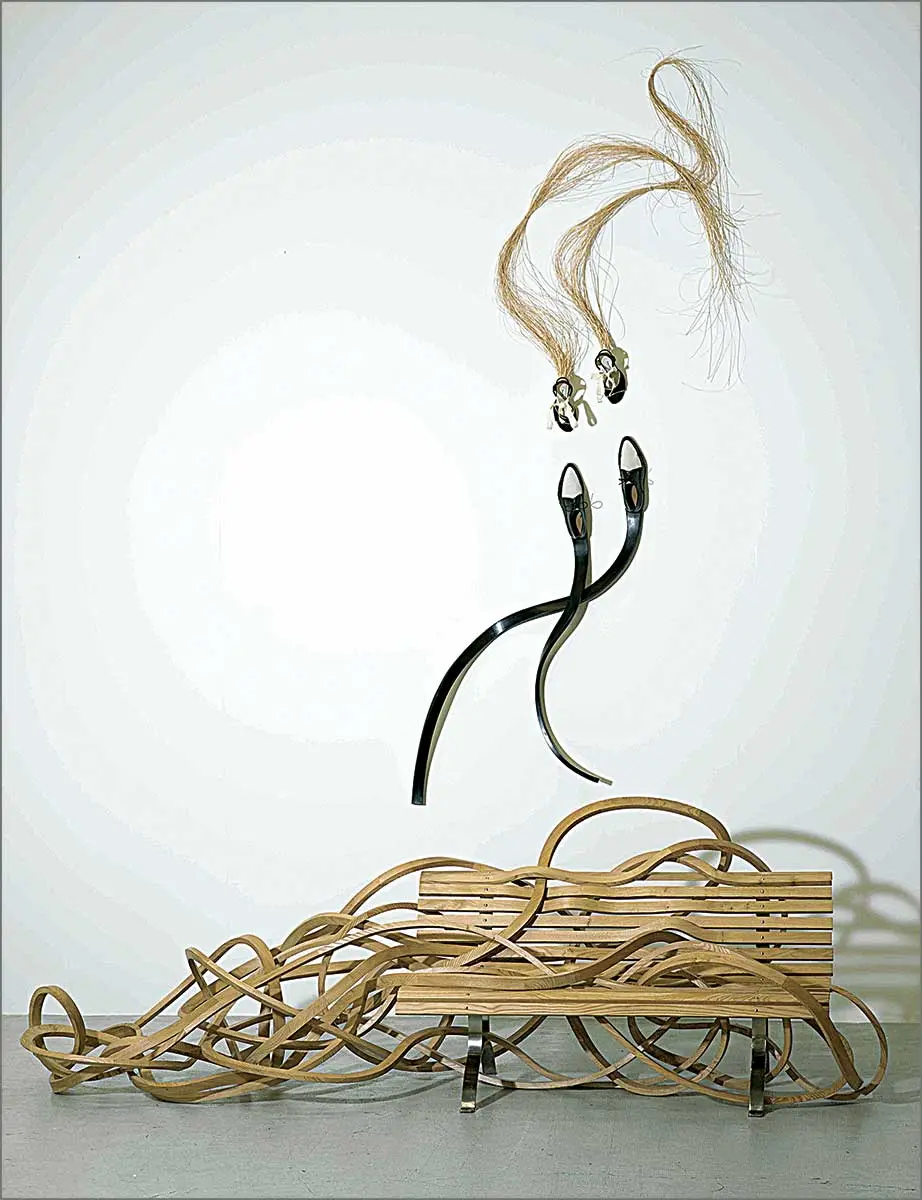
Before entering the great hall that displays the installation Ashes to Ashes, created in 2002 for Casa de America in Madrid, and reconstituted for the exhibition at the Maison de l’Amérique Latine, viewers are presented with several preparatory drawings as well as with the piece Bamboo Light System (2006). Ashes to Ashes is the representation of an apartment that is completely upside-down and has a floor that flows like a beam or stream towards a chimney in the other room. In the same room, one of the famous spaghetti benches titled Retour Végétal (Vegetal Return, 2015), which references the classic French wood benches, deviates from its original function in a wild proliferation of strips, the source of its impracticable beauty.
Reinoso was certainly making poetry.
NOTE
1. The Thonet chair n° 14, an icon of industrial design, is a piece of furniture created in 1859 by German-Austrian industrialist Michael Thonet. Today is better known by the name of de “bistro” chair”.
CHRISTINE FRÈROT