Between 1932 and 1938, during his years of exile as a result of the Nazi ascent to power, Walter Benjamin wrote Berlin Childhood around 1900. First published in 1950, ten years after his death, more than a collection of chronicles about his memories, Benjamin proposes a dialectic on the manner in which we remember; about how to think about childhood, not so much based on specific events but on objects and places. Thus the book territorializes time: Berlin at the turn of the century; while it also temporalizes space: the childhood period. For her second solo exhibition at the Tanya Bonakdar Gallery, Rivane Neuenschwander (Belo Horizonte, 1967) took three sections from Benjamin’s book to name her show in order to explore the relationships between childhood, history, and memory.
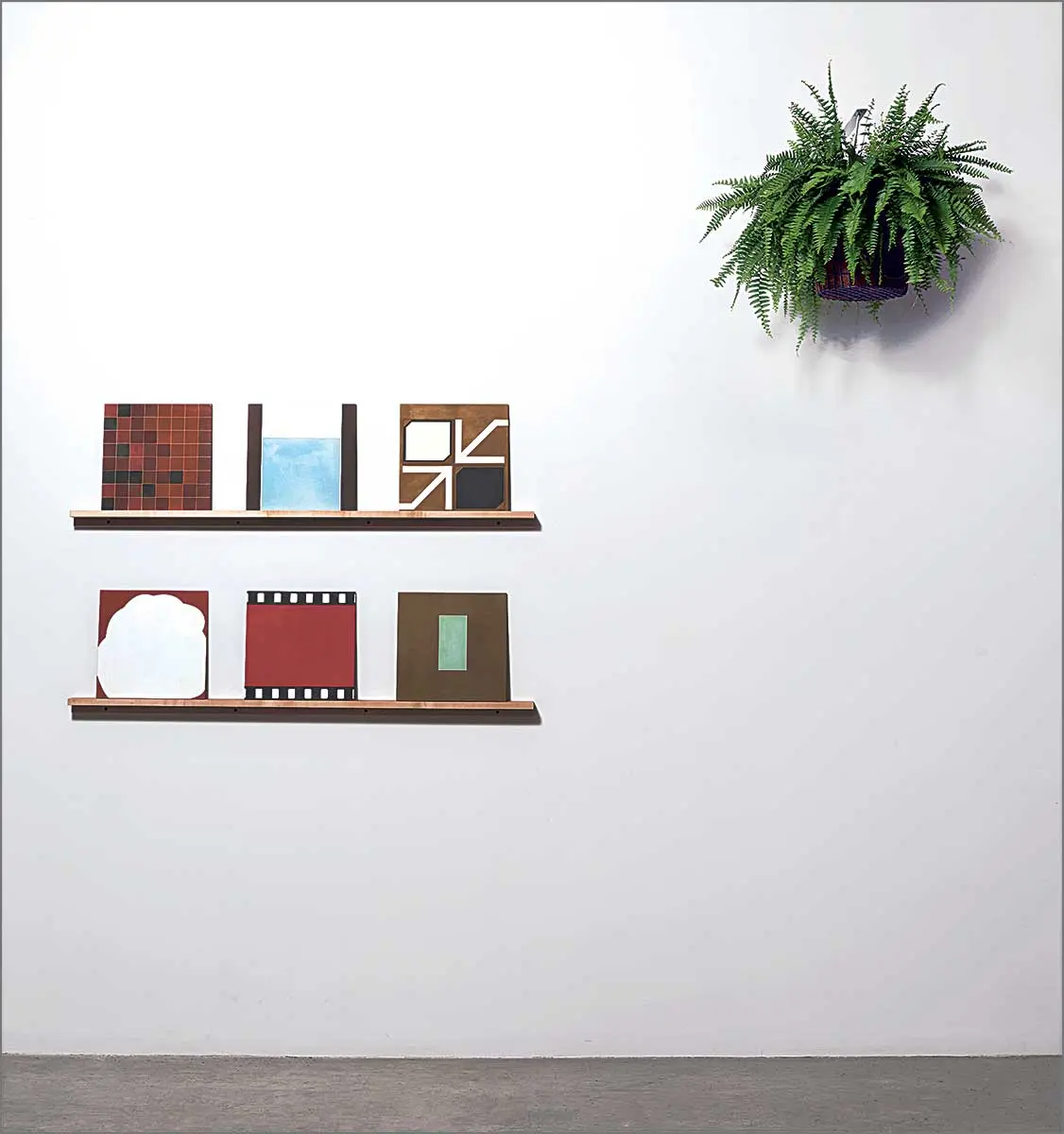
The Fever, the Sewing Box, and a Ghost consist of recent works, most of them created in 2015, including installations, videos, paintings, and embroideries. Known for her conceptualist approach to the examination of the role of chance, the ephemeral nature of things, and non-authoritarian forms of collaboration, Neuenschwander offers a subjective portrait of her generation—the seventies in Brazil—based on their own memories turned into visual forms. In this manner, a green strip covered the left wall of the first exhibition room. In the corners, a pile of confetti looked similar to the leaves of a flamboyant plant, one of the world’s most colorful plants growing in the coastal area of Brazil. The flamboyant allegory covered the floor along the wall. Higher, on the white part of the wall and at eye level, there was a small hole titled M.F. (Road Trip) that invited visitors to come closer and peek; to observe the smell of gasoline; trips to the beach during childhood. Then, there were two square paintings—each measuring 65 centimeters—that remembered two poems by Manuel Bandeira and Cecília Meireres, prominent Brazilian modernist poets. Both paintings contained a colorful composition of organic forms reminiscent of the landscapes by Burle Marx and, therefore, to the imaginary of the gardens in Brazil, but also to the literary tradition of the place. “Who will buy me a flower garden?” This is the first line in the poem by Meireles quoted by Neuenschwander. It is a verse by the poet from Rio de Janeiro that was taught—and still is—in elementary schools so children could identify animals and plants from the perspective of poetry. Next is a piece that could be regarded as a collection of memories. Across from the wall with the flamboyant leaves, Neuenschwander installed a fern, and next to it a series of six small paintings on wooden shelves. Entitled J.N.M. (Chico Buarque), the group consists of reproductions of album covers from records by Chico Buarque, the Brazilian singer, and composer whose ideology opposed that of the military regime and greatly influenced society during the years of the dictatorship (1964–1985). In this manner, Neuenschwander encourages viewers to reflect on the role of memory in today’s society, where individual and collective identity require multiple and interconnected narrative structures. During the walk through the exhibition, viewers encountered different objects and images that appeared, and pretended, not to follow a linear chronology. There was not a before and an after, but a plural invitation in the path of visitors that could begin and end in each of the works, again and again, something that is recurrent in the work of Neuenschwander.
Psychoanalysis also played an essential role in the exhibition. Questions like what is the most distant memory or where does the trauma occur in the reconstruction of memory are present in works like Cabra-Cega / Blind Monsters (Blind-Goat/Blind Monsters), where the artist translated, via the blind drawing technique, the drawings created by a child. In parallel, in the work titled Self-Misunderstanding, displayed in the exhibition room located on the second floor, the audience participation was part of the work. Human-size egg-shaped forms invited viewers to reflect on distortion while alluding to the tradition of participatory art famously explored by Lygia Clark, Hélio Oiticica, and Lygia Pape in Brazil. But Neuenschwander’s egg representation added a cultural component beyond the local tradition: the concept of history, memory, and childhood Benjamin. In The Fever Benjamin a memory of taking medicine as a child “I saw in my imagination the spoon whose edge was colonized by the prayers of my mother.” In addition to the eggs in Self-Misunderstanding, the artist exhibited RN (The Egg and the Spoon), a metal spoon with an egg on it coming out of the wall. Could this be the same spoon that calms or motivates other prayers by other mothers, but this time through the recovery and reinterpretation of the egg in Brazil? Maybe, and if that were the case, Neuenschwander’s proposal not only succeeds because of the reference to art history—which she uses often in her work—but also a result of the incorporation of other records that support the exploration of her childhood in Brazil. This exhibition is an insightful account of memory that never surrenders to the stereotypes associated with Brazil, something that has been said about Tropicalismo.
FLORENCIA SAN MARTÍN