Research, whether artistic or scientific, is very close to creation. A good example of this is the exhibition by Alberto Baraya titled Berlin Expedition. Herbarium of Artificial Plants. Greenhouse of Tropical Mutisianas at the Galería Fernando Pradilla in Madrid. It is an essential exhibition to reflect on the instruments of power validation and a commitment to new subjective strategies as a defense.
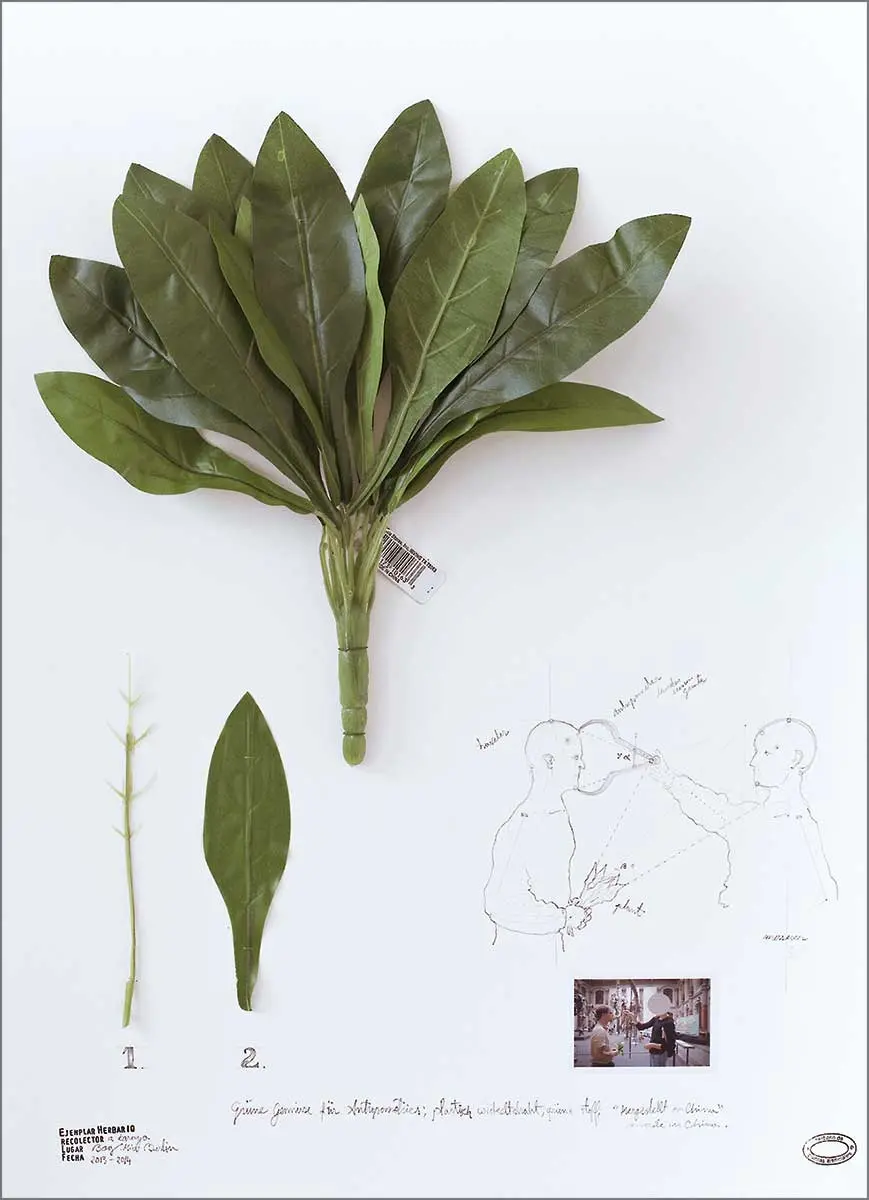
Alberto Baraya (Bogota, Colombia, 1968) began the project Herbario de Plantas Artificiales (Herbarium of Artificial Plants) in 2002 and presented it at the eighth edition of the Berlin Biennale in 2014. During his multiple travels, which he calls “expeditions,” he collects artificial flowers which he later dissects, draws, catalogs, and files following the structure of traditional botanical slides. The slides also include photographs of the original context in which the artificial flower was found. The places are shocking and striking: storefronts, homes, restaurants, and even sex shops.
Inspired by the European expeditions of the eighteenth and nineteenth centuries and their obsession with the categorization of all plants and animals and the physical characteristics of other races, Baraya alludes to the construction of modernity in the West as a control strategy. Do not forget that the seemingly innocent gesture of observing that “new” nature hid a more complex intention: that of mapping territories and identifying areas for political domination1.
The operation now returns from the so-called “periphery”—through the work of a Colombian artist who observes this globalized and apparently homogeneous world—to collect samples of the absurdity of the modern world. It is no coincidence that the artist chooses to work with industrial products: plastic flowers, plants, and vegetables that can be found anywhere, regardless of the weather. The work titled Phalaenopsis Blanca (White Phalaenopsis, 2014) includes one of those artificial flowers collected by the artist in a restaurant. The plaque contains a dissected sample, a handmade drawing of it, its classification and identification label. The artist also includes photographs of the context in which he found this strange readymade. In this manner, Baraya transforms these conceptualized objects into natural samples, just the opposite of those botanical treatises from the Enlightenment, in which flowers and plants became abstract ideas of academia.
In the same vein, the piece Flor Erótica Blanca (White Erotic Flower) shows a plastic flower that the artist found adorning a mannequin in a sex shop. This markedly kitsch proposal contrasts with the delicate hand drawing of the flower directly rendered on the underwear worn by the figure. After this archival impulse, as Hal Foster2 would call it, any desire irretrievably disappears.
The investigation continues with the series Taxón de Verduras y Antropometrías (Taxon of Vegetables and Anthropometries), but this time it centers on people that Baraya met during one of his “expeditions” to Berlin. The photographs, accompanied by an instrument to measure the skull, reveal a nod to classical anthropology, but from a skeptical perspective. The actions are in emblematic places: Museum of American Art (MoAA), Museum für Naturkunde (MfN), and the Holocaust Memorial. Baraya questions the ethnography and anthropology processes of the nineteenth century and turns their cold and mathematical body measuring techniques into casual, almost playful, encounters with strangers.
The last part of the exhibition, Greenhouse of Tropical Mutisianas, uses a different display. It consists of a greenhouse that contains about one hundred plant species (all artificial, of course) typical of the former territory of New Granada. The species are directly taken from the 1923 Botanical Treatise by José Celestino Mutis, who led scientific expeditions funded by the Spanish Crown during the late eighteenth century. Following the words of Nelly Richard3, the installation could be regarded as a practice against cultural appropriation. In this manner, the proposal alludes to very interesting issues: limited space in contrast to the vast nature of the tropical forest or of uncharted territory, greenhouse aseptic conditions (temperate climate and no odors), and the disorder of nature against the rigor of language and classification. All this perfectly summarizes the exhibition and Baraya’s defense of subjective and political research contextualized by the struggle between truth and power.
NOTES
1. In this respect, the work by Jean Ranc titled Charles III as a Child (1724) that belongs to the collection of the Museo del Prado, shows the young monarch classifying flowers as if it were an innocuous and child-appropriate activity. In its iconography and theme-wise, the canvas responds to the construction of power and the strategies of the Enlightenment to legitimize its course of action.
2. Hal Foster, “An Archival Impulse.” October 110, 2004, 3-22.
3. Nelly Richard, “The Postmodern Centro-Marginal Condition,” American Visions/Visiones de las Américas: Artistic and Cultural Identity in the Western Hemisphere, Institute of International Education, New York, 1994.
ANA FOLQUERA