The exploration undertaken by Ana María Olalde is perhaps one of the most subtle approaches to the issues associated with geometry within Venezuelan contemporary painting and is deeply marked by Olalde’s academic training as a mathematician. However, to Olalde the geometric shape transcends form and can be sensed through the ethereal quality of her work as part of an elusive structure. Thus, Olalde’s work communicates a conception of space as an area that, while secretly structured, has the warm quality found in all things natural.
As Susana Benko points out in the text of the catalog that accompanies the exhibition, since the nineties Olalde has made the line the “leading element” in her pictorial work. But the lines in her work are not perfect, delimited, or precise. On the contrary, she draws them “at brush point,” that is to say, freehand, slowly and thoughtfully rendering them as she takes her time to incorporate different thicknesses and saturations, turning them into rich and vividly expressive gestures. Ana María Olalde does not use the vibrant colors traditionally used in geometric art: hers are subtly applied tertiary color combinations that avoid the creation of evenly rendered chromatic planes. This use of nuanced colors is enormously important in Olalde’s latest works, and the curatorship emphasizes this in the exhibition through the use of dim lighting.
To a certain extent, the exhibition Parallels sums up the relationships established by Olalde in her work between the warm line and the structuring of a resonant space—which is not entirely precise—expressed through the forms that emerge, insinuate themselves, through the play of lights and shadows and the positive and negative spaces proposed by juxtaposed lines in succession. While the proposal could be associated with the formulations of kinetic art or op-art, it is precisely the “sensitive” quality (imprecise, ethereal, which favors nuance over flat color) of her work that distinguishes it from the formulations of those movements.
The concept of matter/energy as a vibratory field is one of the notions that science and spirituality seem to agree on, and one that can be perceived in the beautiful pieces by Ana María Olalde. Her proposals explore that which could be archetypally defined as “feminine” and “lunar.” But rather than presenting it in an overt manner, she insinuates it; rather than stating it, she implies it, for it does not come from certain knowledge but from good intuition guided by knowledge (mathematics) that she nevertheless transcends in order to address even more unexplored and mysterious notions.
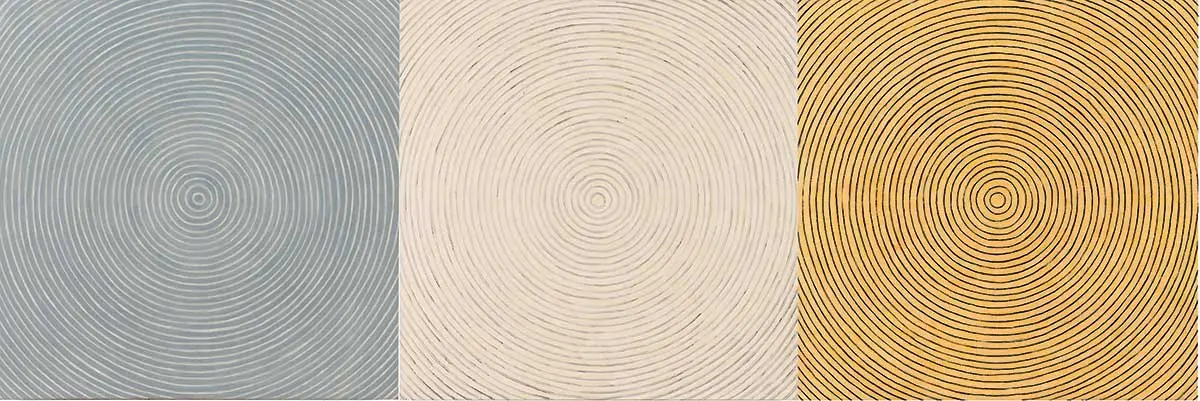
In the work Centro 3 en 1 (Center 3 in 1) from the Parallel series (2014-2015), Olalde uses juxtaposed lines to create a series of concentric circles that, because of their resemblance to the spiral form, immediately unleash a dizzying spinning sensation. On three squares—bluish-gray, creamy white, and yellow mustard, respectively—the artist draws the concentric circles to the edge of the plane, creating an expansive feeling that allows us to visualize these circles as part of something that is outside of them but that is responsible for their creation. The rich hues of the backgrounds and lines underline the warm, “handmade” vibration, of this piece. Another work from this series, the diptych Centro en Cruz (Centre in Cross) plays with the same “mandalic” idea: this time, the lines render squares in a center that appear to expand beyond the surface on which they are painted. Smaller format pieces arranged as polyptychs, address the same concepts, making variations of “represented” geometric figures and of the background color.
Notable among the group of pieces included in the exhibition is the work titled Chivos (Goats, 1996). It consists of an elongated canvas with thick brown parallel lines drawn vertically on it. The design is inspired by a blanket that the artist had bought in the eighties from a traditional weaving workshop in Nicaragua. Several goat skulls are neatly arranged on the canvas. They were modeled after a real goat skull that Olalde found in Adícora, a coastal town in the Venezuelan west.
The rarity of this work lies precisely in the incorporation of this figurative and natural element that serves to underline the profoundly organic nature of Olalde’s spatial conceptualization; namely, her relationship with the non-abstract, as well as her respect for craftsmanship, for those things created by hand, and all the creative possibilities that stem from it.
The exhibition also incorporated a piece from the Between the Lines series, created between 2000 and 2008. According to Benko, in this series, “the compartmentalization between the different areas of the composition is marked by differently colored backgrounds and by the diverse sequential orientation of the lines.” With the introduction of these two pieces, Olalde sought to underscore the connections that stemmed from the entirety of her artistic research, based on this personal, intimate, and profound vision of geometry as a subtle expression of the micro and macrocosm.
KATHERINE CHACÓN