
Diamonds occupy a privileged place in modern and contemporary culture worldwide. Elevated to the status of myth through voices like that of Marilyn Monroe singing Diamonds Are a Girl’s Best Friend—which have led several generations to believe that indeed “men prefer blondes”—diamonds have as of recently been viewed from a more critical, but not less ostentatious, perspective in the song Diamonds from Sierra Leone by Kanye West. However, these gemstones continue their solid trajectory towards those wealthy enough to be surrounded by bodyguards and protected by bulletproof clothes.
When artist Benvenuto Chavajay (Guatemala, 1978) named his first solo exhibition Typical Diamond—at the Galeria Pilar in São Paulo—he reminded us of the many significations that this gemstone evokes. As I walked through the exhibition and observed the images on display, the sarcastic nature of the title became clear. Instead of ostentation, viewers were confronted with the precarious nature of the materials used to render the works.
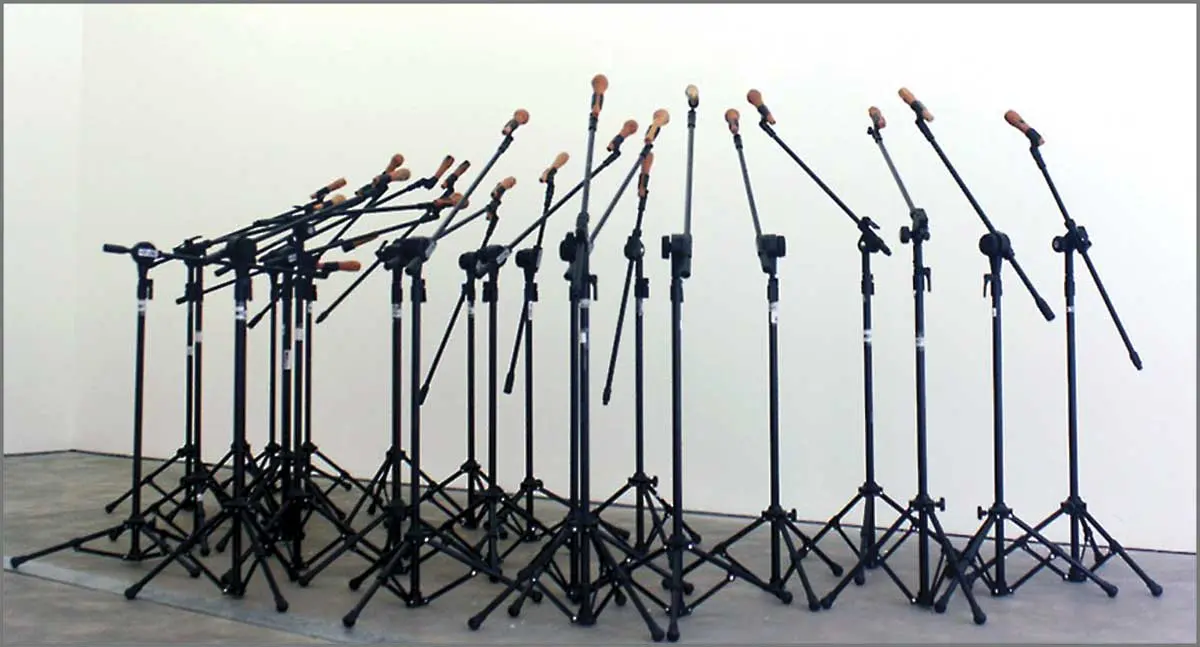
An example of this articulation of meaning in Chavajay’s work could be observed in the piece titled 4’33 “Version 2 (John Cage) displayed at the beginning of the walk through the gallery. It consisted of a group of more than ten microphone tripods placed very close together in front of an empty wall. The microphones that are usually placed on top of them were replaced by small sculpted replicas whose earthy color left no doubt that they were made out of clay. This material and its traditional artisanal manufacture established a contrast with the industrial nature of the tripods and the array of possibilities that digital technology can offer to music in contemporary culture. In the absence of electronic devices, the work offers the same dialogic silence proposed by John Cage in 1952.
However, like the legacy left by that US musician taught us, silence per se is a fiction, that is to say, that even when the work consists of four minutes and thirty-three seconds of a piano that produced no sound, the concert space was nonetheless filled with sounds for the attentive, serious and sensible listeners. Correspondingly, while the clay microphones created by Chavajay were not actually capable of amplifying the human voice or even creating a microphony, the contrast suggested by the materials did however provide a kind of allegory of time and of technological transformations that permeate the human experience. One could quickly make a connection between the contrasting artisanal and industrial productions already mentioned and the numerous historical and economic transformations undergone by Guatemala, the artist’s homeland, in recent decades. However, the strength of the images presented in the exhibition compelled us to enjoy them for reasons that are beyond the specific regional context with which they were conceived to dialogue, and, therefore, the readings also surpass such contextual boundaries.
Because of its presence in many different cultures around the world, the use of clay is important to consider for expanding the reading of some of Chavajay’s work. In the period usually referred to as Antiquity, geographically distant cultures that were never in contact with each other nonetheless shared the use of clay in the production of pottery and sculptures. To that extent, in the same manner, that Guatemala has had to deal with the transformations brought about by technology, as observed by Chavajay daily, other territories such as Hong Kong and Australia also have experienced changes in their traditional forms of production.
Bacuna, a clay sculpture that resembles a syringe, pointed to such reflection by ironically referencing the artisanal dimension that once permeated the whole practice of healing several generations before ours. The work titled Pájaro (Bird), a sculpture composed of fifty plastic magnifying glasses with clay superimposed on each glass, appears to evoke an interpretive mechanism that is similar to that of the work that referenced John Cage. If those microphones were incapable of magnifying sound, then these magnifying glasses (the same device used in the scientific study of birds and the soil) are also destined to the darkness that results from being buried.
Corn, a food that was disseminated across the world after the arrival of the Europeans in the Americas, becomes a metaphor for the human body in the piece titled Hombres de Maíz (Men of Corn). Each tiny seed is perforated by a piercing, and the sum of these bodies of corn is photographed from above. The resulting image becomes a sort of aerial view of the popularization of body alterations that are possible through the use of metal, in the same manner, that many of the original inhabitants of the New Continent had their bodies pierced. It is somehow a return to the past but with the symbolic value of an exhibition that proposed the transformation of the body as synonymous with contemporaneity. Meanwhile, in the piece titled Botones (Buttons), the kernels are removed from the cobs and replaced by buttons or plastic diamonds, while in the piece Retablo 1 (Altarpiece 1), sacred figures are the vehicle for the agglomeration of rubber bands inside wood frames. Again, Chavajay uses the repetition of industrial objects to explore foods or iconographies that are important elements of a culture.
While the search for the type is destroyed and metamorphosed by technological progress, diamonds continue to be forever, like it says in the song performed by Shirley Bassey. The passing of time does not appear to be an issue in the artistic inquiries of Benvenuto Chavajay. In this exhibition, Chavajay appears to be trying to demonstrate that the most precious diamonds found in human history are not those objects cut by hand, but rather the technologies that are handed down from generation to generation and that are both subjects and objects of history.
RAPHAEL FONSECA