Carlos Luna left a promising career in Cuba for Mexico in 1991 where he found new sources of inspiration in the country’s rich artistic traditions, its renowned crafts, and remarkable history. He continued his journey to Miami in 2001 and has now established himself as one of the foremost artists in the city’s renowned art scene. For this exhibition, expertly curated by Dr. Bárbaro Martínez-Ruiz, he presents a survey of his extensive body of work that includes paintings, drawings, etchings on steel, ceramics, and tapestries from the last 10 years, including painting directly on the walls as masterful framing devices. Addressing the Cuban preoccupation with politically charged western notions and contemporary art trends, he focuses on a prouder, more expansive vision of Cuban national identity that looks to rural life, syncretic symbolism drawn from the Yoruba, Indigenous, and Spanish, and the human condition. Every image tells a story as he repetitively reinvents a now-recognizable cast of characters for new situations as they constantly inform each other, change roles and stay inter-connected. Each new story brings an element of surprise as his characters are transformed conceptually and intellectually, and by his persistent exploration of new materials. For Carlos Luna, art is a process and the possibilities are endless to manipulate, recreate and reinvent as each material determines a new direction. It is also extremely personal, based on his life experiences and his journey to capture their essence through art.
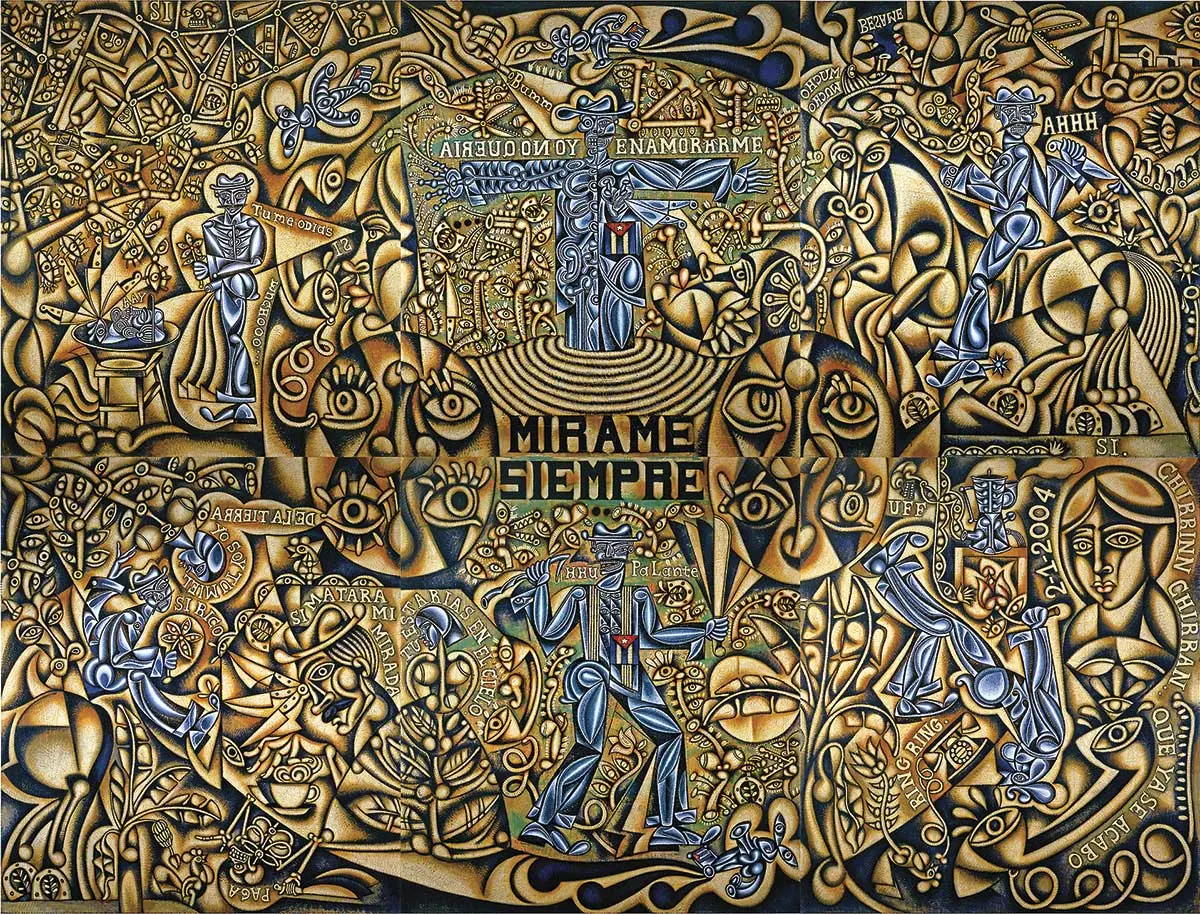
A persistent thread that runs through the exhibition and is its focal point is El Gran Mambo (The Great Mambo), 2006, and the character of the guajiro, the rural peasant (actually translated as “one of us” referring to the significant role of the farmer). Luna was born in Pinar del Rio, Cuba, on the far western end of the island. With a rich pre-Columbian and colonial history, it is known as the tobacco region and its fastidious farmers control acres of grazing and growing land, essential to Cuba’s economy and the identification with its famed product and the cigar industry. El Gran Mambo is a complex work that chronicles the artist’s life and introduces key elements that are a constant presence: the hatted peasant, the floral vegetation and agriculture of the countryside, musical rhythms, the guajiro himself dissected and fragmented as he traces the artist’s journey, and iconic symbols related to Cuba’s syncretic rituals and popular culture. With the words inscribed within, Mírame Siempre (Look at Me Always), the artist also asks his alter-ego to watch and protect as he makes his way through life. It is an image of introspection that continues to edify his work over time and place. The Gran Mambo becomes the Green Machine - the title of the exhibition – the protector of the forests and the farmlands in one of his many appearances and responsibilities. The title alludes to the importance of the rain forest (El Monte), a sacred space in Afro-Cuban religion as well as popular imagination, so the guajiro with his relationship to the land is also the source of the Cuban historical narrative, the oft-forgotten peasant as a participant in rural activities, festivals, and other cultural and popular practices that are at the heart of the island, all of which are explored through different media, from printmaking so key to Cuba’s art history, to drawing, painting, ceramics, etching on steel plates and textiles.
With each new material and the expansion of his narrative, Carlos Luna maintains his distinct pictographic style. A round ceramic plate produced by the famed Talavera Santa Catarina (Mexico), Round Plate, 2015, contains his familiar figural image of a woman, the female counterpart of the guajiro, drawn in fine lines and surrounded by floral patterns, as fragile as the material itself and as appropriate as another image of nostalgia and memory of country life and the importance of women. The work of Carlos Luna is based on his mastery of line and his facility in defining his story through its manipulation as a transformative vehicle of expression. The compositions remain flat with interlaced designs that range from thick to delicate and contain bold flat areas that range from monochromatic to colorful. The adaptation of his style to the newest materials is part of a strategy to revisit his key themes and is especially successful as he transfers his images to tapestry. The 7 large tapestries, a collaboration between the artist and Magnolia Editions of Oakland, California, ambitiously shift his drawings to digital format to be reproduced by computers that control the very complex weaving process. In Heartbreaker, 2015, a jacquard tapestry features his favorite guajiro on horseback surrounded by the repertoire of symbols that have long played a significant role in Luna’s narratives and emerging from what appears to be a flaming red background, perhaps the tears of heartbreak. For Carlos Luna, art is a journey through daily life and its progress is measured through the materials that become a solution for each new idea. It is his constant curiosity and re-exploration of key concepts and philosophies that are the heart and soul of this monumental exhibition.
CAROL DAMIAN