There has been much art that has been intellectually challenging, issue-oriented, and thought-provoking, art that pushes boundaries and even attempts to redefine our notions of what art itself is and can be. Far rarer is the artwork that manages to be conceptually rigorous and visually engaging as well. Rarer still is the artist who can be so thoroughly engrossing that a mere illustration, explanation, or description of his or her work will not suffice. Cildo Meireles is one such artist. Since his participation in the 1970 Information exhibition at The Museum of Modern Art, Meireles moved beyond his beginnings in Brazil in the late 1960s to international recognition. Forging his artistic sensibility through Brazil’s Neo-Concretist movement alongside such peers as Lygia Clark, Meireles explored art that questioned institutional authority and dissolved the invisible barrier between artwork and audience. Informed by the social and political conditions during the dictatorship of the 1960s, Meireles channels Neo-Concretism’s institutional critique into works that raise questions and concerns regarding systems of power and manipulations of perception, all the while creating objects and environments that demand an active, frequently physical interaction with the viewer and that often engage more than one of the senses.
The centerpiece of Meireles’s presentation at Galerie Lelong, his first solo exhibition in the United States in ten years, is Amerikkka. These massive workplace viewers under a free-standing ceiling angled at forty-five degrees that are composed of 40,000 hollow golden bullets set against an intense blue background. The bullets are of varying lengths and viewing them en masse makes them simultaneously overwhelming and also somewhat abstracted. To properly view them, viewers must stand upon a base of over 20,000 white wooden eggs set into a red floor. Although one knows the bullets are hollow, fixed, and therefore harmless, the sense of discomfort is both implied (the symbolic idea of walking on eggshells), potential (the acute angle of the ceiling implies the possibility of becoming trapped within or even simply hitting one’s head on the sharp bullet casings) and real (one must remove one’s shoes to walk on the piece and there is a genuine physical discomfort to the experience.) While there is a universality to the forms and imagery employed, the work takes on a geopolitical specificity through its title, whose triple “K” alludes to the Ku Klux Klan, the far-right organization that espouses white supremacy and the use of extreme violence. Given these references, it is interesting that this work has not been shown in the United States until now.
Aquaurum (2015) is another visually intriguing work that comments on a specific political situation. Combining the Latin for “water” and “gold” in its title, this piece is comprised of two crystal glasses. Our initial perception is that both glasses appear to be empty; one seems to be tinted with a metallic lining and the other is clear. A closer look reveals that the first is actually filled with gold, whereas the other is filled with water. Meireles’s native Brazil produces approximately 12 percent of the world’s freshwater, however, there is a chronic shortage in the country’s most populous city, São Paulo. Questions of sustainability dovetail with issues of ownership, rights, and deprivations, even of such basic human needs. While this work was made with Brazil in mind, anyone aware of the drought issues in California and the questions of politics and power that they have raised is all too keenly aware that this problem is not unique to that country.
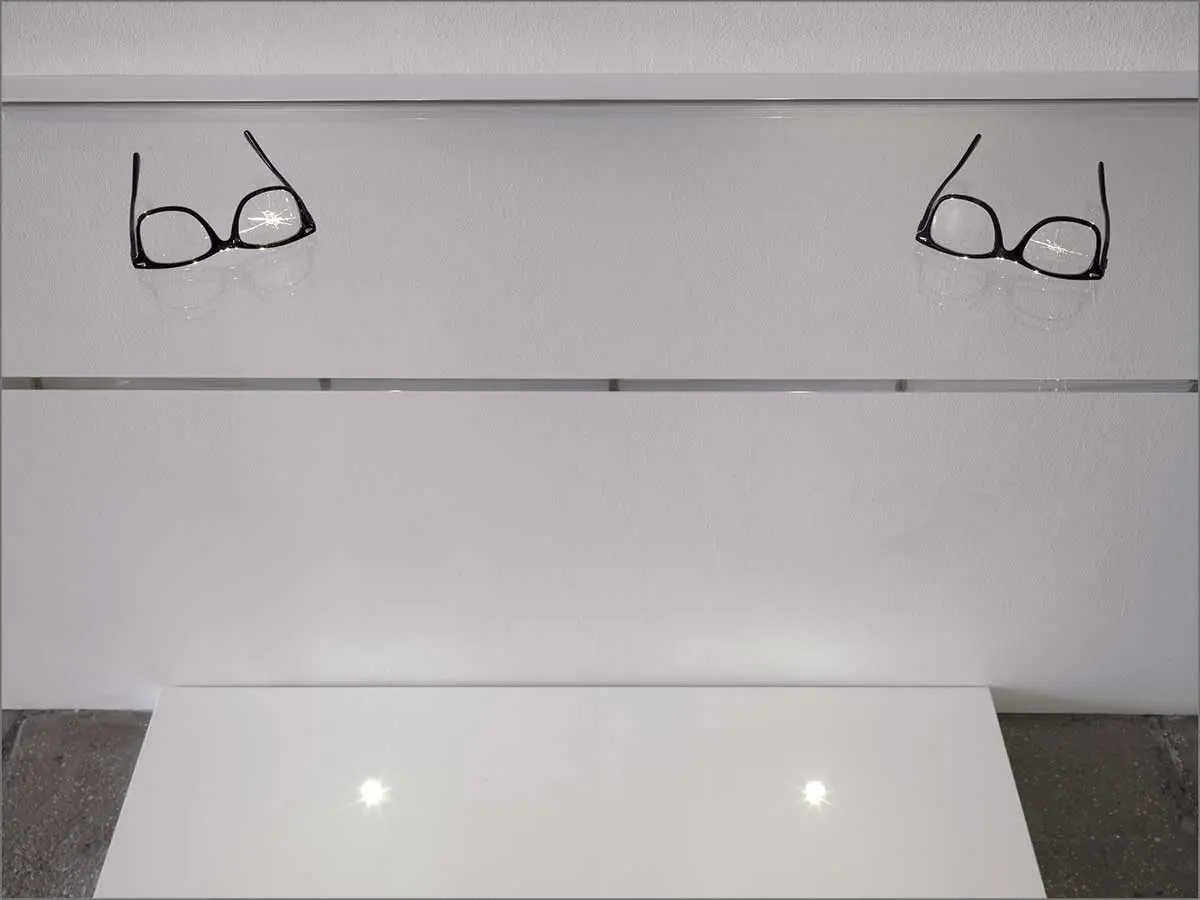
No less provocative yet reminding one of Miereles’s playful side is the witty installation pares/impares. This work ostensibly presents two identical pairs of eyeglasses set on a clear acrylic shelf, with a sharp light projected onto them from below. The light seems to highlight a crack in the lens on both glasses, in the same spot for each pair, reinforcing their identicality. A more careful and closer inspection reveals that while the lens is indeed cracked on one pair, for the other the crack is actually in the shelf itself, and the light projects the image of the crack onto what is actually an unflawed lens. What could be dismissed as a simple trick takes on added meaning by engaging the idea of looking—the use of eyeglasses and light—and the need to once again physically impose oneself by getting literally right up to the piece (thereby shifting one’s perspective and paradigm) to understand what is actually being displayed. Part of what makes the illusion work is the meticulous presentation, which reminds one of all the machinations behind the manipulation and presentation of the visual information we receive on a regular basis, and thus even such trompe l’oeil resonates with deeper meaning. This exhibition, like all of those by Meireles, truly needs to be experienced in person, and one, therefore, hopes that his art will be more broadly and frequently available in the future.
JOHN ANGELINE